
Epeolus canadensis
This record describes Epeolus canadensis (species). Recorded family: Apidae. Recorded order: Hymenoptera.
Identification and Appearance
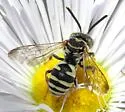
| Feature | Description |
|---|---|
| Additional details | Black bee with white to yellowish bands, lines and patches. |
| Head | Head: Dense whitish hairs around bases of antennae, more so on male. Cheeks half as wide as eye width. Mandibles reddish-yellow. Antenna: Black. |
| Thorax | Thorax: Collar stripe interrupted at center. Segment 1 (scutum) black with a V-shaped patch of hairs (replacing the two median stripes on other Epeolus). Segment end has fringe of hair extending across from wing knob to wing knob (tegulae). Segment 2 (scutellum) entirely black, curved outward, with spines at each side (axillae). Lower edge (metanotum) has a double row of hairs, widely interrupted at center. Segment 3 (propodeum) has light fringe of hairs at each side. |
| Thorax | Thorax sides have dense pale hairs on top half, lower half black. Tubercle reddish-brown surrounded with a fringe of pale hairs. |
| Wings | Wings: Wing knobs (tegulae) dark reddish-brown. |
| Wings | Wings lightly tinted, darker around marginal cell and at tips. Veins dark reddish-brown. |
| Legs | Legs: Legs can be quite pruinose. Coxae black, with white pruinose mostly on underside. Thighs (femora) dark, shins (tibiae), feet and spurs reddish-yellow. |
| Abdomen | Abdomen: Black with white to yellowish stripes on all segments, each stripe is wider at side edge, narrows slightly and widens again. Segment 1 has a double stripe, the two stripes joined at side edges. Base stripe very wide. Lower stripe widely interrupted at center. Segment 2 stripe and sometimes 3 on female are slightly interrupted at center. Male 2 and 3 entire, slightly indented at center. Segment 4 stripe entire on both. Segment 5 on female can have a wide unbroken band, narrowing at center, or slightly interrupted. Segment 5 and 6 on male entire. Female tip bright white, triangular. Male tip widely rounded U-shape with raised lip and very short hair tuft. Underside of segments 2 to 4 striped on both male and female. Types: Holotype: Female Aug. 7, 1928, from Mitchell in MCZ (Smithsonian) #32859. Locality: Ingonish, Cape Breton Island, Nova Scotia. No photo. Holotype: Female May 30, 1950, MCZ (Smithsonian) #79021. Locality: N. Carolina. Not listed. Paratype: Male, June 28, 1906 in U.S. National Museum. Locality: Goderich, Ontario Allotype: Deposited in U.S. National Museum, Purdue University; University of Michigan now the Museum of Natural History. Localities: Quebec, Michigan, Indiana. |
Classification
- Kingdom
- Animalia
- Phylum
- Arthropoda
- Class
- Insecta
- Order
- Hymenoptera (Ants, Bees, Wasps and Sawflies)
- Superfamily
- Trigonaloidea
- Family
- Apidae (Cuckoo, Carpenter, Digger, Bumble, and Honey Bees)
- Subfamily
- Nomadinae
- Tribe
- Epeolini
- Genus
- Epeolus
Imported taxonomy record. Source availability varies; see the source references and editorial policy below.
Habitat and Range
Habitat
Forest edges and meadows.
Geographic Range
Ontario and Indiana to New York and Nova Scotia. (ON, QC, NS, NY, MI, IN) Discover Life Map
Seasonal Activity
Flight Time: Late June to mid-August.
Diet and Behavior
Diet: The larva are cleptoparasites of Plasterer Bees Colletes. Adults eat nectar. The Hosts section on its Discover Life species page lists known associations based on specimen records and images.
Life History
All species of Epeolus are cleptoparasites of Plasterer Bees Colletes . The female finds Plasterer ground bee nests, enters and lays an egg. When larva hatch, it kills the Plasterer bee egg or larva, and feeds on the stored pollen, nectar.
About Flies: the wider group
Order-level background for Hymenoptera, the group containing Epeolus canadensis. Species-specific details appear above.
Group overview
Hymenoptera includes over 150,000 described species of ants, bees, wasps, and sawflies. Earth harbors approximately 20 quadrillion (20×10^15) ants, with a combined biomass of ~12 megatons of dry carbon - exceeding the combined biomass of all wild birds and mammals (PNAS, 2022).
Ecological role of the group
About 35% of the world's food crops depend on animal pollinators. The chocolate industry, valued at over $100 billion, depends on pollinating flies and midges. Ants are the dominant soil engineers in most terrestrial ecosystems, turning more soil than earthworms in many habitats.
Economic and practical significance of the group
Pollinators contribute $235-577 billion worth of annual global food production (FAO). In the U.S., bee pollination alone benefits crops valued at $18 billion annually, and honey bees are responsible for $5.4 billion in agricultural productivity. Between April 2023-2024, 55.1% of managed honey bee colonies were lost. The U.S. bee population dropped from 5 million to 2.5 million.
Recorded sources for this group: FAO, USDA, EPA, PNAS (2022), US Fish & Wildlife Service. Imported estimates may describe particular regions or reporting periods.
Photos of Epeolus canadensis (5)
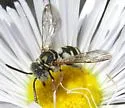
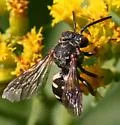
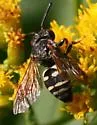
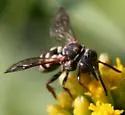
Photo credits: Contributed by Maury J. Heiman; Additional contributions by Beatriz Moisset , John S. Ascher , hg , PaleoJon
Frequently Asked Questions About Epeolus canadensis
What is Epeolus canadensis?
Epeolus canadensis is a species in the family Apidae, within the order Hymenoptera.
How big is Epeolus canadensis?
Female 9 mm. Male 6 to 8 mm
How do you identify Epeolus canadensis?
| Feature | Description |
|---|---|
| Additional details | Black bee with white to yellowish bands, lines and patches. |
| Head | Head: Dense whitish hairs around bases of antennae, more so on male. Cheeks half as wide as eye width. Mandibles reddish-yellow. Antenna: Black. |
| Thorax | Thorax: Collar stripe interrupted at center. Segment 1 (scutum) black with a V-shaped patch of hairs (replacing the two median stripes on other Epeolus). Segment end has fringe of hair extending across from wing knob to wing knob (tegulae). Segment 2 (scutellum) entirely black, curved outward, with spines at each side (axillae). Lower edge (metanotum) has a double row of hairs, widely interrupted at center. Segment 3 (propodeum) has light fringe of hairs at each side. |
| Thorax | Thorax sides have dense pale hairs on top half, lower half black. Tubercle reddish-brown surrounded with a fringe of pale hairs. |
| Wings | Wings: Wing knobs (tegulae) dark reddish-brown. |
| Wings | Wings lightly tinted, darker around marginal cell and at tips. Veins dark reddish-brown. |
| Legs | Legs: Legs can be quite pruinose. Coxae black, with white pruinose mostly on underside. Thighs (femora) dark, shins (tibiae), feet and spurs reddish-yellow. |
| Abdomen | Abdomen: Black with white to yellowish stripes on all segments, each stripe is wider at side edge, narrows slightly and widens again. Segment 1 has a double stripe, the two stripes joined at side edges. Base stripe very wide. Lower stripe widely interrupted at center. Segment 2 stripe and sometimes 3 on female are slightly interrupted at center. Male 2 and 3 entire, slightly indented at center. Segment 4 stripe entire on both. Segment 5 on female can have a wide unbroken band, narrowing at center, or slightly interrupted. Segment 5 and 6 on male entire. Female tip bright white, triangular. Male tip widely rounded U-shape with raised lip and very short hair tuft. Underside of segments 2 to 4 striped on both male and female. |
Where is Epeolus canadensis found?
| Feature | Details |
|---|---|
| Habitat | Forest edges and meadows. |
| Range | Ontario and Indiana to New York and Nova Scotia. (ON, QC, NS, NY, MI, IN) Discover Life Map |
What does Epeolus canadensis eat?
The diet of the Epeolus canadensis includes The larva are cleptoparasites of Plasterer Bees Colletes. Adults eat nectar. The Hosts section on its Discover Life species page lists known associations based on specimen records and images..
When is Epeolus canadensis active?
Epeolus canadensis: seasonal activity - Flight Time: Late June to mid-August..
What is the life cycle of a Epeolus canadensis?
All species of Epeolus are cleptoparasites of Plasterer Bees Colletes . The female finds Plasterer ground bee nests, enters and lays an egg. When larva hatch, it kills the Plasterer bee egg or larva, and feeds on the stored pollen, nectar.