
Epeolus bifasciatus
This record describes Epeolus bifasciatus (species). Recorded family: Apidae. Recorded order: Hymenoptera.
Identification and Appearance
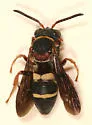
| Feature | Description |
|---|---|
| Additional details | Male and female similar. |
| Abdomen | Abdomen has only 2 yellowish stripes. |
| Thorax | Thorax segment 2 (scutellum) entirely red. |
| Head | Head: White hairs faintly circle antenna bases in female. Cheeks very narrow. Antenna: Scape and segment 1 reddish, rest of segments black, antenna short. |
| Thorax | Thorax: Black. Collar scaly light yellow, not interrupted at center. Segment 1 (scutum) dark, rough and pitted, no white median lines. Segment 2 (scutellum) red, with a spine (axilla) at each side edge. |
| Thorax | Thorax sides bare, tubercle reddish. |
| Wings | Wings: Wing knobs (tegulae) red. |
| Wings | Wings dark. |
| Legs | Legs: Reddish. Underside of hind thigh (femur) dark. |
| Legs | Legs may be black in northern populations. Spurs black. |
| Abdomen | Abdomen: Black, short. Segment 1 has a scaly, very wide light yellow stipe at mid segment; slightly indented or interrupted at center, and most times with a yellow line just below the stripe. Segment 2 has a narrower yellow stripe on lower edge. |
| Abdomen | Abdomen tip is squarish on female, rounded on male. They are uncommon nest parasites of plasterer bees, one host species is likely to be Colletes latitarsus, another uncommon species. It's a nice find since it's a first record for MA. Types: Holotype as Epeolus bifasciatus male #2658 by Cresson 1864. Locality: Illinois. In collection of the Entomological Society, Philadelphia (Now the Academy of Natural Sciences, Drexel University). No photos. Lectotype male by Cresson at National Museum of Natural History, Smithsonian. No photos. Paralectotype female from Cape May, New Jersey July 19, 1935 at Academy of Natural Sciences, Drexel University, Philadelphia, Penn. Determined by R. L. Brumley in 1965. No photos. |
Classification
- Kingdom
- Animalia
- Phylum
- Arthropoda
- Class
- Insecta
- Order
- Hymenoptera (Ants, Bees, Wasps and Sawflies)
- Superfamily
- Trigonaloidea
- Family
- Apidae (Cuckoo, Carpenter, Digger, Bumble, and Honey Bees)
- Subfamily
- Nomadinae
- Tribe
- Epeolini
- Genus
- Epeolus
Imported taxonomy record. Source availability varies; see the source references and editorial policy below.
Habitat and Range
Habitat
Forest edges and meadows.
Geographic Range
Northern Mexico, Colorado, Oklahoma and Minnesota, Iowa to the New England states and Florida. Canada: Ontario Discover Life Map
Seasonal Activity
February to April in Florida, June to September in the North.
Diet and Behavior
Diet: Adults eat nectar. Larva are possible cleptoparasites of Plasterer Bee Colletes latitarsis . The Hosts section on its Discover Life species page lists known associations based on specimen records and images.
Life History
Females lay eggs in ground-nesting cells of Plasterer bees (possibly Colletes latitarsis ). Larva hatch and kill the Plasterer bee egg and feed on the provisions of pollen and nectar stored in the cell.
Additional species information
Species notes from the sources
Etymology: bifasciatus = Latin for 'two-banded'
About Flies: the wider group
Order-level background for Hymenoptera, the group containing Epeolus bifasciatus. Species-specific details appear above.
Group overview
Hymenoptera includes over 150,000 described species of ants, bees, wasps, and sawflies. Earth harbors approximately 20 quadrillion (20×10^15) ants, with a combined biomass of ~12 megatons of dry carbon - exceeding the combined biomass of all wild birds and mammals (PNAS, 2022).
Ecological role of the group
About 35% of the world's food crops depend on animal pollinators. The chocolate industry, valued at over $100 billion, depends on pollinating flies and midges. Ants are the dominant soil engineers in most terrestrial ecosystems, turning more soil than earthworms in many habitats.
Economic and practical significance of the group
Pollinators contribute $235-577 billion worth of annual global food production (FAO). In the U.S., bee pollination alone benefits crops valued at $18 billion annually, and honey bees are responsible for $5.4 billion in agricultural productivity. Between April 2023-2024, 55.1% of managed honey bee colonies were lost. The U.S. bee population dropped from 5 million to 2.5 million.
Recorded sources for this group: FAO, USDA, EPA, PNAS (2022), US Fish & Wildlife Service. Imported estimates may describe particular regions or reporting periods.
Photos of Epeolus bifasciatus (5)
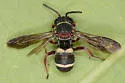
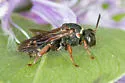
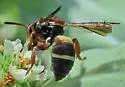
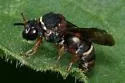
Photo credits: Contributed by tom murray; Additional contributions by Beatriz Moisset , John S. Ascher , hg , lee_penner , PaleoJon
Frequently Asked Questions About Epeolus bifasciatus
What is Epeolus bifasciatus?
Epeolus bifasciatus is a species in the family Apidae, within the order Hymenoptera.
How big is Epeolus bifasciatus?
7 to 9 mm long.
How do you identify Epeolus bifasciatus?
| Feature | Description |
|---|---|
| Additional details | Male and female similar. |
| Abdomen | Abdomen has only 2 yellowish stripes. |
| Thorax | Thorax segment 2 (scutellum) entirely red. |
| Head | Head: White hairs faintly circle antenna bases in female. Cheeks very narrow. Antenna: Scape and segment 1 reddish, rest of segments black, antenna short. |
| Thorax | Thorax: Black. Collar scaly light yellow, not interrupted at center. Segment 1 (scutum) dark, rough and pitted, no white median lines. Segment 2 (scutellum) red, with a spine (axilla) at each side edge. |
| Thorax | Thorax sides bare, tubercle reddish. |
| Wings | Wings: Wing knobs (tegulae) red. |
| Wings | Wings dark. |
| Legs | Legs: Reddish. Underside of hind thigh (femur) dark. |
| Legs | Legs may be black in northern populations. Spurs black. |
| Abdomen | Abdomen: Black, short. Segment 1 has a scaly, very wide light yellow stipe at mid segment; slightly indented or interrupted at center, and most times with a yellow line just below the stripe. Segment 2 has a narrower yellow stripe on lower edge. |
| Abdomen | Abdomen tip is squarish on female, rounded on male. |
Where is Epeolus bifasciatus found?
| Feature | Details |
|---|---|
| Habitat | Forest edges and meadows. |
| Range | Northern Mexico, Colorado, Oklahoma and Minnesota, Iowa to the New England states and Florida. Canada: Ontario Discover Life Map |
What does Epeolus bifasciatus eat?
The diet of the Epeolus bifasciatus includes Adults eat nectar. Larva are possible cleptoparasites of Plasterer Bee Colletes latitarsis . The Hosts section on its Discover Life species page lists known associations based on specimen records and images..
When is Epeolus bifasciatus active?
Epeolus bifasciatus: seasonal activity - February to April in Florida, June to September in the North..
What is the life cycle of a Epeolus bifasciatus?
Females lay eggs in ground-nesting cells of Plasterer bees (possibly Colletes latitarsis ). Larva hatch and kill the Plasterer bee egg and feed on the provisions of pollen and nectar stored in the cell.