
Entypus unifasciatus
This record describes Entypus unifasciatus (species). Recorded family: Pompilidae. Recorded order: Hymenoptera.
Identification and Appearance
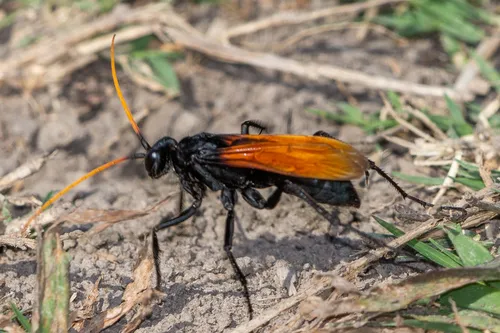
Body blue-black, smoky brown wings with orange tips, prominent orange antennae.
Wikipedia reference for Entypus unifasciatus: https://en.wikipedia.org/wiki/Entypus_unifasciatus.
Classification
- Kingdom
- Animalia
- Phylum
- Arthropoda
- Class
- Insecta
- Order
- Hymenoptera (Ants, Bees, Wasps and Sawflies)
- Superfamily
- Pompiloidea
- Family
- Pompilidae (Spider Wasps)
- Subfamily
- Pepsinae
- Tribe
- Pepsini
- Genus
- Entypus
Imported taxonomy record. Source availability varies; see the source references and editorial policy below.
Habitat and Range
Habitat
Always in semi-open or open situations ("waste areas", meadows, pastures, open woods and edges, desert, semi-arid grassland, etc.). Never found in deep woods.
Geographic Range
This very common species is essentially transcontinental, except in the northwest. E. u. unifasciatus : Atlantic Coast to c. and n. Great Plains, e. Texas. Includes southern Canada. E. u. cressoni : UT, sw. CO, AZ, NM, w. TX (i.e. mainly arid). E. u. californicus : California only.
Seasonal Activity
This species is a typical late summer-early Autumn species in the east (nominal subspecies). July-September (North Carolina). In Ohio (and probably most of the northeast) some adults appear in late June, but most in early July. Most females are seen provisioning from mid-July to September. Out of all individuals seen from Ohio the peak in numbers of captures was from the last half of August.
Diet and Behavior
Diet: Adults frequently visit flowers. They are known to feed from the flowers of the following genera of plants: Asclepias , Baccharis , Condalia , Daucus , Euphorbia , Eryngium , Pastinaca , Polytaenia , Sapindus , Solidago , and Tamarix . One provisioning female was observed malaxating near a joint in the leg of her prey spider, so it is possible that they may also take fluids from their spider prey.
Life History
There is one generation per year. Males emerge first. By late August/early September most females are worn. By mid- to late September most female are very worn, with most of the apical area of the wing being tattered away. Life cycle probably more drawn out in far south, but there is very little difference. Most individuals do not persist into October. E. u. cressoni may be found during a longer period (May-October) but there is still only one generation per year. E. u. californicus has a similar life cycle to the nominal subspecies. Parasitoid of spiders, including wolf spiders (Lycosidae). Prey records only exist for E. unifasciatus unifasciatus . They are known to prey on Pardosa riparia and Rabidosa rabida . A. B. A. Typical prey of E. unifasciatus unifasciatus . B. A "young" (that is, not worn) female with prey. This always transport their prey in this fashion; they often cache their prey in plants, dragging them vertically up the stem. Females dig a burrow that ends in a terminal chamber off of the side of a mammal burrow or large crack in the ground. The serrations on the hind tibiae are used to aid the movement of soil out of the burrow entrance. The position in which the egg is laid is unknown. Larvae feed on one large spider and, as in all Pompilids that have one generation per year, overwinter as pupae.
About Flies: the wider group
Order-level background for Hymenoptera, the group containing Entypus unifasciatus. Species-specific details appear above.
Group overview
Hymenoptera includes over 150,000 described species of ants, bees, wasps, and sawflies. Earth harbors approximately 20 quadrillion (20×10^15) ants, with a combined biomass of ~12 megatons of dry carbon - exceeding the combined biomass of all wild birds and mammals (PNAS, 2022).
Ecological role of the group
About 35% of the world's food crops depend on animal pollinators. The chocolate industry, valued at over $100 billion, depends on pollinating flies and midges. Ants are the dominant soil engineers in most terrestrial ecosystems, turning more soil than earthworms in many habitats.
Economic and practical significance of the group
Pollinators contribute $235-577 billion worth of annual global food production (FAO). In the U.S., bee pollination alone benefits crops valued at $18 billion annually, and honey bees are responsible for $5.4 billion in agricultural productivity. Between April 2023-2024, 55.1% of managed honey bee colonies were lost. The U.S. bee population dropped from 5 million to 2.5 million.
Recorded sources for this group: FAO, USDA, EPA, PNAS (2022), US Fish & Wildlife Service. Imported estimates may describe particular regions or reporting periods.
Photos of Entypus unifasciatus (3)
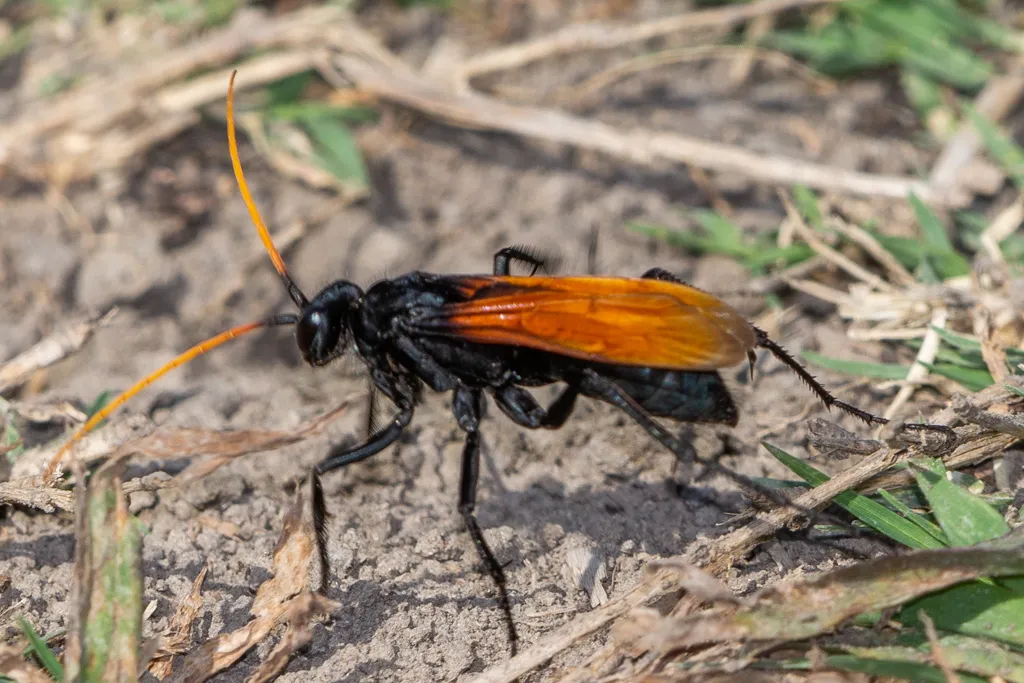
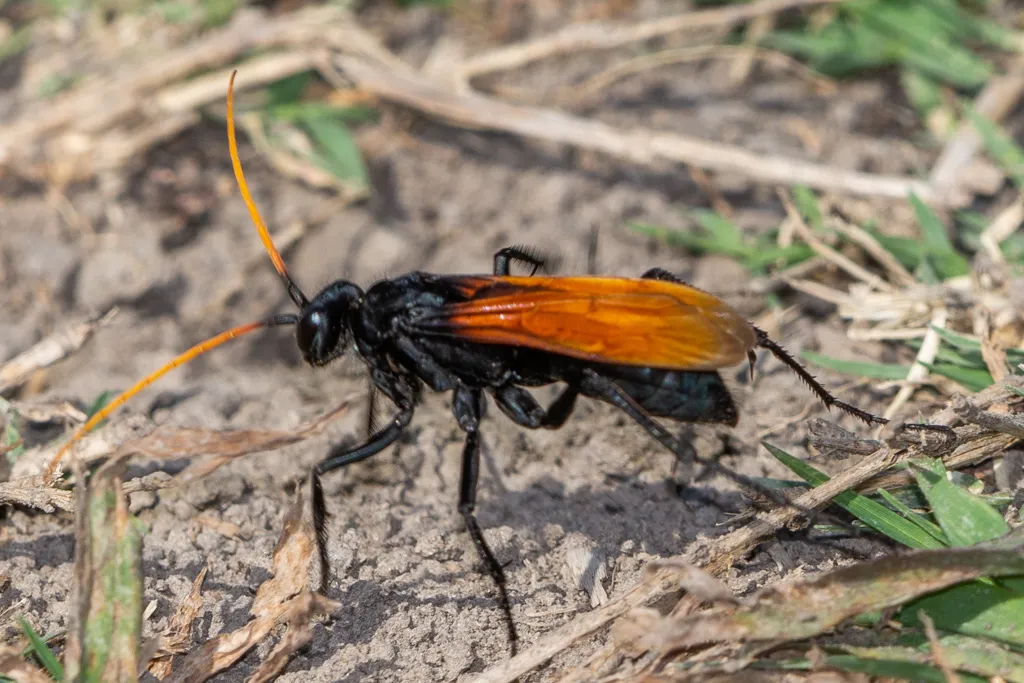
Photo credits: Contributed by Cotinis; Additional contributions by NFensler
Frequently Asked Questions About Entypus unifasciatus
What is Entypus unifasciatus?
Entypus unifasciatus is a species in the family Pompilidae, within the order Hymenoptera.
How big is Entypus unifasciatus?
| Feature | Details |
|---|---|
| Males | 15-25 mm |
| Females | 25-35 mm. Some tropical specimens are comparable in size to some Pepsis . |
How do you identify Entypus unifasciatus?
Body blue-black, smoky brown wings with orange tips, prominent orange antennae.
Where is Entypus unifasciatus found?
| Feature | Details |
|---|---|
| Habitat | Always in semi-open or open situations (waste areas, meadows, pastures, open woods and edges, desert, semi-arid grassland, etc.). Never found in deep woods. |
| Range | This very common species is essentially transcontinental, except in the northwest. E. u. unifasciatus : Atlantic Coast to c. and n. Great Plains, e. Texas. Includes southern Canada. E. u. cressoni : UT, sw. CO, AZ, NM, w. TX (i.e. mainly arid). E. u. californicus : California only. |
What does Entypus unifasciatus eat?
The diet of the Entypus unifasciatus includes Adults frequently visit flowers. They are known to feed from the flowers of the following genera of plants: Asclepias , Baccharis , Condalia , Daucus , Euphorbia , Eryngium , Pastinaca , Polytaenia , Sapindus , Solidago , and Tamarix . One provisioning female was observed malaxating near a joint in the leg of her prey spider, so it is possible that they may also take fluids from their spider prey..
When is Entypus unifasciatus active?
Entypus unifasciatus: seasonal activity - This species is a typical late summer-early Autumn species in the east (nominal subspecies). July-September (North Carolina). In Ohio (and probably most of the northeast) some adults appear in late June, but most in early July. Most females are seen provisioning from mid-July to September. Out of all individuals seen from Ohio the peak in numbers of captures was from the last half of August..
What is the life cycle of a Entypus unifasciatus?
There is one generation per year. Males emerge first. By late August/early September most females are worn. By mid- to late September most female are very worn, with most of the apical area of the wing being tattered away. Life cycle probably more drawn out in far south, but there is very little difference. Most individuals do not persist into October. E. u. cressoni may be found during a longer period (May-October) but there is still only one generation per year. E. u. californicus has a similar life cycle to the nominal subspecies. Parasitoid of spiders, including wolf spiders (Lycosidae). Prey records only exist for E. unifasciatus unifasciatus . They are known to prey on Pardosa riparia and Rabidosa rabida . A. B. A. Typical prey of E. unifasciatus unifasciatus . B. A young (that is, not worn) female with prey. This always transport their prey in this fashion; they often cache their prey in plants, dragging them vertically up the stem. Females dig a burrow that ends in a terminal chamber off of the side of a mammal burrow or large crack in the ground. The serrations on the hind tibiae are used to aid the movement of soil out of the burrow entrance. The position in which the egg is laid is unknown. Larvae feed on one large spider and, as in all Pompilids that have one generation per year, overwinter as pupae.