
Sharpheaded Sharpshooter
Draeculacephala zeae
This record describes Draeculacephala zeae (species). Recorded family: Cicadellidae. Recorded order: Hemiptera.
Identification and Appearance
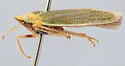
Differentiated from D. robinsoni on the basis of the form of the male 2S apodemes: Apodemes 2S produced most strongly mesad on lower halves vs. robinsoni : Apodemes 2S produced most strongly mesad near apex or with both lobes subequal (Hamilton, 1985) Characters as in D. robinsoni , but 2S apoclemes expanded on lower halves, overlapping when mature and aedeagus shorter. - Hamilton, 1985 Given the ambiguity and contested validity of this species, most images that could be either D. robinsoni or D. zeae (excluding other members of the complex and the externally similar D. mollipes ) are placed under D. robinsoni on BugGuide, for now. This is a cryptic species which may not be differentiable from D. robinsoni without dissection or DNA barcoding. Treated as a jr. syn. of Draeculacephala robinsoni Hamilton, 1967 in Dietrich, 1994 . Revalidated in Chandler & Hamilton, 2017 on the basis of DNA barcoding. Dietrich considered D. zeae and D. sphagneticola Hamilton to be junior synonyms of D. robinsoni , while continuing recognition of D. portola Ball and D. paludosa Ball & China as valid species. Molecular work using the COI gene for barcoding (Fig. 31) has revealed that there are two clusters for these species, separated by a genetic divergence value of 1%, with the first cluster containing specimens placed as D. robinsoni and D. sphagneticola that are intermixed (indicating a single species, D. robinsoni ), and the second cluster holding representatives of the other names that cluster genetically tightly at a value less than 1%, but separately as three species: D. zeae , D. portola , and D. paludosa . Since D. zeae is in a separate cluster from D. robinsoni , and clusters tightly but separately with the two species recognized as such based on external characters by Dietrich, it is here treated as a species on this basis, and supported by the differences in morphological characters and color patterns discussed by Hamilton (1985b). This low level of divergence in the COI gene has been documented for other groups where morphological characters can be used for separation (Hebert et al., 2004; Gibbs, 2010). (Chandler & Hamilton, 2017)
Classification
- Kingdom
- Animalia
- Phylum
- Arthropoda
- Class
- Insecta
- Order
- Hemiptera (True Bugs, Cicadas, Hoppers, Aphids and Allies)
- Suborder
- Auchenorrhyncha
- Superfamily
- Membracoidea
- Family
- Cicadellidae (Typical Leafhoppers)
- Subfamily
- Cicadellinae
- Tribe
- Cicadellini
- Genus
- Draeculacephala
Imported taxonomy record. Source availability varies; see the source references and editorial policy below.
Habitat and Range
Geographic Range
Eastern and Central U.S. + Canada
Diet and Behavior
Diet: Many grasses (Poaceae), including Zea mays (corn)
Additional species information
Species notes from the sources
Etymology: Draeculacephala zeae Hamilton, 1985
About True Bugs, Cicadas, Hoppers, Aphids and Allies: the wider group
Order-level background for Hemiptera, the group containing Draeculacephala zeae. Species-specific details appear above.
Group overview
Hemiptera (true bugs) includes over 80,000 described species across cicadas, aphids, leafhoppers, shield bugs, and bed bugs. Aphids alone cost global agriculture an estimated $2.5 billion annually in crop losses.
Ecological role of the group
Many Hemiptera are essential food sources for birds and predatory insects. Cicadas provide massive nutrient pulses during emergence events - a single Brood X emergence can involve trillions of individuals across 15 states.
Economic and practical significance of the group
The brown marmorated stink bug (Halyomorpha halys) caused $37 million in apple crop losses in a single year in the U.S. Mid-Atlantic region. Bed bug infestations in the U.S. increased by 500% between 2001-2010, costing the hotel industry hundreds of millions annually.
Recorded sources for this group: USDA, EPA, University research. Imported estimates may describe particular regions or reporting periods.
Photos of Sharpheaded Sharpshooter (2)
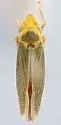
Photo credits: Contributed by Solomon V. Hendrix
Frequently Asked Questions About Sharpheaded Sharpshooter
What is Sharpheaded Sharpshooter?
Sharpheaded Sharpshooter (Draeculacephala zeae) is a species in the family Cicadellidae, within the order Hemiptera.
How do you identify Sharpheaded Sharpshooter?
Differentiated from D. robinsoni on the basis of the form of the male 2S apodemes: Apodemes 2S produced most strongly mesad on lower halves vs. robinsoni : Apodemes 2S produced most strongly mesad near apex or with both lobes subequal (Hamilton, 1985) Characters as in D. robinsoni , but 2S apoclemes expanded on lower halves, overlapping when mature and aedeagus shorter. - Hamilton, 1985 Given the ambiguity and contested validity of this species, most images that could be either D. robinsoni or D. zeae (excluding other members of the complex and the externally similar D. mollipes ) are placed under D. robinsoni on BugGuide, for now.
Where is Sharpheaded Sharpshooter found?
Range: Eastern and Central U.S. + Canada
What does Sharpheaded Sharpshooter eat?
The diet of the Sharpheaded Sharpshooter includes Many grasses (Poaceae), including Zea mays (corn).