
Tenderfoot Leafhopper
Draeculacephala mollipes
This record describes Draeculacephala mollipes (species). Recorded family: Cicadellidae. Recorded order: Hemiptera.
Identification and Appearance
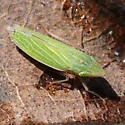
One of the smaller members of the genus, this species is morphologically somewhat similar to the more common Draeculacephala robinsoni dorsally and therefor it is important that clear photos are taken of the underside and a length is acquired to distinguish the species. D. mollipes is a yellowish-green species with blue wing venation and a pale/yellow face and underside. The faces of males can occasionally be more fuscous. The species can have somewhat bold blue pronotal lines (these appear more often on mollipes than on robinsoni ), but can sometimes lack all but the median blue line. Note yellow underside in males This species is the type species of the genus. For quite some time it was a taxonomic mess (still reflected in numerous collections): The original type material of this species is lost, and the confusion concerning its identity did not subside with designation of a neotype by Davidson and DeLong (1943). Because Davidson and Delong's interpretation of T. mollipes Say differed from that of Lawson (1920), who first illustrated the male genitalia, Young and Davidson (1959) rejected the neotype, describing a new species (based on different type material), Draeculacephala delongi Young and Davidson, for the species interpreted as mollipes by Davidson and DeLong. Later, Hamilton (1985) accepted Davidson and DeLong's neotype as valid and synonymies D. delongi with D. constricta . Neither Davidson and DeLong (1943) nor Hamilton (1985) satisfied the International Code of Zoological Nomenclature, governing the designation of neotypes (Dietrich, 1992). Thus, Tettigonia mollipes (Say), the type species of Draeculacephala Ball, lacks a validly designated name-bearing type. In accordance with Recommendation 75D of the Code and based on previous (Dietrich, 1992) arguments, I hereby designate Davidson and DeLong's invalid neotype specimen as the neotype of Tettigonia mollipes . [...] The neoallotype and the series of neoparatypes labeled by Davidson and DeLong are invalid because the former is a male specimen of D. robinsoni and the latter is a mixed series of D. constricta and D. mollipes . - Dietrich (1994)
Classification
- Kingdom
- Animalia
- Phylum
- Arthropoda
- Class
- Insecta
- Order
- Hemiptera (True Bugs, Cicadas, Hoppers, Aphids and Allies)
- Suborder
- Auchenorrhyncha
- Superfamily
- Membracoidea
- Family
- Cicadellidae (Typical Leafhoppers)
- Subfamily
- Cicadellinae
- Tribe
- Cicadellini
- Genus
- Draeculacephala
Imported taxonomy record. Source availability varies; see the source references and editorial policy below.
Habitat and Range
Habitat
Mixed hardwood forest, grassy areas, fields, etc.
Geographic Range
e.NA
Diet and Behavior
Diet: Grasses
Additional species information
Species notes from the sources
Etymology: Draeculacephala mollipes (Say 1840)
About True Bugs, Cicadas, Hoppers, Aphids and Allies: the wider group
Order-level background for Hemiptera, the group containing Draeculacephala mollipes. Species-specific details appear above.
Group overview
Hemiptera (true bugs) includes over 80,000 described species across cicadas, aphids, leafhoppers, shield bugs, and bed bugs. Aphids alone cost global agriculture an estimated $2.5 billion annually in crop losses.
Ecological role of the group
Many Hemiptera are essential food sources for birds and predatory insects. Cicadas provide massive nutrient pulses during emergence events - a single Brood X emergence can involve trillions of individuals across 15 states.
Economic and practical significance of the group
The brown marmorated stink bug (Halyomorpha halys) caused $37 million in apple crop losses in a single year in the U.S. Mid-Atlantic region. Bed bug infestations in the U.S. increased by 500% between 2001-2010, costing the hotel industry hundreds of millions annually.
Recorded sources for this group: USDA, EPA, University research. Imported estimates may describe particular regions or reporting periods.
Photos of Tenderfoot Leafhopper (5)
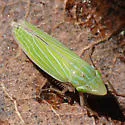
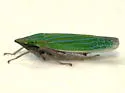
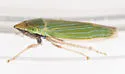
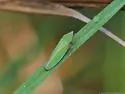
Photo credits: Contributed by Claude Pilon; Additional contributions by v belov , Chuck Sexton , TurtleDude , antarctica
Frequently Asked Questions About Tenderfoot Leafhopper
What is Tenderfoot Leafhopper?
Tenderfoot Leafhopper (Draeculacephala mollipes) is a species in the family Cicadellidae, within the order Hemiptera.
How big is Tenderfoot Leafhopper?
♂♂ <6.6 mm, ♀♀ <8.0 mm
How do you identify Tenderfoot Leafhopper?
One of the smaller members of the genus, this species is morphologically somewhat similar to the more common Draeculacephala robinsoni dorsally and therefor it is important that clear photos are taken of the underside and a length is acquired to distinguish the species. D. mollipes is a yellowish-green species with blue wing venation and a pale/yellow face and underside. The faces of males can occasionally be more fuscous. The species can have somewhat bold blue pronotal lines (these appear more often on mollipes than on robinsoni ), but can sometimes lack all but the median blue line. Note yellow underside in males
Where is Tenderfoot Leafhopper found?
| Feature | Details |
|---|---|
| Habitat | Mixed hardwood forest, grassy areas, fields, etc. |
| Range | e.NA |
What does Tenderfoot Leafhopper eat?
The diet of the Tenderfoot Leafhopper includes Grasses.