
European Longhorn Robber
Dioctria hyalipennis
This record describes Dioctria hyalipennis (species). Recorded family: Asilidae. Recorded order: Diptera.
Identification and Appearance
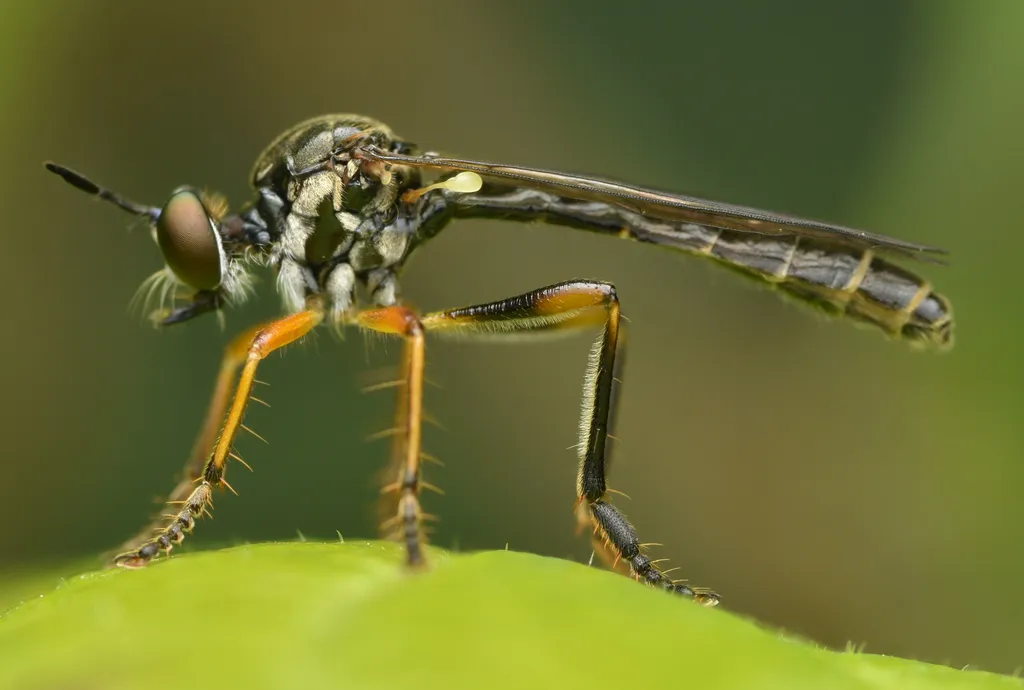
delicate build; long slender abdomen is narrower at the base than at the tip; halteres yellow; legs less hairy/spiny than most robber flies, fore and mid legs yellowish with dark streaks on top side, hind legs dark. Abdomen black, shining. Lower margin of segments have a thin whitish line. First 4 male segments very narrow and constricted (appear wavy); last few segments gradually widen to tip. Female abdomen flat on top side, rounded and orange on underside; much wider and thicker than male, but shorter. From England, introduced to Boston, Massachusetts area around 1916. Types: Holotype as Asilus hyalipennis by Fabricius, 1794. Type Locality: Denmark. Fabricius’ collection is in the University of Copenhagen Zoological Museum, Copenhagen, Denmark. Holotype as Dioctria anomala by Macquart, 1826. Type Locality: Unknown. Many Macquart types are in Bigot’s collection which is divided between the University Museum at Oxford and the British Museum of Natural History, London, England. Also, Macquart types are scattered among a number of museums, with his personal collection deposited in Lille. Holotype as Dioctria flavipes by Meigen, 1804. Type Locality: Netherlands. Baumhauer’s collection is split between the Liege and the Leiden Museum, Netherlands. Holotype as Dioctria frontalis by Meigen, 1804. Type Locality: Unknown. Most of the Meigen collection is now in the Museum National d'Histoire Naturelle in Paris, France. Holotype as Dioctria varipes by Meigen, 1820. Type Locality: Unknown. Most of the Meigen collection is now in the Museum National d'Histoire Naturelle in Paris, France. Holotype as Dioctria baumhaueri by Meigen, 1820. Type Locality: Netherlands. Baumhauer’s collection is split between the Liege and the Leiden Museum, Netherlands. Holotype as Dioctria strandi by Duda, 1940. Type Locality: Unknown. Museum unknown.
Wikipedia reference for Dioctria hyalipennis: https://en.wikipedia.org/wiki/Dioctria_hyalipennis.
Classification
Habitat and Range
Habitat
shrubs in woodlands, parks, suburban yards; likes large shrubs and Cedar trees.
Geographic Range
holarctic: ne. NA (QC-ON to MD-MI) & w. Palaearctic
Seasonal Activity
May-Jul
Diet and Behavior
Diet: Adults feed on mostly small wasps and bees like Lasioglossum and Hylaeus. Also reported feeding on small flies Diptera and pygmy grasshoppers Tetrigidae.
Additional species information
Species notes from the sources
Etymology: Dioctria hyalipennis (Fabricius 1794) European Longhorn Robber: https://www.robberfliesoftheworld.com/NA_CommonNames.php
About Flies: the wider group
Order-level background for Diptera, the group containing Dioctria hyalipennis. Species-specific details appear above.
Group overview
Diptera includes over 150,000 described species of flies, mosquitoes, and midges. Mosquitoes are the deadliest animal on Earth (CDC). Malaria alone causes ~249 million cases and over 608,000 deaths annually, mostly children under 5 (WHO). Vector-borne diseases account for over 17% of all infectious diseases, causing 700,000+ deaths per year.
Ecological role of the group
Despite their disease impact, flies are critical decomposers and pollinators. Hoverflies alone pollinate hundreds of crop and wildflower species. Flies are also the primary food source for many birds, bats, and fish. Forensic entomology relies heavily on fly species for crime scene analysis.
Economic and practical significance of the group
In the U.S., vector-borne disease cases tripled between 2004-2016, with over 640,000 cases reported in that period (CDC). Tickborne diseases doubled from 22,000 to 48,000 annual reports. Globally, mosquito-borne diseases cost billions in healthcare and lost productivity.
Recorded sources for this group: WHO, CDC, PNAS. Imported estimates may describe particular regions or reporting periods.
Photos of European Longhorn Robber (3)
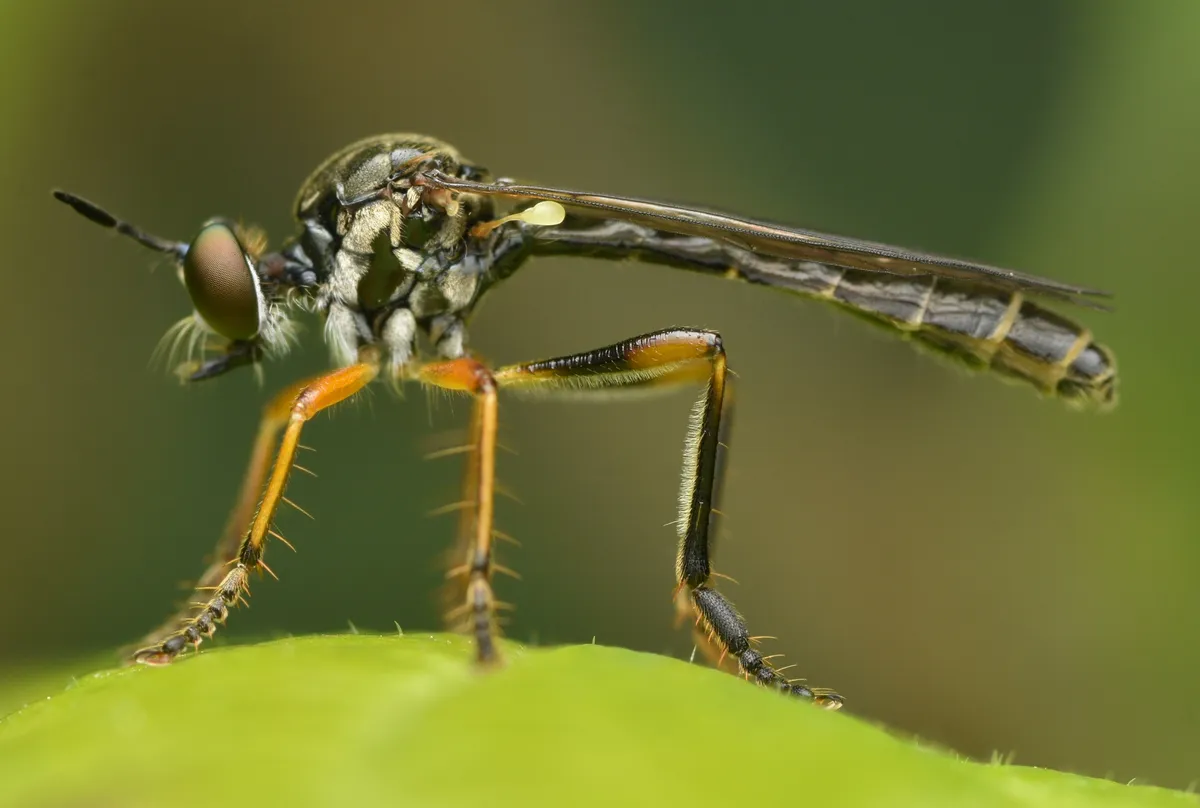
Photo credits: Contributed by Robin McLeod; Additional contributions by Bbarnd , v belov , lee_penner , Chris Cohen
Frequently Asked Questions About European Longhorn Robber
What is European Longhorn Robber?
European Longhorn Robber (Dioctria hyalipennis) is a species in the family Asilidae, within the order Diptera.
How big is European Longhorn Robber?
10-12 mm
How do you identify European Longhorn Robber?
delicate build; long slender abdomen is narrower at the base than at the tip; halteres yellow; legs less hairy/spiny than most robber flies, fore and mid legs yellowish with dark streaks on top side, hind legs dark. Abdomen black, shining. Lower margin of segments have a thin whitish line. First 4 male segments very narrow and constricted (appear wavy); last few segments gradually widen to tip. Female abdomen flat on top side, rounded and orange on underside; much wider and thicker than male, but shorter.
Where is European Longhorn Robber found?
| Feature | Details |
|---|---|
| Habitat | shrubs in woodlands, parks, suburban yards; likes large shrubs and Cedar trees. |
| Range | holarctic: ne. NA (QC-ON to MD-MI) & w. Palaearctic |
What does European Longhorn Robber eat?
The diet of the European Longhorn Robber includes Adults feed on mostly small wasps and bees like Lasioglossum and Hylaeus. Also reported feeding on small flies Diptera and pygmy grasshoppers Tetrigidae..
When is European Longhorn Robber active?
European Longhorn Robber: seasonal activity - May-Jul.