
Common Red-legged Robberfly
Dioctria rufipes
This record describes Dioctria rufipes (species). Recorded family: Asilidae. Recorded order: Diptera.
Identification and Appearance
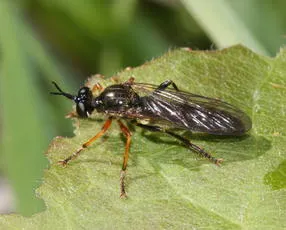
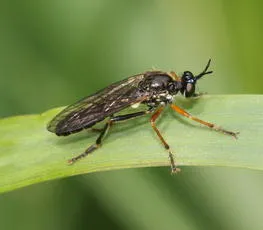
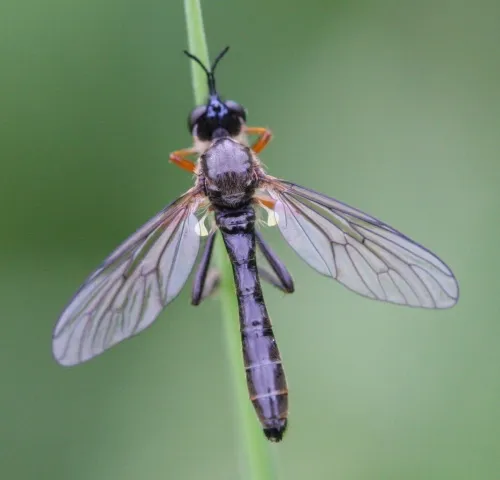
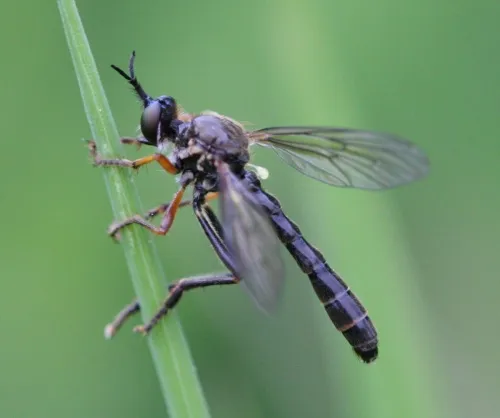
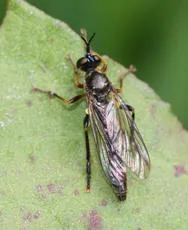
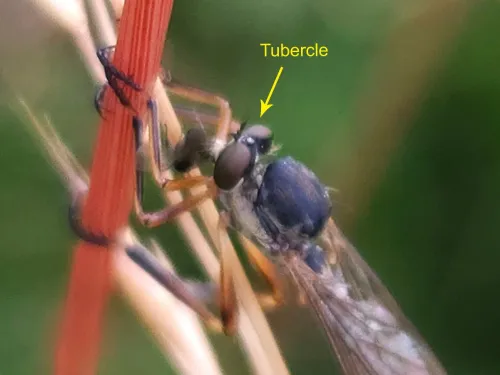
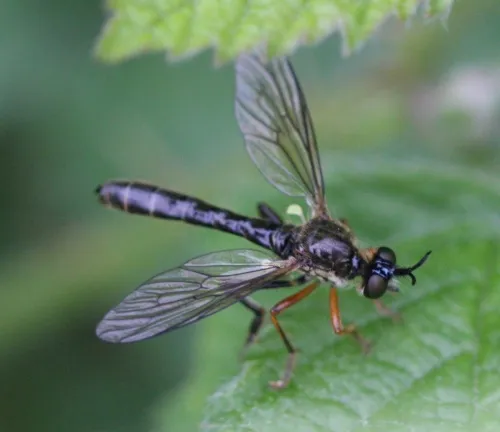
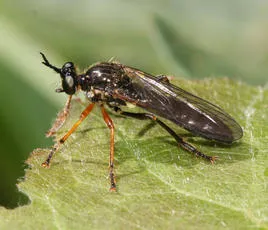
Size approx 15 mm. The front 2 pairs of legs are usually completely orange-red and the hind legs almost wholly black, though variants do occur (see image below). All Dioctria species have shiny patches on the side of thorax which in good light show as silvery patches or 'shimmer stripes'. D. rufipes has a particularly well-developed tubercle at the base of the antennae which helps to distinguish it from other Dioctria species. Unless identified by a recognised expert, a photo is required. If the photo doesn't show the key ID features then in the comments box describe the size and identifying characters you have observed. They are usually sluggish flies that perch on the foliage of mainly herbaceous plants, shrubs and trees waiting to launch attacks on insect prey. They have hard piercing mouthparts and often prey on parasitic wasps. The eggs are dropped whilst sitting on a leaf, one at a time. Widespread but rather local in distribution.
Classification
Habitat and Range
Habitat
Scrub and well wooded areas.
Seasonal Activity
May to July.
Diet and Behavior
Life History
They are usually sluggish flies that perch on the foliage of mainly herbaceous plants, shrubs and trees waiting to launch attacks on insect prey. They have hard piercing mouthparts and often prey on parasitic wasps. The eggs are dropped whilst sitting on a leaf, one at a time.
Additional species information
Recorded status
Widespread but rather local in distribution.
About Flies: the wider group
Order-level background for Diptera, the group containing Dioctria rufipes. Species-specific details appear above.
Group overview
Diptera includes over 150,000 described species of flies, mosquitoes, and midges. Mosquitoes are the deadliest animal on Earth (CDC). Malaria alone causes ~249 million cases and over 608,000 deaths annually, mostly children under 5 (WHO). Vector-borne diseases account for over 17% of all infectious diseases, causing 700,000+ deaths per year.
Ecological role of the group
Despite their disease impact, flies are critical decomposers and pollinators. Hoverflies alone pollinate hundreds of crop and wildflower species. Flies are also the primary food source for many birds, bats, and fish. Forensic entomology relies heavily on fly species for crime scene analysis.
Economic and practical significance of the group
In the U.S., vector-borne disease cases tripled between 2004-2016, with over 640,000 cases reported in that period (CDC). Tickborne diseases doubled from 22,000 to 48,000 annual reports. Globally, mosquito-borne diseases cost billions in healthcare and lost productivity.
Recorded sources for this group: WHO, CDC, PNAS. Imported estimates may describe particular regions or reporting periods.
Photos of Common Red-legged Robberfly (10)
Frequently Asked Questions About Common Red-legged Robberfly
What is Common Red-legged Robberfly?
Common Red-legged Robberfly (Dioctria rufipes) is a species in the family Asilidae, within the order Diptera.
How big is Common Red-legged Robberfly?
approx 15 mm. The front 2 pairs of legs are usually completely orange-red and the hind legs almost wholly black, though variants do occur (see image below). All
Where is Common Red-legged Robberfly found?
Habitat: Scrub and well wooded areas.
When is Common Red-legged Robberfly active?
Common Red-legged Robberfly: seasonal activity - May to July..
What is the life cycle of a Common Red-legged Robberfly?
They are usually sluggish flies that perch on the foliage of mainly herbaceous plants, shrubs and trees waiting to launch attacks on insect prey. They have hard piercing mouthparts and often prey on parasitic wasps. The eggs are dropped whilst sitting on a leaf, one at a time.