
Diceroprocta cinctifera
This record describes Diceroprocta cinctifera (species). Recorded family: Cicadidae. Recorded order: Hemiptera.
Identification and Appearance
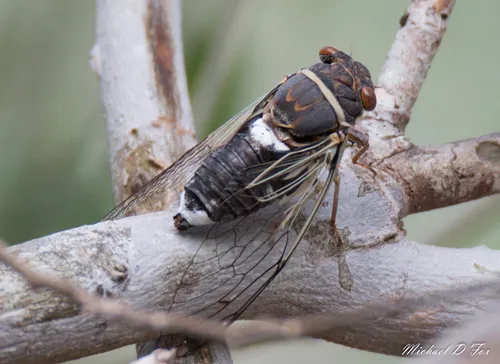
broad white band across tip of abdomen is distinctive Basic characters usu. include: Eyes: Described as tan to reddish (rust-colored) Body: Usually dark, often with some reddish-brown coloration visible Pronotal Collar: VARIABLE (may be described as bisected with the anterior region being dark and the posterior region an orangish or ochreous color or the pronotal collar may appear entirely orangish or tan in some populations) Mesonotum: Often dark with some evidence of reddish brown pattern (variable) Abdomen: On many specimens identified as cinctifera, there are usually 2 well defined pruinose features. One is a well developed pruinose ring on the terminal abdominal segments (also seen in apache and semicincta) coupled with a white band posterior to the cruciform elevation often clearly delineating the abdomen from the thorax (this trait has fallen into question & may not be diagnostic for this taxon??). Opercula: Pointed with the points being subparallel or slightly divergent (NOT pointing inward as in semicincta) - Opercula with the outer edges nearly parallel to each other; 8th segment and middle base of tergum pruinose. WINGS: costal margin of fore wing usually orangish to bright orange in color NOTE: Some of the IMAGES under this taxon may be MISIDENTIFIED and in need of review! Based on morphological characteristics, call similarities, and distribution patterns, the following three taxa appear to be closely related and easily confused. Frequently confused. Diceroprocta apache Diceroprocta cinctifera Diceroprocta semicincta Another species with a similar call Diceroprocta marevagans For details on cinctifera, apache & semicincta, please refer to the following: Journal of the N.Y. Entomol. Soc. XXXVI, Dec. 1928, pp. 439–457
Classification
- Kingdom
- Animalia
- Phylum
- Arthropoda
- Class
- Insecta
- Order
- Hemiptera (True Bugs, Cicadas, Hoppers, Aphids and Allies)
- Suborder
- Auchenorrhyncha
- Superfamily
- Cicadoidea
- Family
- Cicadidae (Cicadas)
- Subfamily
- Cicadinae
- Tribe
- Fidicinini
- Genus
- Diceroprocta (Scrub Cicadas)
Imported taxonomy record. Source availability varies; see the source references and editorial policy below.
Habitat and Range
Habitat
riparian communities along Rio Grande River and its tributaries
Geographic Range
Specimens identified as D. cintifera have been placed across parts of the southwestern United States (incl. Texas, New Mexico & Arizona. However, most authenticated records place this species in Texas (per. comm.) Most information suggests Diceroprocta cinctifera has a more eastern distribution than several related taxa (incl. D. apache & D. semicincta ). It is important to mention, given misidentifications and confusions regarding separation of similar taxa, the distributions of several of these western Diceroprocta species remains suspect and incomplete.
About True Bugs, Cicadas, Hoppers, Aphids and Allies: the wider group
Order-level background for Hemiptera, the group containing Diceroprocta cinctifera. Species-specific details appear above.
Group overview
Hemiptera (true bugs) includes over 80,000 described species across cicadas, aphids, leafhoppers, shield bugs, and bed bugs. Aphids alone cost global agriculture an estimated $2.5 billion annually in crop losses.
Ecological role of the group
Many Hemiptera are essential food sources for birds and predatory insects. Cicadas provide massive nutrient pulses during emergence events - a single Brood X emergence can involve trillions of individuals across 15 states.
Economic and practical significance of the group
The brown marmorated stink bug (Halyomorpha halys) caused $37 million in apple crop losses in a single year in the U.S. Mid-Atlantic region. Bed bug infestations in the U.S. increased by 500% between 2001-2010, costing the hotel industry hundreds of millions annually.
Recorded sources for this group: USDA, EPA, University research. Imported estimates may describe particular regions or reporting periods.
Photos of Diceroprocta cinctifera (2)
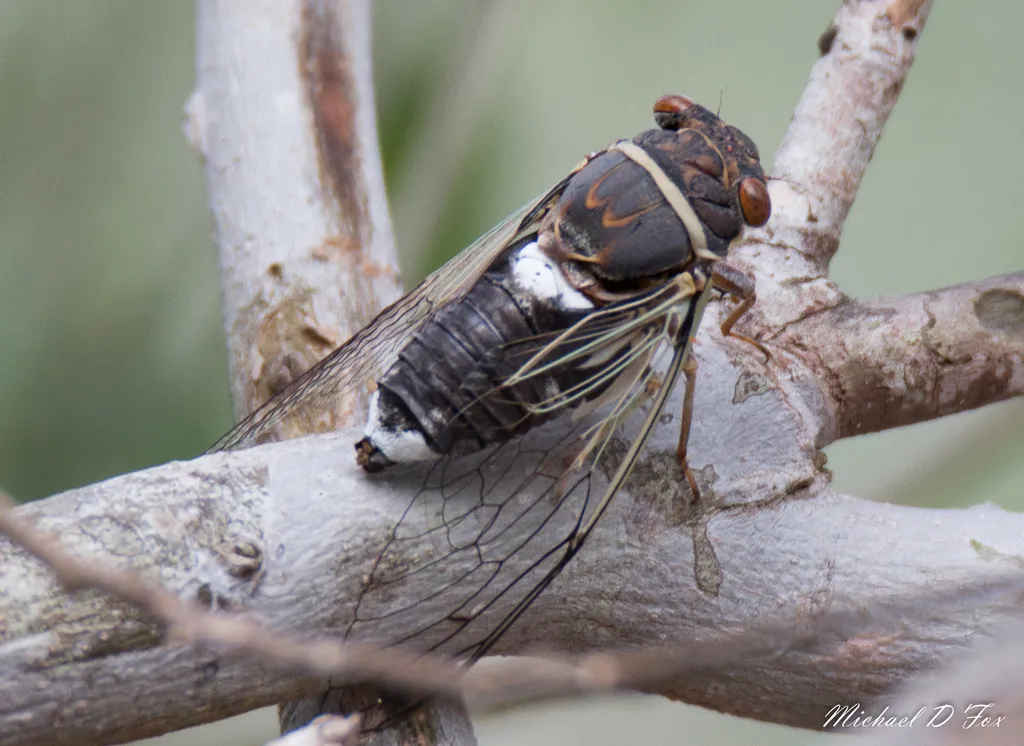
Photo credits: Contributed by Robin McLeod; Additional contributions by Bill Reynolds
Frequently Asked Questions About Diceroprocta cinctifera
What is Diceroprocta cinctifera?
Diceroprocta cinctifera is a species in the family Cicadidae, within the order Hemiptera.
How do you identify Diceroprocta cinctifera?
broad white band across tip of abdomen is distinctive Basic characters usu. include: Eyes: Described as tan to reddish (rust-colored) Body: Usually dark, often with some reddish-brown coloration visible Pronotal Collar: VARIABLE (may be described as bisected with the anterior region being dark and the posterior region an orangish or ochreous color or the pronotal collar may appear entirely orangish or tan in some populations) Mesonotum: Often dark with some evidence of reddish brown pattern (variable) Abdomen: On many specimens identified as cinctifera, there are usually 2 well defined pruinose features. One is a well developed pruinose ring on the terminal abdominal segments (also seen in apache and semicincta) coupled with a white band posterior to the cruciform elevation often clearly delineating the abdomen from the thorax (this trait has fallen into question & may not be diagnostic for this taxon??). Opercula: Pointed with the points being subparallel or slightly divergent (NOT pointing inward as in semicincta) - Opercula with the outer edges nearly parallel to each other; 8th segment and middle base of tergum pruinose. WINGS: costal margin of fore wing usually orangish to bright orange in color NOTE: Some of the IMAGES under this taxon may be MISIDENTIFIED and in need of review! Based on morphological characteristics, call similarities, and distribution patterns, the following three taxa appear to be closely related and easily confused. Frequently confused. Diceroprocta apache Diceroprocta cinctifera Diceroprocta semicincta Another species with a similar call Diceroprocta marevagans For details on cinctifera, apache & semicincta, please refer to the following: Journal of the N.Y. Entomol. Soc. XXXVI, Dec. 1928, pp. 439–457
Where is Diceroprocta cinctifera found?
| Feature | Details |
|---|---|
| Habitat | riparian communities along Rio Grande River and its tributaries |
| Range | Specimens identified as D. cintifera have been placed across parts of the southwestern United States (incl. Texas, New Mexico & Arizona. However, most authenticated records place this species in Texas (per. comm.) Most information suggests Diceroprocta cinctifera has a more eastern distribution than several related taxa (incl. D. apache & D. semicincta ). It is important to mention, given misidentifications and confusions regarding separation of similar taxa, the distributions of several of these western Diceroprocta species remains suspect and incomplete. |