
Dalmannia vitiosa
This record describes Dalmannia vitiosa (species). Recorded family: Conopidae. Recorded order: Diptera.
Identification and Appearance
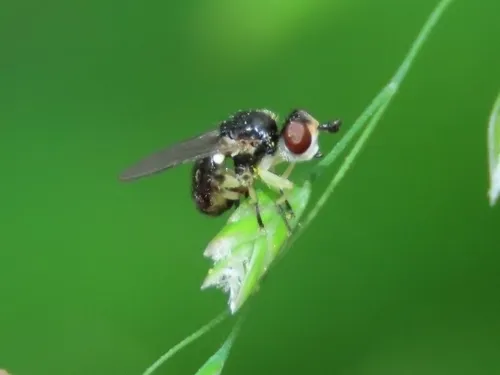
This is the only Dalmannia species with both humeri and scutellum pure black (all others have some yellow in those parts). Also, D. vitosa is unique among nearctic Dalmannia in that cross-vein bm-cu (see bottom of this page ) is entirely absent...making the usually separated discal and 2nd basal (=basal medial) cells confluent as one long cell. This character is well-illustrated in Figs. 13D & E on pg. 384 of Trevor Burt's thesis , and also apparent in the photo below: Note, however, that it appears cross-vein bm-cu can be partly missing or broken in some species (e.g. D. nigriceps ). According to Bohart and Stone , only two species occur to the east of the Rocky Mountains... D. vittosa and D. nigriceps . ( D. vittosa occurs to the west of the Rockies as well, but D. nigriceps is exclusively eastern, its most western record being from Colorado .)
Classification
Habitat and Range
Geographic Range
Idaho to New Hampshire, south to California and Georgia
About Flies: the wider group
Order-level background for Diptera, the group containing Dalmannia vitiosa. Species-specific details appear above.
Group overview
Diptera includes over 150,000 described species of flies, mosquitoes, and midges. Mosquitoes are the deadliest animal on Earth (CDC). Malaria alone causes ~249 million cases and over 608,000 deaths annually, mostly children under 5 (WHO). Vector-borne diseases account for over 17% of all infectious diseases, causing 700,000+ deaths per year.
Ecological role of the group
Despite their disease impact, flies are critical decomposers and pollinators. Hoverflies alone pollinate hundreds of crop and wildflower species. Flies are also the primary food source for many birds, bats, and fish. Forensic entomology relies heavily on fly species for crime scene analysis.
Economic and practical significance of the group
In the U.S., vector-borne disease cases tripled between 2004-2016, with over 640,000 cases reported in that period (CDC). Tickborne diseases doubled from 22,000 to 48,000 annual reports. Globally, mosquito-borne diseases cost billions in healthcare and lost productivity.
Recorded sources for this group: WHO, CDC, PNAS. Imported estimates may describe particular regions or reporting periods.
Photos of Dalmannia vitiosa (2)
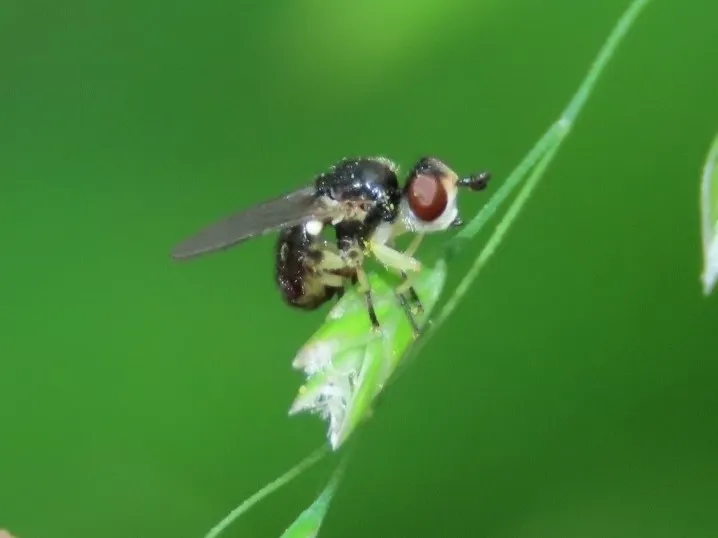
Photo credits: Contributed by Martin Hauser; Additional contributions by Aaron Schusteff
Frequently Asked Questions About Dalmannia vitiosa
What is Dalmannia vitiosa?
Dalmannia vitiosa is a species in the family Conopidae, within the order Diptera.
How do you identify Dalmannia vitiosa?
This is the only Dalmannia species with both humeri and scutellum pure black (all others have some yellow in those parts). Also, D. vitosa is unique among nearctic Dalmannia in that cross-vein bm-cu (see bottom of this page ) is entirely absent...making the usually separated discal and 2nd basal (=basal medial) cells confluent as one long cell. This character is well-illustrated in Figs. 13D & E on pg. 384 of Trevor Burt's thesis , and also apparent in the photo below: Note, however, that it appears cross-vein bm-cu can be partly missing or broken in some species (e.g. D. nigriceps ).
Where is Dalmannia vitiosa found?
Range: Idaho to New Hampshire, south to California and Georgia