
Cuerna striata
This record describes Cuerna striata (species). Recorded family: Cicadellidae. Recorded order: Hemiptera.
Identification and Appearance
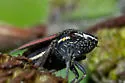
This is a complex of many closely-related and variable species with their limits poorly defined. The most recent revision collapsed the complex back into one species until further study can be used to determine the limits of the species. C. striata is interpreted here sensu Nielson, i.e. as a variable species complex widely distributed in the northern parts of the continent. Populations from geographically distant localities can be as different as good species, yet dividing geographical variants into discrete taxa is difficult. Nielson pointed out that specimens from the western parts of the United States, Canada, and Alaska are smaller and display relatively longer caudal and shorter lateral processes of the male aedeagus, and female sternum VIII with lateral plates connected by a more narrow bridge than specimens from the eastern parts of the United States and Canada. Hamilton interpreted the eastern forms as C. striata and C. lugens (endemic to Nova Scotia, synonymized by Nielson with C. striata ). He interpreted the western forms as C. septentrionalis (originally described from Northwest Territories and also synonymized by Nielson with C. striata ) and five newly described species, four of them found only in Canada. Examination of specimens from the entire range of the striata complex suggests that C. inflata , C. lugens , C. nielsoni , C. pseudoalba , and C. reducta represent within-population variants, whereas cuesta seems to have a well-defined range in the northwestern United States and British Columbia and may merit subspecific status. Several additional forms from Arizona, Nevada, and Utah, interpreted here as C. striata s. l., appear to be distinct and may be recognized as separate species in the future, when the entire striata species group is better studied.
Classification
- Kingdom
- Animalia
- Phylum
- Arthropoda
- Class
- Insecta
- Order
- Hemiptera (True Bugs, Cicadas, Hoppers, Aphids and Allies)
- Suborder
- Auchenorrhyncha
- Superfamily
- Membracoidea
- Family
- Cicadellidae (Typical Leafhoppers)
- Subfamily
- Cicadellinae
- Tribe
- Proconiini
- Genus
- Cuerna
Imported taxonomy record. Source availability varies; see the source references and editorial policy below.
Habitat and Range
Geographic Range
when treated broadly, northern transcontinental & western montane ; otherwise, see above State/Province records: CAN: AB, BC, MB, NS, NT, ON, QC, SK USA: AK, AZ, CO, ID, IL, KS, MA, ME, MI, MN, MT, ND, NE, NH, NM, NV, NY, SD, TX, UT, VT, WA, WI, WY
Additional species information
Species notes from the sources
Etymology: = Cuerna septentrionalis Walker, Cuerna cuesta Hamilton ["these biological species can be differentiated by the amateur on their distribution ( C. cuesta is only in BC, WA and ID; C. septentrionalis east of that, rarely found east of Lake Superior and only in boreal sites; C. striata is eastern, in temperate-zone sites)." --K.G.A. Hamilton, pers. comm. to =v= 13.iii.2013] The most recent revision treats the complex discussed above as a single species. It is still considered likely that this is a complex of closely related species, with Cuerna cuesta being the most likely to be clearly distinct.
About True Bugs, Cicadas, Hoppers, Aphids and Allies: the wider group
Order-level background for Hemiptera, the group containing Cuerna striata. Species-specific details appear above.
Group overview
Hemiptera (true bugs) includes over 80,000 described species across cicadas, aphids, leafhoppers, shield bugs, and bed bugs. Aphids alone cost global agriculture an estimated $2.5 billion annually in crop losses.
Ecological role of the group
Many Hemiptera are essential food sources for birds and predatory insects. Cicadas provide massive nutrient pulses during emergence events - a single Brood X emergence can involve trillions of individuals across 15 states.
Economic and practical significance of the group
The brown marmorated stink bug (Halyomorpha halys) caused $37 million in apple crop losses in a single year in the U.S. Mid-Atlantic region. Bed bug infestations in the U.S. increased by 500% between 2001-2010, costing the hotel industry hundreds of millions annually.
Recorded sources for this group: USDA, EPA, University research. Imported estimates may describe particular regions or reporting periods.
Photos of Cuerna striata (5)
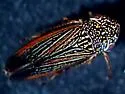
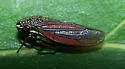
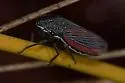
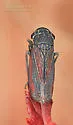
Photo credits: Contributed by Robin McLeod; Additional contributions by Bbarnd , v belov , antarctica