
Cristate Grasshopper
Conozoa texana
This record describes Conozoa texana (species). Recorded family: Acrididae. Recorded order: Orthoptera.
Identification and Appearance
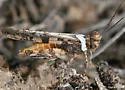
Typical of Conozoa (see Info section under genus heading). Variable, but slender; with lateral lobes of pronotum projecting somewhat downward at lower rear corner and usually somewhat angled or toothed there; median crest of pronotum distinct, twice cut, strongly bilobed on prozona (front part); hind tibiae usually greenish to blue toward northwest part of range, yellow to greenish in most areas, and yellow to red from central New Mexico into Texas and Chihuahua. Conozoa sulcifrons and carinata favor different habitats (mostly bare silty flat low-lying areas, often near water); have the median carina on the pronotum less strongly bilobed on the prozona (often not at all); and C. sulcifrons almost always has bright orange or red hind tibiae, while they are normally yellow in C. carinata (never greenish or bluish in either species). Both species crepitate with a rapid interrupted buzz, instead of the relatively slow ticking of C. texana . Trimerotropis gracilis can look nearly identical, but is always larger when found in the same areas, and has the lower rear angle of the pronotal lateral lobes rounded. The hind tibiae are brownish to yellow. Body coloration is usually rather plain, sometimes speckled, and gray or brown to blackish (coloring is much more variable in C. texana , and usually not dark). The dark band of the hind wing is usually wider and less curved on the innder edge. It is usually found with sagebrush and does not favor sand over other soil types. It also ticks, in flight, but is louder. The species listed on BugGuide as Trimerotropis undescribed-species-a differs as does T. gracilis , except it is also common in scrub covered alkali flats, the wings may also be greenish or bluish, and the dark wing band is cloudy and faint or absent. Conozoa texana is almost always found in dry sand areas. One of very few species of American Oedipodinae in which the hind tibia varies in color all the way from blue through green, yellow, and orange to red. Depending on how species are defined, perhaps the only one! As currently defined, it is possible that more than one species are combined under this name. There is great diversity included, and specimens from opposite ends of the species' distribution appear quite different when compared directly. However, there seems to be a gradual continuum of variation from one region to the next that connects almost all, and there is no obvious place to divide them. Populations along the southern California and northern Baja coastline stand out as particularly distinctive though, and could represent a different species. The close relationship to C. albolineata also needs more study.
Classification
- Kingdom
- Animalia
- Phylum
- Arthropoda
- Class
- Insecta
- Order
- Orthoptera (Grasshoppers, Crickets, Katydids)
- Suborder
- Caelifera
- Family
- Acrididae (Short-horned Grasshoppers)
- Subfamily
- Oedipodinae
- Tribe
- Trimerotropini
- Genus
- Conozoa
Imported taxonomy record. Source availability varies; see the source references and editorial policy below.
Habitat and Range
Habitat
Exposed sandy areas, particularly stable dunes, mostly in desert or grassland regions.
Geographic Range
Very wide-ranging, and often quite abundant. South central British Columbia south through the Columbia Plateau, Snake River Plains, Great Basin, Colorado Plateaus, and Chihuahuan and Sonoran Desert to east central Mexico. Found mostly west from the Rocky Mountains and east of the Sierra Nevada and Cascades. Also in all of Baja California. Replaced in parts of California by more contrastingly patterned and closely related C. rebellis .
Diet and Behavior
Life History
Overwinters as eggs. Adults from spring to autumn, usually most common in late spring and/or early summer.
About Grasshoppers, Crickets, Katydids: the wider group
Order-level background for Orthoptera, the group containing Conozoa texana. Species-specific details appear above.
Group overview
Orthoptera includes ~28,000 described species of grasshoppers, crickets, and katydids. Desert locusts can form swarms covering 460 square miles containing up to 80 million individuals per square kilometer.
Ecological role of the group
Grasshoppers and crickets are a primary food source for birds, reptiles, and small mammals. Cricket farming is a growing industry - crickets require 12× less feed than cattle to produce the same amount of protein, using 2,000× less water.
Economic and practical significance of the group
A single large locust swarm can consume the same amount of food in one day as 35,000 people. The 2019-2021 East Africa locust crisis affected food security for 42 million people across multiple countries. Global crop losses from locusts can reach billions annually.
Recorded sources for this group: FAO, UN World Food Programme, research publications. Imported estimates may describe particular regions or reporting periods.
Photos of Cristate Grasshopper (5)
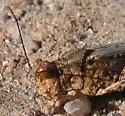
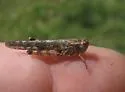
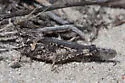
Photo credits: Contributed by Joyce Gross; Additional contributions by David Ferguson
Frequently Asked Questions About Cristate Grasshopper
What is Cristate Grasshopper?
Cristate Grasshopper (Conozoa texana) is a species in the family Acrididae, within the order Orthoptera.
How big is Cristate Grasshopper?
males about 20-30 mm females about 25-40 mm
How do you identify Cristate Grasshopper?
Typical of Conozoa (see Info section under genus heading). Variable, but slender; with lateral lobes of pronotum projecting somewhat downward at lower rear corner and usually somewhat angled or toothed there; median crest of pronotum distinct, twice cut, strongly bilobed on prozona (front part); hind tibiae usually greenish to blue toward northwest part of range, yellow to greenish in most areas, and yellow to red from central New Mexico into Texas and Chihuahua. Conozoa sulcifrons and carinata favor different habitats (mostly bare silty flat low-lying areas, often near water); have the median carina on the pronotum less strongly bilobed on the prozona (often not at all); and C. sulcifrons almost always has bright orange or red hind tibiae, while they are normally yellow in C. carinata (never greenish or bluish in either species). Both species crepitate with a rapid interrupted buzz, instead of the relatively slow ticking of C. texana . Trimerotropis gracilis can look nearly identical, but is always larger when found in the same areas, and has the lower rear angle of the pronotal lateral lobes rounded. The hind tibiae are brownish to yellow. Body coloration is usually rather plain, sometimes speckled, and gray or brown to blackish (coloring is much more variable in C. texana , and usually not dark). The dark band of the hind wing is usually wider and less curved on the innder edge. It is usually found with sagebrush and does not favor sand over other soil types. It also ticks, in flight, but is louder. The species listed on BugGuide as Trimerotropis undescribed-species-a differs as does T. gracilis , except it is also common in scrub covered alkali flats, the wings may also be greenish or bluish, and the dark wing band is cloudy and faint or absent. Conozoa texana is almost always found in dry sand areas.
Where is Cristate Grasshopper found?
| Feature | Details |
|---|---|
| Habitat | Exposed sandy areas, particularly stable dunes, mostly in desert or grassland regions. |
| Range | Very wide-ranging, and often quite abundant. South central British Columbia south through the Columbia Plateau, Snake River Plains, Great Basin, Colorado Plateaus, and Chihuahuan and Sonoran Desert to east central Mexico. Found mostly west from the Rocky Mountains and east of the Sierra Nevada and Cascades. Also in all of Baja California. Replaced in parts of California by more contrastingly patterned and closely related C. rebellis . |
What is the life cycle of a Cristate Grasshopper?
Overwinters as eggs. Adults from spring to autumn, usually most common in late spring and/or early summer.