
White-lined Grasshopper
Conozoa rebellis
This record describes Conozoa rebellis (species). Recorded family: Acrididae. Recorded order: Orthoptera.
Identification and Appearance
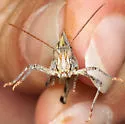
Not distinguishable from Conozoa texana except by coloration and location. C. rebellis differing in usually being more strikingly marked with linear dark and white patterning that tends to run along the axis of the body. Hind tibiae are usually yellowish, sometimes greenish. C. texana displaces C. rebellis eastward and to the south. Coloring is usually enough to separate C. rebellis from any other similar species with which it might be found, but the following are perhaps most similar. Conozoa hyalina averages somewhat larger, more plain (often yellowish) in body coloring, has the front portion of the median ridge of the pronotum higher and more strongly bilobed (it is moderately strongly so in C. rebellis ). Also, the wing of C. hyalina is usually only faintly pigmented yellow with the dark cross band weak or even absent. It is in the Central Valley of California, and is probably quite rare due to agriculture. C. sulcifrons usually has the front of the pronotal crest only shallowly notched and not strongly bilobed, and the hind tibiae orange or red (sometimes yellow), and tends to be in more stable bare silty habitats with things like Salt Grass, Willow, and often water nearby. It can be found in much of the same area as C. rebellis , but usually the habitat difference is enough of a first clue (they occasionally are in the same places though). C. carinata is much like C. sulcifrons in habits, and has the pronotal ridge distinctly and nearly evenly raised the whole length of the pronotum, and usually cut only once (sometimes notched again in front of the main cut, but not strongly bilobed). It may be found in some of the more easterly desert areas where C. rebellis occurs. When they fly, C. rebellis & C. texana may produce a clicking sound (often they are silent). C. sulcifrons & C. carinata produce a fast interrupted buzzing sound (but also often remain silent). The crepitation sound is unknown for C. hyalina (at least by this writer - David J. Ferguson). Distinction from Conozoa texana as a different species seems based on coloration alone. This species blends into that one where they come into contact, and populatons in western Arizona, southern Nevada, and southeastern California contain individuals that are intermediate or that can fit into either species. Occasional specimens everywhere in the range of C. carinata may be more plain and colored as in normal C. texana . The oldest name in this species group is rebellis , so they would all become that species if combined. This little grasshopper usually flies low and not far, but it is very alert and often flies very fast and erratically, zig-zagging between, through, and over bushes (if there are any present). Even though it usually doesn't make long flights, it can be very difficult to approach and photograph. It is usually very striking in appearance, but the pattern leaves it almost invisible when sitting against a sand background.
Classification
- Kingdom
- Animalia
- Phylum
- Arthropoda
- Class
- Insecta
- Order
- Orthoptera (Grasshoppers, Crickets, Katydids)
- Suborder
- Caelifera
- Family
- Acrididae (Short-horned Grasshoppers)
- Subfamily
- Oedipodinae
- Tribe
- Trimerotropini
- Genus
- Conozoa
Imported taxonomy record. Source availability varies; see the source references and editorial policy below.
Habitat and Range
Habitat
Mostly open dry sandy areas.
Geographic Range
Southern half of California, mostly west of the Sierra Nevada, but entering the Mojave and Colorado Deserts in the south, and extending into southwestern Arizona. Also, Baja California Norte and perhaps northwestern Sonora in Mexico.
Diet and Behavior
Life History
Overwintering as eggs. Adults spring into autumn, most common in early summer.
About Grasshoppers, Crickets, Katydids: the wider group
Order-level background for Orthoptera, the group containing Conozoa rebellis. Species-specific details appear above.
Group overview
Orthoptera includes ~28,000 described species of grasshoppers, crickets, and katydids. Desert locusts can form swarms covering 460 square miles containing up to 80 million individuals per square kilometer.
Ecological role of the group
Grasshoppers and crickets are a primary food source for birds, reptiles, and small mammals. Cricket farming is a growing industry - crickets require 12× less feed than cattle to produce the same amount of protein, using 2,000× less water.
Economic and practical significance of the group
A single large locust swarm can consume the same amount of food in one day as 35,000 people. The 2019-2021 East Africa locust crisis affected food security for 42 million people across multiple countries. Global crop losses from locusts can reach billions annually.
Recorded sources for this group: FAO, UN World Food Programme, research publications. Imported estimates may describe particular regions or reporting periods.
Photos of White-lined Grasshopper (5)
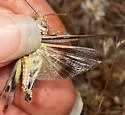
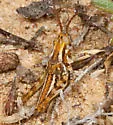
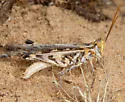
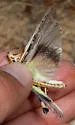
Photo credits: Contributed by Harsi S. Parker; Additional contributions by David Ferguson
Frequently Asked Questions About White-lined Grasshopper
What is White-lined Grasshopper?
White-lined Grasshopper (Conozoa rebellis) is a species in the family Acrididae, within the order Orthoptera.
How big is White-lined Grasshopper?
| Feature | Details |
|---|---|
| Males | 22-27 mm |
| Females | 31-37 mm |
How do you identify White-lined Grasshopper?
Not distinguishable from Conozoa texana except by coloration and location. C. rebellis differing in usually being more strikingly marked with linear dark and white patterning that tends to run along the axis of the body. Hind tibiae are usually yellowish, sometimes greenish. C. texana displaces C. rebellis eastward and to the south. Coloring is usually enough to separate C. rebellis from any other similar species with which it might be found, but the following are perhaps most similar. Conozoa hyalina averages somewhat larger, more plain (often yellowish) in body coloring, has the front portion of the median ridge of the pronotum higher and more strongly bilobed (it is moderately strongly so in C. rebellis ). Also, the wing of C. hyalina is usually only faintly pigmented yellow with the dark cross band weak or even absent. It is in the Central Valley of California, and is probably quite rare due to agriculture. C. sulcifrons usually has the front of the pronotal crest only shallowly notched and not strongly bilobed, and the hind tibiae orange or red (sometimes yellow), and tends to be in more stable bare silty habitats with things like Salt Grass, Willow, and often water nearby. It can be found in much of the same area as C. rebellis , but usually the habitat difference is enough of a first clue (they occasionally are in the same places though). C. carinata is much like C. sulcifrons in habits, and has the pronotal ridge distinctly and nearly evenly raised the whole length of the pronotum, and usually cut only once (sometimes notched again in front of the main cut, but not strongly bilobed). It may be found in some of the more easterly desert areas where C. rebellis occurs. When they fly, C. rebellis & C. texana may produce a clicking sound (often they are silent). C. sulcifrons & C. carinata produce a fast interrupted buzzing sound (but also often remain silent). The crepitation sound is unknown for C. hyalina (at least by this writer - David J. Ferguson).
Where is White-lined Grasshopper found?
| Feature | Details |
|---|---|
| Habitat | Mostly open dry sandy areas. |
| Range | Southern half of California, mostly west of the Sierra Nevada, but entering the Mojave and Colorado Deserts in the south, and extending into southwestern Arizona. Also, Baja California Norte and perhaps northwestern Sonora in Mexico. |
What is the life cycle of a White-lined Grasshopper?
Overwintering as eggs. Adults spring into autumn, most common in early summer.