
Four-spotted Green Lacewing
Chrysopa quadripunctata
This record describes Chrysopa quadripunctata (species). Recorded family: Chrysopidae. Recorded order: Neuroptera.
Identification and Appearance
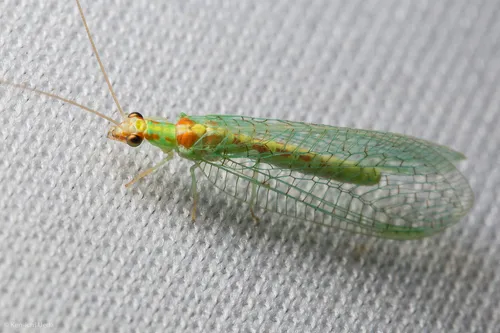
Adults The head is pale with a yellowish-green occiput and reddish stripe following the genae. The antennae are entirely pale. The body is green with a yellowish median stripe. Bordering this stripe are paired orange-to-reddish spots on either side (variable): often two pairs on the pronotum, two pairs on the mesothorax, and about four pairs on the abdomen. The costal cells above the origin of the radial sector at most 2x as long as wide, which separate it from the similarly marked C. slossonae . Larvae The head capsule bears four marks. The inner two are roughly V-shaped (without joining), and the outer two extend from the antennae and curve inward to the prothorax. The body is primarily pale with brownish markings (loosely forming 3 stripes along the thorax, these margined laterally by a series of spots on the abdomen), and all of the lateral tubercles are gray.
Wikipedia reference for Chrysopa quadripunctata: http://en.wikipedia.org/wiki/Chrysopa_quadripunctata.
Classification
- Kingdom
- Animalia
- Phylum
- Arthropoda
- Class
- Insecta
- Order
- Neuroptera (Antlions, Lacewings, and Allies)
- Family
- Chrysopidae (Green Lacewings)
- Subfamily
- Chrysopinae
- Tribe
- Chrysopini
- Genus
- Chrysopa (Stink Lacewings)
Imported taxonomy record. Source availability varies; see the source references and editorial policy below.
Habitat and Range
Habitat
Larvae are arboreal on the likes of maples, oaks, and shrubs.
Geographic Range
e. NA west to SK-KS-TX; BC ( 4 ) ( 5 ) (Canada: BC, MB, NS, ON, PE, QC, SK; United States: CA, DC, IL, IN, KS, MD, MN, MO, NC, NJ, NY, PA, SC, TN, TX, VA, WI)
Diet and Behavior
Diet: Larvae are generalist predators on aphid (and other arthropods). ( 3 )
Life History
Eggs are laid singly, often on trees. The larvae don't carry a full debris packet but frequently have smaller bits of debris.
Additional species information
Species notes from the sources
Etymology: Chrysopa quadripunctata Burmeister 1839
About Antlions, Lacewings, and Allies: the wider group
Order-level background for Neuroptera, the group containing Chrysopa quadripunctata. Species-specific details appear above.
Group overview
Neuroptera (lacewings, antlions, owlflies) includes ~6,000 described species. Green lacewing larvae are called 'aphid lions' - a single larva can consume up to 200 aphids per week.
Ecological role of the group
Antlion larvae build conical pit traps in sandy soil - an engineering feat studied by physicists for insights into granular mechanics. Adult lacewings are important pollinators of night-blooming flowers.
Economic and practical significance of the group
Lacewings are commercially reared and sold as biological pest control agents. The global biological pest control market, which heavily features lacewings, was valued at $6.6 billion in 2023 and is projected to reach $16.4 billion by 2033.
Recorded sources for this group: USDA IPM, biological control market research. Imported estimates may describe particular regions or reporting periods.
Photos of Four-spotted Green Lacewing (3)
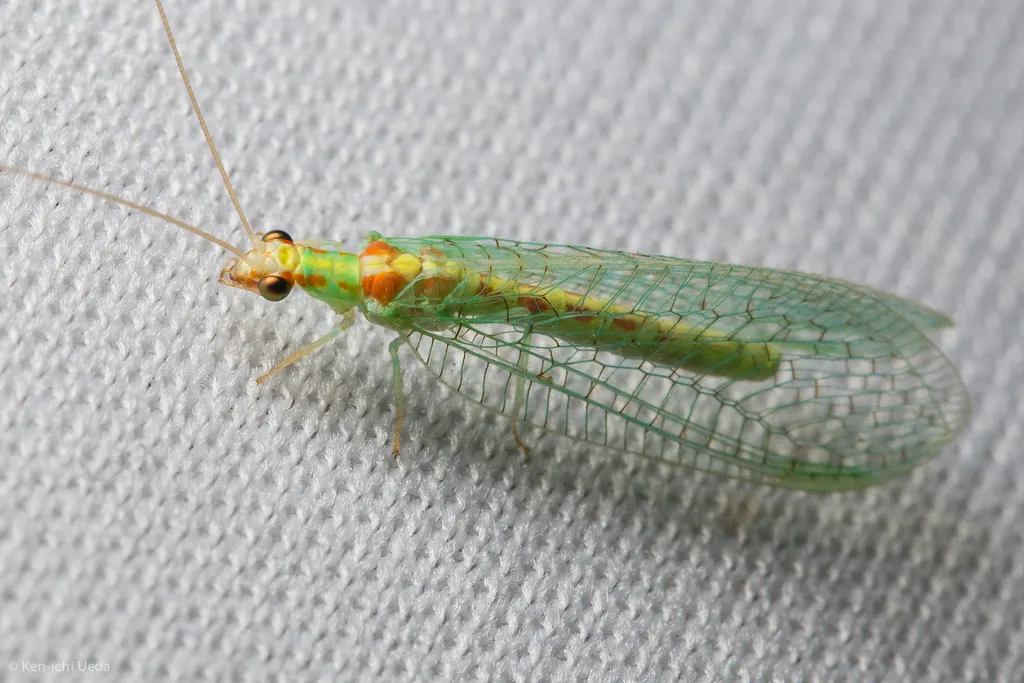
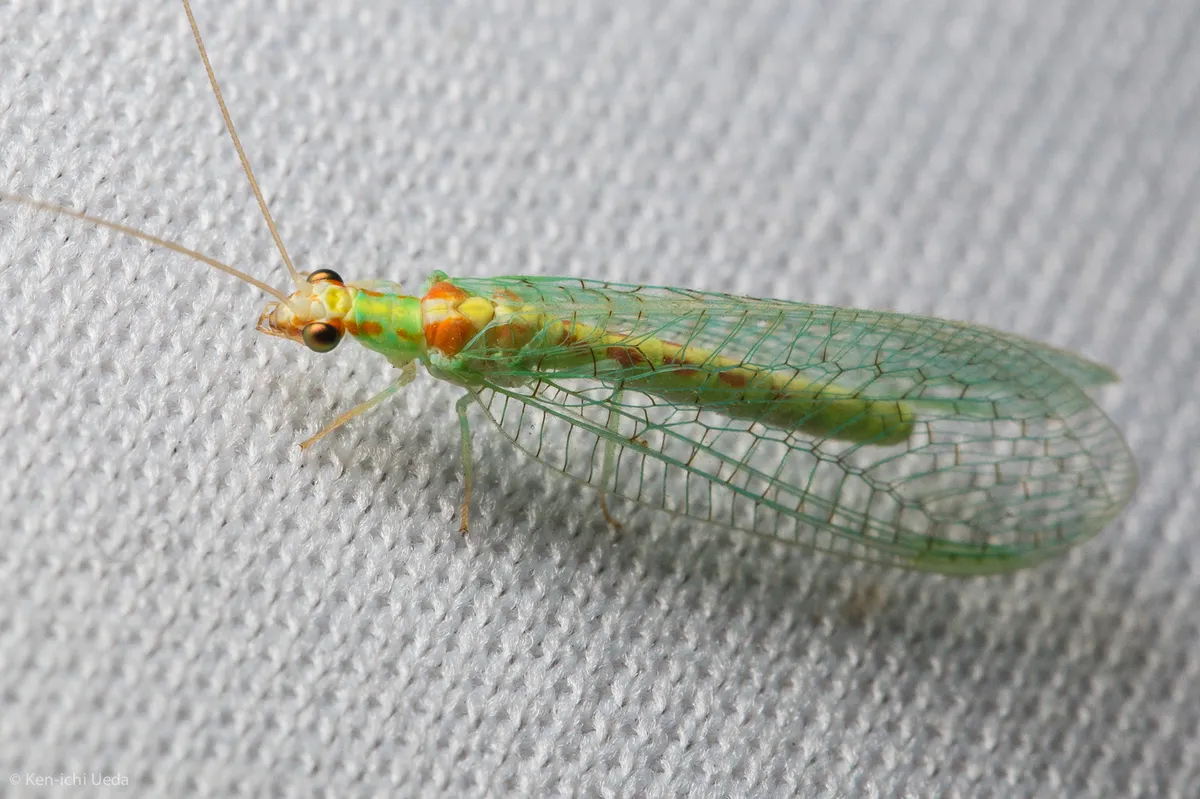
Photo credits: Contributed by Ken Schneider; Additional contributions by v belov , PaleoJon
Frequently Asked Questions About Four-spotted Green Lacewing
What is Four-spotted Green Lacewing?
Four-spotted Green Lacewing (Chrysopa quadripunctata) is a species in the family Chrysopidae, within the order Neuroptera.
How big is Four-spotted Green Lacewing?
12 - 16 mm
How do you identify Four-spotted Green Lacewing?
Adults The head is pale with a yellowish-green occiput and reddish stripe following the genae. The antennae are entirely pale. The body is green with a yellowish median stripe. Bordering this stripe are paired orange-to-reddish spots on either side (variable): often two pairs on the pronotum, two pairs on the mesothorax, and about four pairs on the abdomen. The costal cells above the origin of the radial sector at most 2x as long as wide, which separate it from the similarly marked C. slossonae . Larvae The head capsule bears four marks. The inner two are roughly V-shaped (without joining), and the outer two extend from the antennae and curve inward to the prothorax. The body is primarily pale with brownish markings (loosely forming 3 stripes along the thorax, these margined laterally by a series of spots on the abdomen), and all of the lateral tubercles are gray.
Where is Four-spotted Green Lacewing found?
| Feature | Details |
|---|---|
| Habitat | Larvae are arboreal on the likes of maples, oaks, and shrubs. |
| Range | e. NA west to SK-KS-TX; BC ( 4 ) ( 5 ) (Canada: BC, MB, NS, ON, PE, QC, SK; United States: CA, DC, IL, IN, KS, MD, MN, MO, NC, NJ, NY, PA, SC, TN, TX, VA, WI) |
What does Four-spotted Green Lacewing eat?
The diet of the Four-spotted Green Lacewing includes Larvae are generalist predators on aphid (and other arthropods). ( 3 ).
What is the life cycle of a Four-spotted Green Lacewing?
Eggs are laid singly, often on trees. The larvae don't carry a full debris packet but frequently have smaller bits of debris.