
Praeclara Underwing - Hodges#8865
Catocala praeclara
This record describes Catocala praeclara (species). Recorded family: Erebidae. Recorded order: Lepidoptera.
Identification and Appearance
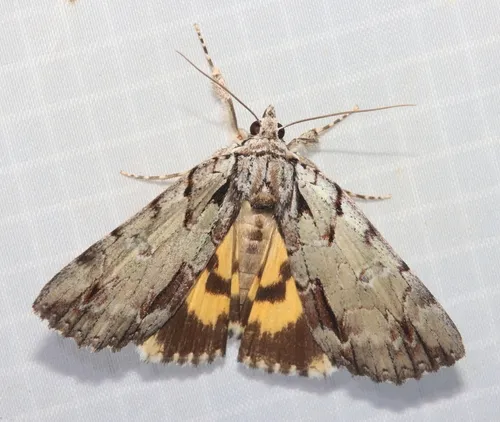
A medium-size moth with dull greenish or purple grey forewings. The antemedial line is black and distinct, the other cross-lines less so, mainly indicated by dark marks at the costa. The basal dash is indistinct or absent. A short dark dash in the outer fold, with some dark red-brown scaling adjacent. The hindwings are bright yellow-orange, with a median black band that forms a long loop with the basal streak. A wider black terminal band, divided or nearly so in the anal area, forming a dark, anal spot. The antennae are simple and both the sexes are alike. It can only be mistaken with Catocala blandula , which has much more mottled grey, black and whitish forewings. Canadian populations, which are darker and duller than more southern ones, were previously treated as a separate species, Catocala manitoba (Beut). ( 7 )
Classification
- Kingdom
- Animalia
- Phylum
- Arthropoda
- Class
- Insecta
- Order
- Lepidoptera (Butterflies and Moths)
- Superfamily
- Noctuoidea
- Family
- Erebidae
- Subfamily
- Erebinae
- Tribe
- Catocalini
- Genus
- Catocala (Underwings)
Imported taxonomy record. Source availability varies; see the source references and editorial policy below.
Habitat and Range
Habitat
Dry shrub stands in the valleys of the grassland region. ( 7 )
Geographic Range
Primarily eastern, from Nova Scotia west to southeastern Alberta, south to Florida and Kansas. ( 7 ) Lectotype female: New York. ( 8 )
Seasonal Activity
Adults fly August and September.
Diet and Behavior
Diet: E.H. Strickland Museum lists chokeberry ( Aronia Rosaceae) and plum ( Prunus Rosaceae) ( 7 ) , HOSTS lists only leadplant ( Amorpha canescens Fabaceae) ( 9 ) , Bill Oehlke lists chokeberry and juneberry. ( 10 )
Life History
Adults are nocturnal and come to light and probably sugar baits (no data). Larvae are solitary defoliators and the egg is the overwintering stage. There is a single annual brood. ( 7 )
Additional species information
Species notes from the sources
Etymology: Specific epithet from Latin meaning "very bright," for the "anterior wings lustrous, evenly and nearly entirely covered with pale cinereous and greenish scales which have a bright reflection."
About Butterflies and Moths: the wider group
Order-level background for Lepidoptera, the group containing Catocala praeclara. Species-specific details appear above.
Group overview
Lepidoptera includes approximately 180,000 described species of butterflies and moths. Moths outnumber butterflies roughly 10:1. The monarch butterfly's eastern population has declined by more than 80% since the mid-1990s, and the western population by over 95% since the 1980s. The IUCN lists the migratory monarch as Vulnerable.
Ecological role of the group
Butterflies and moths are essential indicators of ecosystem health. As caterpillars, they are a primary food source for birds - a single nest of blue tit chicks requires ~10,000 caterpillars. Adult moths pollinate many night-blooming plants.
Economic and practical significance of the group
Lepidoptera are critical pollinators. In Europe, grassland butterfly species have declined by almost 50% since the early 1990s. In the UK, three-quarters of butterflies are in decline. In the U.S., five butterfly species have gone extinct since 1950, with 29 listed as endangered.
Recorded sources for this group: IUCN Red List, Xerces Society, USFWS, PNAS, WWF. Imported estimates may describe particular regions or reporting periods.
Photos of Praeclara Underwing - Hodges#8865 (2)
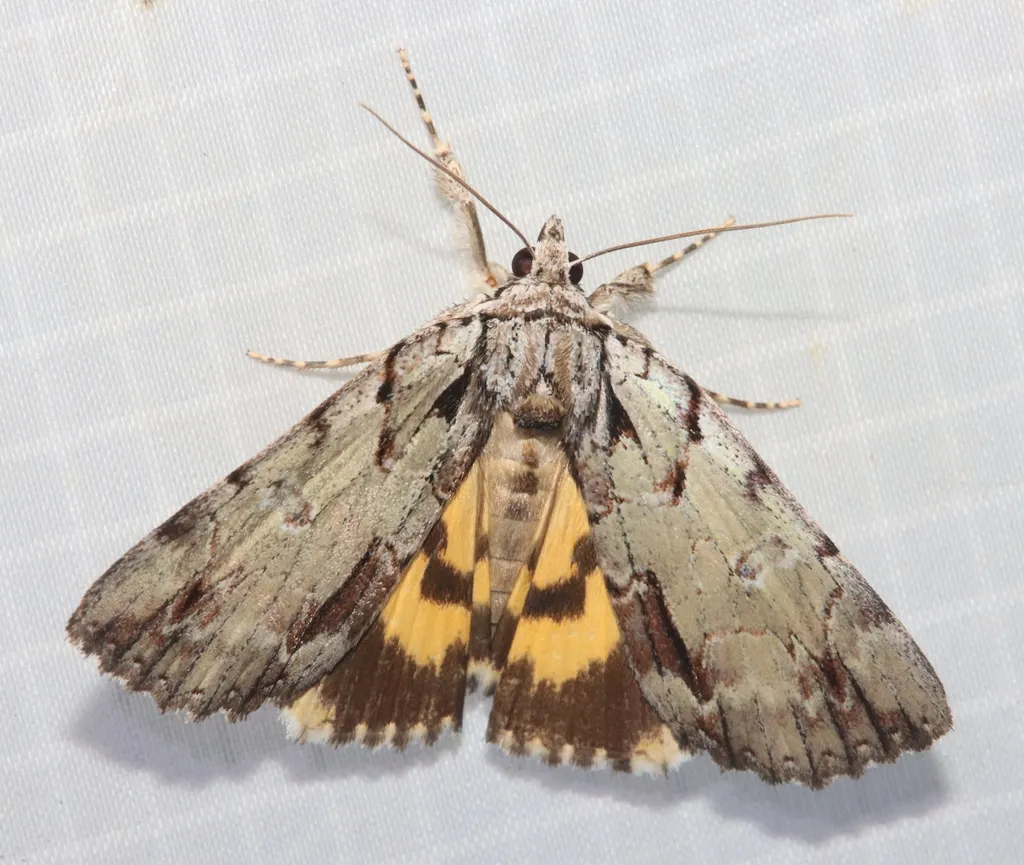
Photo credits: Contributed by Chuck Entz; Additional contributions by Jason D. Roberts , marcie oconnor , Randy Hardy
Frequently Asked Questions About Praeclara Underwing - Hodges#8865
What is Praeclara Underwing - Hodges#8865?
Praeclara Underwing - Hodges#8865 (Catocala praeclara) is a species in the family Erebidae, within the order Lepidoptera.
How big is Praeclara Underwing - Hodges#8865?
Wingspan 3.8-5.0 cm. ( 7 )
How do you identify Praeclara Underwing - Hodges#8865?
A medium-size moth with dull greenish or purple grey forewings. The antemedial line is black and distinct, the other cross-lines less so, mainly indicated by dark marks at the costa. The basal dash is indistinct or absent. A short dark dash in the outer fold, with some dark red-brown scaling adjacent. The hindwings are bright yellow-orange, with a median black band that forms a long loop with the basal streak. A wider black terminal band, divided or nearly so in the anal area, forming a dark, anal spot. The antennae are simple and both the sexes are alike. It can only be mistaken with Catocala blandula , which has much more mottled grey, black and whitish forewings. Canadian populations, which are darker and duller than more southern ones, were previously treated as a separate species, Catocala manitoba (Beut). ( 7 )
Where is Praeclara Underwing - Hodges#8865 found?
| Feature | Details |
|---|---|
| Habitat | Dry shrub stands in the valleys of the grassland region. ( 7 ) |
| Range | Primarily eastern, from Nova Scotia west to southeastern Alberta, south to Florida and Kansas. ( 7 ) Lectotype |
| Female | New York. ( 8 ) |
What does Praeclara Underwing - Hodges#8865 eat?
The diet of the Praeclara Underwing - Hodges#8865 includes E.H. Strickland Museum lists chokeberry ( Aronia Rosaceae) and plum ( Prunus Rosaceae) ( 7 ) , HOSTS lists only leadplant ( Amorpha canescens Fabaceae) ( 9 ) , Bill Oehlke lists chokeberry and juneberry. ( 10 ).
When is Praeclara Underwing - Hodges#8865 active?
Praeclara Underwing - Hodges#8865: seasonal activity - Adults fly August and September..
What is the life cycle of a Praeclara Underwing - Hodges#8865?
Adults are nocturnal and come to light and probably sugar baits (no data). Larvae are solitary defoliators and the egg is the overwintering stage. There is a single annual brood. ( 7 )