
Girlfriend & Little Lined Underwing
Catocala amica-lineella
This record describes Catocala amica-lineella (species). Recorded family: Erebidae. Recorded order: Lepidoptera.
Identification and Appearance
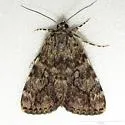
Adult : FW of typical form dark gray to blackish with heavy black lines; pale gray or whitish band across AM area, and small pale patches along PM line; subreniform spot pale and boldy outlined in black; light grayish-brown patch in upper median area next to PM line; reniform spot partially obscured by dark shading in median area; form curvifascia has dark curving band beginning mid-way along costa, curving under reniform spot, and ending at outer margin near apex; hindwing mostly yellowish-orange with large black area at apex, extending part-way along costa and outer margin; small black spot at anal angle Larva : brown twig mimic; usually lies lengthwise on top of twig; black dorsal spot on abdomen two-thirds distance from head; head dark gray to black; top of head with white or orange spot on each side; body gray with several pale faint lines; fifth abdominal segment slightly humped and usually followed by darkened saddle; eighth abdominal segment with two dorsal orange warts [adapted from description by Bill Oehlke] *Update March 2016 : The adults of both species, amica and lineella , are indistinguishable by photo (larva indistinguishable as well, Wagner 361). Traditionally, amica was distinguished by being lighter color overall, with less bold lines, and less blackish shading in the basal and median areas, while lineella was said to be darker overall with bolder lines and more black shading. However , as numerous specimens of both species have been sequenced and identified via DNA analysis, not only have those traditional characteristics been shown unreliable ( > 50% inaccuracy rate), but even the COI sequence data between some individual amica and lineella specimens have been so close as to be statistically identical. (See here for brief discussion on this.)
Classification
- Kingdom
- Animalia
- Phylum
- Arthropoda
- Class
- Insecta
- Order
- Lepidoptera (Butterflies and Moths)
- Superfamily
- Noctuoidea
- Family
- Erebidae
- Subfamily
- Erebinae
- Tribe
- Catocalini
- Genus
- Catocala (Underwings)
Imported taxonomy record. Source availability varies; see the source references and editorial policy below.
Habitat and Range
Habitat
wooded areas with oak trees; adults are nocturnal and come to light
Geographic Range
Ontario and Quebec to Florida, west to Texas, north to Minnesota and North Dakota.
Seasonal Activity
adults fly in June through September
Diet and Behavior
Diet: larvae feed on leaves of oak ( Quercus spp.)
Life History
eggs are deposited on tree bark in the fall and hatch the following spring; larvae ascend the tree to feed on foliage, then descend the trunk and pupate on the ground; adults emerge from pupae at ground level; one generation per year; overwinters as an egg Larva; adult
About Butterflies and Moths: the wider group
Order-level background for Lepidoptera, the group containing Catocala amica-lineella. Species-specific details appear above.
Group overview
Lepidoptera includes approximately 180,000 described species of butterflies and moths. Moths outnumber butterflies roughly 10:1. The monarch butterfly's eastern population has declined by more than 80% since the mid-1990s, and the western population by over 95% since the 1980s. The IUCN lists the migratory monarch as Vulnerable.
Ecological role of the group
Butterflies and moths are essential indicators of ecosystem health. As caterpillars, they are a primary food source for birds - a single nest of blue tit chicks requires ~10,000 caterpillars. Adult moths pollinate many night-blooming plants.
Economic and practical significance of the group
Lepidoptera are critical pollinators. In Europe, grassland butterfly species have declined by almost 50% since the early 1990s. In the UK, three-quarters of butterflies are in decline. In the U.S., five butterfly species have gone extinct since 1950, with 29 listed as endangered.
Recorded sources for this group: IUCN Red List, Xerces Society, USFWS, PNAS, WWF. Imported estimates may describe particular regions or reporting periods.
Photos of Girlfriend & Little Lined Underwing (5)
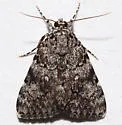
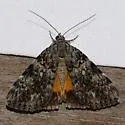
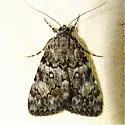
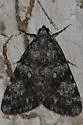
Photo credits: Contributed by Jim McClarin; Additional contributions by Steve Nanz , Robin McLeod , Jason D. Roberts , Robert Lord Zimlich , marcie oconnor , Randy Hardy
Frequently Asked Questions About Girlfriend & Little Lined Underwing
What is Girlfriend & Little Lined Underwing?
Girlfriend & Little Lined Underwing (Catocala amica-lineella) is a species in the family Erebidae, within the order Lepidoptera.
How big is Girlfriend & Little Lined Underwing?
wingspan 35-40 mm
How do you identify Girlfriend & Little Lined Underwing?
Adult : FW of typical form dark gray to blackish with heavy black lines; pale gray or whitish band across AM area, and small pale patches along PM line; subreniform spot pale and boldy outlined in black; light grayish-brown patch in upper median area next to PM line; reniform spot partially obscured by dark shading in median area; form curvifascia has dark curving band beginning mid-way along costa, curving under reniform spot, and ending at outer margin near apex; hindwing mostly yellowish-orange with large black area at apex, extending part-way along costa and outer margin; small black spot at anal angle Larva : brown twig mimic; usually lies lengthwise on top of twig; black dorsal spot on abdomen two-thirds distance from head; head dark gray to black; top of head with white or orange spot on each side; body gray with several pale faint lines; fifth abdominal segment slightly humped and usually followed by darkened saddle; eighth abdominal segment with two dorsal orange warts [adapted from description by Bill Oehlke] *Update March 2016 : The adults of both species, amica and lineella , are indistinguishable by photo (larva indistinguishable as well, Wagner 361). Traditionally, amica was distinguished by being lighter color overall, with less bold lines, and less blackish shading in the basal and median areas, while lineella was said to be darker overall with bolder lines and more black shading. However , as numerous specimens of both species have been sequenced and identified via DNA analysis, not only have those traditional characteristics been shown unreliable ( > 50% inaccuracy rate), but even the COI sequence data between some individual amica and lineella specimens have been so close as to be statistically identical. (See here for brief discussion on this.)
Where is Girlfriend & Little Lined Underwing found?
| Feature | Details |
|---|---|
| Habitat | wooded areas with oak trees; adults are nocturnal and come to light |
| Range | Ontario and Quebec to Florida, west to Texas, north to Minnesota and North Dakota. |
What does Girlfriend & Little Lined Underwing eat?
The diet of the Girlfriend & Little Lined Underwing includes larvae feed on leaves of oak ( Quercus spp.).
When is Girlfriend & Little Lined Underwing active?
Girlfriend & Little Lined Underwing: seasonal activity - adults fly in June through September.
What is the life cycle of a Girlfriend & Little Lined Underwing?
eggs are deposited on tree bark in the fall and hatch the following spring; larvae ascend the tree to feed on foliage, then descend the trunk and pupate on the ground; adults emerge from pupae at ground level; one generation per year; overwinters as an egg Larva; adult