
Camponotus nearcticus
This record describes Camponotus nearcticus (species). Recorded family: Formicidae. Recorded order: Hymenoptera.
Identification and Appearance
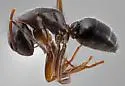
small, mostly black and shiny, very few apparent hairs; there is a form with an orange/red mesosoma. in the NE one of 3 spp. with a distinct notch in the clypeus
Classification
- Kingdom
- Animalia
- Phylum
- Arthropoda
- Class
- Insecta
- Order
- Hymenoptera (Ants, Bees, Wasps and Sawflies)
- Superfamily
- Formicoidea
- Family
- Formicidae (Ants)
- Subfamily
- Formicinae
- Tribe
- Camponotini
- Genus
- Camponotus (Carpenter Ants)
Imported taxonomy record. Source availability varies; see the source references and editorial policy below.
Habitat and Range
Habitat
Occurs virtually anywhere there is standing dead wood to support its preferred nesting habitat, preformed cavities in dead parts of living trees and in galls or in snags. It may be found in the backyard tree or pristine upland or floodplain forest, and is almost or indeed as ubiquitous as C. pennsylvanicus .
Geographic Range
widely dist., though less common across w. N. Amer. - Map , The most common and widely distributed of the smaller carpenter ants.
Seasonal Activity
Sexuals are reared at the end of the growing season, overwinter with the parent colony, then fly in mid-spring of the following year.
Diet and Behavior
Diet: Food habits include feeding on honeydew, extrfloral and gall nectar, sap fluxes, bird and reptile droppings, and occasional insect or spider prey. Like most of our Camponotus , alates of this species are reared in late summer and fall, but do not fly until the following May. ( AntWeb )
Life History
Arboreal. Forages on trees day and night, but more abundantly at night, at least in warm weather.
About Flies: the wider group
Order-level background for Hymenoptera, the group containing Camponotus nearcticus. Species-specific details appear above.
Group overview
Hymenoptera includes over 150,000 described species of ants, bees, wasps, and sawflies. Earth harbors approximately 20 quadrillion (20×10^15) ants, with a combined biomass of ~12 megatons of dry carbon - exceeding the combined biomass of all wild birds and mammals (PNAS, 2022).
Ecological role of the group
About 35% of the world's food crops depend on animal pollinators. The chocolate industry, valued at over $100 billion, depends on pollinating flies and midges. Ants are the dominant soil engineers in most terrestrial ecosystems, turning more soil than earthworms in many habitats.
Economic and practical significance of the group
Pollinators contribute $235-577 billion worth of annual global food production (FAO). In the U.S., bee pollination alone benefits crops valued at $18 billion annually, and honey bees are responsible for $5.4 billion in agricultural productivity. Between April 2023-2024, 55.1% of managed honey bee colonies were lost. The U.S. bee population dropped from 5 million to 2.5 million.
Recorded sources for this group: FAO, USDA, EPA, PNAS (2022), US Fish & Wildlife Service. Imported estimates may describe particular regions or reporting periods.
Photos of Camponotus nearcticus (5)
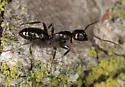
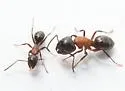
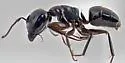
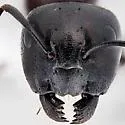
Photo credits: Contributed by tom murray; Additional contributions by Tony-2 , Mike Quinn , James C. Trager , metrioptera , Oliver.Yung
Frequently Asked Questions About Camponotus nearcticus
What is Camponotus nearcticus?
Camponotus nearcticus is a species in the family Formicidae, within the order Hymenoptera.
How do you identify Camponotus nearcticus?
small, mostly black and shiny, very few apparent hairs; there is a form with an orange/red mesosoma. in the NE one of 3 spp. with a distinct notch in the clypeus
Where is Camponotus nearcticus found?
| Feature | Details |
|---|---|
| Habitat | Occurs virtually anywhere there is standing dead wood to support its preferred nesting habitat, preformed cavities in dead parts of living trees and in galls or in snags. It may be found in the backyard tree or pristine upland or floodplain forest, and is almost or indeed as ubiquitous as C. pennsylvanicus . |
| Range | widely dist., though less common across w. N. Amer. - Map , The most common and widely distributed of the smaller carpenter ants. |
What does Camponotus nearcticus eat?
The diet of the Camponotus nearcticus includes Food habits include feeding on honeydew, extrfloral and gall nectar, sap fluxes, bird and reptile droppings, and occasional insect or spider prey. Like most of our Camponotus , alates of this species are reared in late summer and fall, but do not fly until the following May. ( AntWeb ).
When is Camponotus nearcticus active?
Camponotus nearcticus: seasonal activity - Sexuals are reared at the end of the growing season, overwinter with the parent colony, then fly in mid-spring of the following year..
What is the life cycle of a Camponotus nearcticus?
Arboreal. Forages on trees day and night, but more abundantly at night, at least in warm weather.