
Common Cactus Dodger
Cacama valvata
This record describes Cacama valvata (species). Recorded family: Cicadidae. Recorded order: Hemiptera.
Identification and Appearance
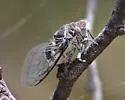
A common and widespread species TL - ? Similar by most accounts to C. moorei with which it may be sympatric across parts of Arizona. Similar to several other species incl. C. dissimilis (MEXICO) & C. furcata (MEXICO) Described as a dark species Wings: the basal area of the forewings darkened and opaque anteriorly and slightly translucent posteriorly; anal membranes of all 4 wings greyish with an occasional pale ochreous-orangish tinge; 1st and 2nd transverse crossveins lightly infuscated (just as seen in dissimilis found to the south in AZ and Sonora Mex.). C. valvata is described as having a greyish straw-colored venter + dark wing bases. First cell at base of wing dark anteriorly then blending to an ochreous-tan. Basal wing veins may be tan or straw-colored (not variegated with orange). Pronotum dark. vs. C. moorei Similar to valvata, however, the opercula and venter is characterized by a distinctive orange coloration. The head & pronotum may also bear slight ochreaous patterns. For more details regarding the Genus Cacama, please refer to the following link (for details on valvata, see pp. 69-72) Note: Some of the images from Arizona placed under Cacama valvata are possibly Cacama moorei . Given locality & distribution (esp. with regards to AZ) coupled with an inability to review the ventral aspect of some images, cicadas placed under this taxon may be misidentified (C. valvata vs. C. moorei). For comparison and details, please REFER to the following: Cacama moorei sw. USA (ARIZONA) & MEXICO Cacama moorei sp. n. Sanborn & M. Heath
Classification
- Kingdom
- Animalia
- Phylum
- Arthropoda
- Class
- Insecta
- Order
- Hemiptera (True Bugs, Cicadas, Hoppers, Aphids and Allies)
- Suborder
- Auchenorrhyncha
- Superfamily
- Cicadoidea
- Family
- Cicadidae (Cicadas)
- Subfamily
- Cicadinae
- Tribe
- Tacuini
- Genus
- Cacama (Cactus Dodgers)
Imported taxonomy record. Source availability varies; see the source references and editorial policy below.
Habitat and Range
Habitat
Arid scrub
Geographic Range
sw. USA & adj. Mexico w. TX, OK, s. CO, NM, AZ
Seasonal Activity
May-July
About True Bugs, Cicadas, Hoppers, Aphids and Allies: the wider group
Order-level background for Hemiptera, the group containing Cacama valvata. Species-specific details appear above.
Group overview
Hemiptera (true bugs) includes over 80,000 described species across cicadas, aphids, leafhoppers, shield bugs, and bed bugs. Aphids alone cost global agriculture an estimated $2.5 billion annually in crop losses.
Ecological role of the group
Many Hemiptera are essential food sources for birds and predatory insects. Cicadas provide massive nutrient pulses during emergence events - a single Brood X emergence can involve trillions of individuals across 15 states.
Economic and practical significance of the group
The brown marmorated stink bug (Halyomorpha halys) caused $37 million in apple crop losses in a single year in the U.S. Mid-Atlantic region. Bed bug infestations in the U.S. increased by 500% between 2001-2010, costing the hotel industry hundreds of millions annually.
Recorded sources for this group: USDA, EPA, University research. Imported estimates may describe particular regions or reporting periods.
Photos of Common Cactus Dodger (5)
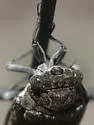
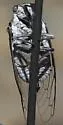
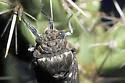
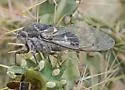
Photo credits: Contributed by john and jane balaban; Additional contributions by David Ferguson , Bill Reynolds
Frequently Asked Questions About Common Cactus Dodger
What is Common Cactus Dodger?
Common Cactus Dodger (Cacama valvata) is a species in the family Cicadidae, within the order Hemiptera.
How do you identify Common Cactus Dodger?
A common and widespread species TL - ? Similar by most accounts to C. moorei with which it may be sympatric across parts of Arizona. Similar to several other species incl. C. dissimilis (MEXICO) & C. furcata (MEXICO) Described as a dark species Wings: the basal area of the forewings darkened and opaque anteriorly and slightly translucent posteriorly; anal membranes of all 4 wings greyish with an occasional pale ochreous-orangish tinge; 1st and 2nd transverse crossveins lightly infuscated (just as seen in dissimilis found to the south in AZ and Sonora Mex.). C. valvata is described as having a greyish straw-colored venter + dark wing bases. First cell at base of wing dark anteriorly then blending to an ochreous-tan. Basal wing veins may be tan or straw-colored (not variegated with orange). Pronotum dark. vs. C. moorei Similar to valvata, however, the opercula and venter is characterized by a distinctive orange coloration. The head & pronotum may also bear slight ochreaous patterns. For more details regarding the Genus Cacama, please refer to the following link (for details on valvata, see pp. 69-72)
Where is Common Cactus Dodger found?
| Feature | Details |
|---|---|
| Habitat | Arid scrub |
| Range | sw. USA & adj. Mexico w. TX, OK, s. CO, NM, AZ |
When is Common Cactus Dodger active?
Common Cactus Dodger: seasonal activity - May-July.