
Aporinellus taeniolatus
This record describes Aporinellus taeniolatus (species). Recorded family: Pompilidae. Recorded order: Hymenoptera.
Identification and Appearance
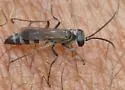
In all the currently existing keys, two principal characters are cited for separating taeniolatus from all other species in the genus: 1) The 2nd submarginal cell is relatively small...less than twice as wide as high (cf. Fig. 245 here from ). 2) The distal-most tarsal segments have a few minute spines on the underside (cf. Fig. 255 here from ) This character will not likely be visible in most BugGuide posts! As might be expected from the large number of synonyms, Wasbauer & Kimsey state that: Aporinellus taeniolatus is a highly variable species, in both the color and extent of the patterns of appressed pubescence and also in integumental color. Females vary from entirely black to extensively banded with whitish or silvery pubescence, and the integumental color may be entirely black or partly to entirely red. Males are always black and are conspicuously banded. And Evans adds that: ...in some specimens the pubescence is almost entirely brownish. Evan's detailed 1951 description of A. taeniolatus taeniolatus can be read starting on pg. 282 here . He described further varieties (which may, or may not, be currently recognized by various workers) on the pages that follow (pp. 284-288).
Classification
- Kingdom
- Animalia
- Phylum
- Arthropoda
- Class
- Insecta
- Order
- Hymenoptera (Ants, Bees, Wasps and Sawflies)
- Superfamily
- Pompiloidea
- Family
- Pompilidae (Spider Wasps)
- Subfamily
- Pompilinae
- Tribe
- Pompilini
- Genus
- Aporinellus
Imported taxonomy record. Source availability varies; see the source references and editorial policy below.
Habitat and Range
Geographic Range
Transcontinental U.S. and British Columbia to southern Costa Rica
Diet and Behavior
Diet: From Wasbauer & Kimsey: "Evans stated that adults of this species visit honeydew occasionally. We have taken both sexes at honeydew of Chaitophorus populicola on Populus trichocarpa in Mono County and females at honeydew from galls of Disholcaspis eldoradensis on Quercus lobata in Riverside County. Females have also been taken at extrafloral nectaries on the stems of Gossypium hirsutum and are known to visit flowers of the following: Eriogonum spp., Euphorbia sp., Melilotus albus and Prosopis juliflora . Males have been collected on flowers of Calochortus luteus, Euphorbia albomarginata and E. serpyllifolia . Both sexes have been taken at flowers of Atriplex semibaccata, Foeniculum vulgare and Karwinskia Humboldtiana ." "Kurczewski and Kurczewski provide the following prey records: Pellenes agilis (Banks), immature; P. borealis (Banks), immature; and P. viridipes (Hentz) (Salticidae). Another salticid, Habronattus calcaratus (Banks), is reported as prey by Evans."
Life History
From Wasbauer & Kimsey: "Kurczewski and Kurczewski describe the burrow of taeniolatus as constructed in sand at about a 50° angle to the surface, 3 mm in diameter and 5.5 an long, terminating in an oval cell.
Additional species information
Species notes from the sources
Etymology: Quoting from Kurczewski & Kurczewski (1987: p. 83): "The correct name for Aporinellus taeniatus Kohl is Aporinellus taeniolatus (Dalla Torre). A. taeniatus was renamed while in homonymy and the name stands even though homonymy no longer exists. A. taeniatus was a junior homonym while in Pompilus . (A. S. Menke, pers. comm., 1980)."
About Flies: the wider group
Order-level background for Hymenoptera, the group containing Aporinellus taeniolatus. Species-specific details appear above.
Group overview
Hymenoptera includes over 150,000 described species of ants, bees, wasps, and sawflies. Earth harbors approximately 20 quadrillion (20×10^15) ants, with a combined biomass of ~12 megatons of dry carbon - exceeding the combined biomass of all wild birds and mammals (PNAS, 2022).
Ecological role of the group
About 35% of the world's food crops depend on animal pollinators. The chocolate industry, valued at over $100 billion, depends on pollinating flies and midges. Ants are the dominant soil engineers in most terrestrial ecosystems, turning more soil than earthworms in many habitats.
Economic and practical significance of the group
Pollinators contribute $235-577 billion worth of annual global food production (FAO). In the U.S., bee pollination alone benefits crops valued at $18 billion annually, and honey bees are responsible for $5.4 billion in agricultural productivity. Between April 2023-2024, 55.1% of managed honey bee colonies were lost. The U.S. bee population dropped from 5 million to 2.5 million.
Recorded sources for this group: FAO, USDA, EPA, PNAS (2022), US Fish & Wildlife Service. Imported estimates may describe particular regions or reporting periods.
Photos of Aporinellus taeniolatus (5)
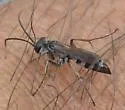
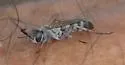
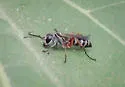
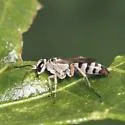
Photo credits: Contributed by Nick Fensler; Additional contributions by Matthias Buck , Aaron Schusteff
Frequently Asked Questions About Aporinellus taeniolatus
What is Aporinellus taeniolatus?
Aporinellus taeniolatus is a species in the family Pompilidae, within the order Hymenoptera.
How do you identify Aporinellus taeniolatus?
In all the currently existing keys, two principal characters are cited for separating taeniolatus from all other species in the genus: 1) The 2nd submarginal cell is relatively small...less than twice as wide as high (cf. Fig. 245 here from ). 2) The distal-most tarsal segments have a few minute spines on the underside (cf. Fig. 255 here from ) This character will not likely be visible in most BugGuide posts! As might be expected from the large number of synonyms, Wasbauer & Kimsey state that: Aporinellus taeniolatus is a highly variable species, in both the color and extent of the patterns of appressed pubescence and also in integumental color. Females vary from entirely black to extensively banded with whitish or silvery pubescence, and the integumental color may be entirely black or partly to entirely red. Males are always black and are conspicuously banded. And Evans adds that: ...in some specimens the pubescence is almost entirely brownish. Evan's detailed 1951 description of A. taeniolatus taeniolatus can be read starting on pg. 282 here . He described further varieties (which may, or may not, be currently recognized by various workers) on the pages that follow (pp. 284-288).
Where is Aporinellus taeniolatus found?
Range: Transcontinental U.S. and British Columbia to southern Costa Rica
What does Aporinellus taeniolatus eat?
The diet of the Aporinellus taeniolatus includes From Wasbauer & Kimsey: Evans stated that adults of this species visit honeydew occasionally. We have taken both sexes at honeydew of Chaitophorus populicola on Populus trichocarpa in Mono County and females at honeydew from galls of Disholcaspis eldoradensis on Quercus lobata in Riverside County. Females have also been taken at extrafloral nectaries on the stems of Gossypium hirsutum and are known to visit flowers of the following: Eriogonum spp., Euphorbia sp., Melilotus albus and Prosopis juliflora . Males have been collected on flowers of Calochortus luteus, Euphorbia albomarginata and E. serpyllifolia . Both sexes have been taken at flowers of Atriplex semibaccata, Foeniculum vulgare and Karwinskia Humboldtiana . Kurczewski and Kurczewski provide the following prey records: Pellenes agilis (Banks), immature; P. borealis (Banks), immature; and P. viridipes (Hentz) (Salticidae). Another salticid, Habronattus calcaratus (Banks), is reported as prey by Evans..
What is the life cycle of a Aporinellus taeniolatus?
From Wasbauer & Kimsey: Kurczewski and Kurczewski describe the burrow of taeniolatus as constructed in sand at about a 50° angle to the surface, 3 mm in diameter and 5.5 an long, terminating in an oval cell.