
Zebra Mussel
Dreissena polymorpha
This record describes Dreissena polymorpha (species). Recorded family: Dreissenidae. Recorded order: Veneroida.
Identification and Appearance
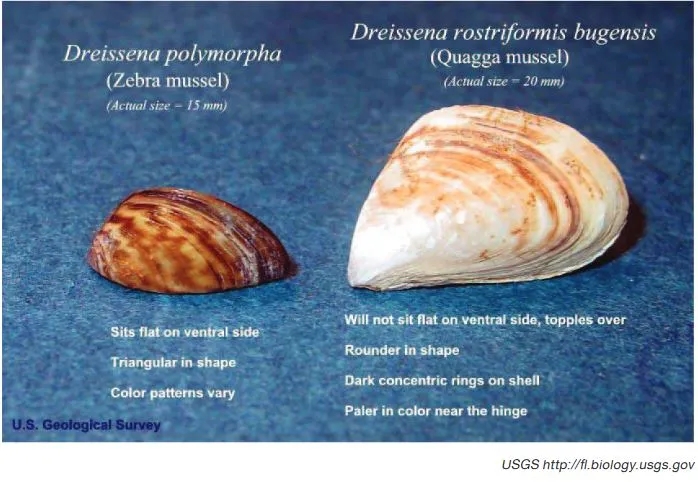
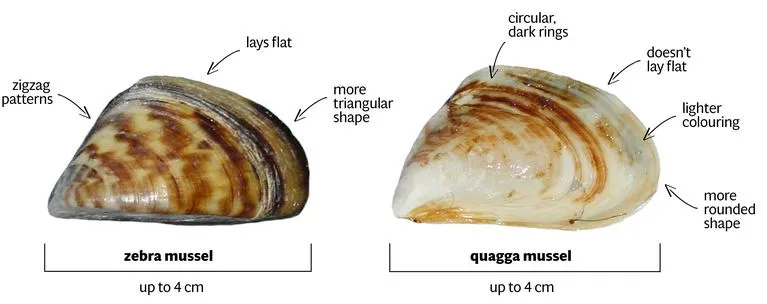
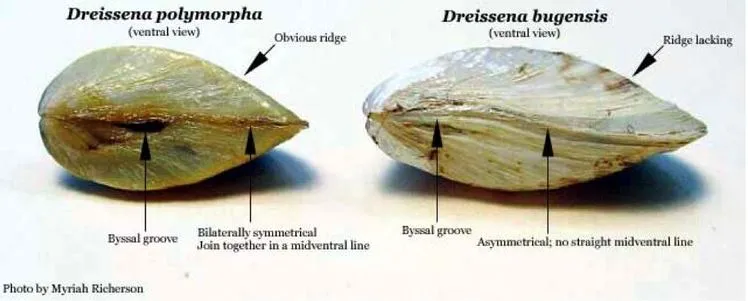
Adults are up to 3 to 4 cm in length with a typical mussel shape. The shell is yellow with darker bands or zig-zags. It is highly variable, as suggested by its latin name, and some specimens lack the stripes and can be all white or all brown/black. The most likely confusion is with the closely related Quagga Mussel Dreissena rostriformis bugensis which has now been found in our area. Though Quaggas grow to a larger size, young colonies generally comprise smaller mussels so this isn't a reliable guide. The easiest way to tell them apart is that the two shells of the Zebra Mussel join in a flat plane (ie. the shell is bilaterally symmetrical). A single shell should therefore lie flat on the ground. Quagga Mussels however are not symmetrical and the two shells fit together with a sinuous join and a single shell will wobble on a flat surface. The two also have a differently shaped outline. Zebra Mussels are roughly triangular with a prominent ridge whereas Quagga Mussels are more rounded, broadly 'D' shaped and lack the ridge. See Identification Aids for more details. Images should be submitted with your record showing the key ID features, otherwise include a comment explaining how you identified the species. Lakes, canals. reservoirs and slow rivers. It attaches itself to solid surfaces such as walls, stones and other mussels. It can colonise soft sediments if dead mussel shells provide sufficient substrate for it to attach to. Larvae are sensitive to UV light so it is not normally found below 1m in depth where it can form huge colonies. This is a non-native pest species that arrived in Britain in the 1820's. Since 1999 there has been a dramatic increase in its abundance and it can be a problem in water treatment or extraction facilities, such as at Rutland Water. Widespread in England, but less common elsewhere in Britain.
Identification notes
Aids for more details.
Classification
- Kingdom
- Animalia
- Phylum
- Arthropoda
- Order
- Veneroida
- Family
- Dreissenidae
- Genus
- Dreissena
Imported taxonomy record. Source availability varies; see the source references and editorial policy below.
Habitat and Range
Habitat
Lakes, canals. reservoirs and slow rivers. It attaches itself to solid surfaces such as walls, stones and other mussels. It can colonise soft sediments if dead mussel shells provide sufficient substrate for it to attach to. Larvae are sensitive to UV light so it is not normally found below 1m in depth where it can form huge colonies.
Seasonal Activity
All year round
Diet and Behavior
Life History
This is a non-native pest species that arrived in Britain in the 1820's. Since 1999 there has been a dramatic increase in its abundance and it can be a problem in water treatment or extraction facilities, such as at Rutland Water.
Additional species information
Recorded status
Widespread in England, but less common elsewhere in Britain.
About Veneroida: the wider group
Order-level background for Veneroida, the group containing Dreissena polymorpha. Species-specific details appear above.
Group overview
This is a smaller arthropod order with specialized ecological roles. Arthropods are the most diverse animal phylum, comprising over 80% of all known animal species with approximately 1.2 million described species globally.
Ecological role of the group
Members of this order contribute to broader arthropod ecosystem functions including decomposition, predation, and serving as food sources for vertebrates. Arthropod biodiversity is essential for ecosystem resilience.
Economic and practical significance of the group
While this order has limited direct economic impact, arthropods collectively provide ecosystem services worth trillions of dollars annually through pollination, decomposition, pest control, and nutrient cycling.
Recorded sources for this group: General entomology and arthropod research. Imported estimates may describe particular regions or reporting periods.
Photos of Zebra Mussel (3)
Frequently Asked Questions About Zebra Mussel
What is Zebra Mussel?
Zebra Mussel (Dreissena polymorpha) is a species in the family Dreissenidae, within the order Veneroida.
How big is Zebra Mussel?
with a typical mussel shape. The shell is yellow with darker bands or zig-zags. It is highly variable, as suggested by its latin name, and some specimens lack the stripes and can be all white or all brown/black.
How do you identify Zebra Mussel?
Aids for more details.
Where is Zebra Mussel found?
Habitat: Lakes, canals. reservoirs and slow rivers. It attaches itself to solid surfaces such as walls, stones and other mussels. It can colonise soft sediments if dead mussel shells provide sufficient substrate for it to attach to. Larvae are sensitive to UV light so it is not normally found below 1m in depth where it can form huge colonies.
When is Zebra Mussel active?
Zebra Mussel: seasonal activity - All year round.
What is the life cycle of a Zebra Mussel?
This is a non-native pest species that arrived in Britain in the 1820's. Since 1999 there has been a dramatic increase in its abundance and it can be a problem in water treatment or extraction facilities, such as at Rutland Water.