
Xestia tecta - Hodges#10936
Xestia tecta
This record describes Xestia tecta (species). Recorded family: Noctuidae. Recorded order: Lepidoptera.
Identification and Appearance
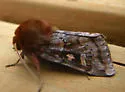
Adult : FW ground color is rich red-brown, strikingly patterned with light gray and ochre scales, producing lighter areas that appear to be multicolored ● The median area appears darker and redder than the rest of the wing ● Transverse lines are dark red-brown to gray-brown ● AM is relatively smooth and straight ● PM is strongly dentate with the tips of the teeth accentuated with dots in many individuals ● Subterminal line is smooth and pale ● The three spots are similar to the lines on the outside and have an inner ochre line and filling of ochre scales ● Orbicular spot is variable, sometimes small and round but more often elongate and irregular ● Reniform spot is relatively narrow and upright ● Claviform spot is small but usually evident due to lighter filling ● HW is medium red-brown with a heavy suffusion of smoky gray scales, with rosy-pink fringe ● Head and thorax are covered in red-brown hair-like scales ● male antenna is strongly biserrate. a Larva : smooth, mottled reddish brown with a broad white lateral band. a
Classification
- Kingdom
- Animalia
- Phylum
- Arthropoda
- Class
- Insecta
- Order
- Lepidoptera (Butterflies and Moths)
- Superfamily
- Noctuoidea
- Family
- Noctuidae (Owlet Moths)
- Subfamily
- Noctuinae
- Tribe
- Noctuini
- Genus
- Xestia
Imported taxonomy record. Source availability varies; see the source references and editorial policy below.
Habitat and Range
Habitat
Widely distributed on wet arctic shrub tundra across the northern regions of both Eurasia and North America, extending southward to sub-alpine forests at high elevations in the Rocky Mountain region. a
Geographic Range
Limited to northern British Columbia in our region. It has been found at Pink Mountain but likely occurs on other mountains since it is known from adjacent southwestern Yukon Territory. a
Seasonal Activity
Flies near timberline in the mountains of northern British Columbia during the summer a
Diet and Behavior
Diet: Larva : feeds on hardwood shrubs such as huckleberries ( Vaccinium spp. ) in the Ericaceae and dwarf birch ( Betula nana ) in the Betulaceae. a
About Butterflies and Moths: the wider group
Order-level background for Lepidoptera, the group containing Xestia tecta. Species-specific details appear above.
Group overview
Lepidoptera includes approximately 180,000 described species of butterflies and moths. Moths outnumber butterflies roughly 10:1. The monarch butterfly's eastern population has declined by more than 80% since the mid-1990s, and the western population by over 95% since the 1980s. The IUCN lists the migratory monarch as Vulnerable.
Ecological role of the group
Butterflies and moths are essential indicators of ecosystem health. As caterpillars, they are a primary food source for birds - a single nest of blue tit chicks requires ~10,000 caterpillars. Adult moths pollinate many night-blooming plants.
Economic and practical significance of the group
Lepidoptera are critical pollinators. In Europe, grassland butterfly species have declined by almost 50% since the early 1990s. In the UK, three-quarters of butterflies are in decline. In the U.S., five butterfly species have gone extinct since 1950, with 29 listed as endangered.
Recorded sources for this group: IUCN Red List, Xerces Society, USFWS, PNAS, WWF. Imported estimates may describe particular regions or reporting periods.
Photos of Xestia tecta - Hodges#10936 (3)
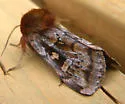
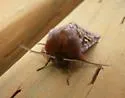
Photo credits: Contributed by Robert Lord Zimlich
Frequently Asked Questions About Xestia tecta - Hodges#10936
What is Xestia tecta - Hodges#10936?
Xestia tecta - Hodges#10936 (Xestia tecta) is a species in the family Noctuidae, within the order Lepidoptera.
How big is Xestia tecta - Hodges#10936?
FWL ≈ 16-18mm
How do you identify Xestia tecta - Hodges#10936?
Adult : FW ground color is rich red-brown, strikingly patterned with light gray and ochre scales, producing lighter areas that appear to be multicolored ● The median area appears darker and redder than the rest of the wing ● Transverse lines are dark red-brown to gray-brown ● AM is relatively smooth and straight ● PM is strongly dentate with the tips of the teeth accentuated with dots in many individuals ● Subterminal line is smooth and pale ● The three spots are similar to the lines on the outside and have an inner ochre line and filling of ochre scales ● Orbicular spot is variable, sometimes small and round but more often elongate and irregular ● Reniform spot is relatively narrow and upright ● Claviform spot is small but usually evident due to lighter filling ● HW is medium red-brown with a heavy suffusion of smoky gray scales, with rosy-pink fringe ● Head and thorax are covered in red-brown hair-like scales ● male antenna is strongly biserrate. a Larva : smooth, mottled reddish brown with a broad white lateral band. a
Where is Xestia tecta - Hodges#10936 found?
| Feature | Details |
|---|---|
| Habitat | Widely distributed on wet arctic shrub tundra across the northern regions of both Eurasia and North America, extending southward to sub-alpine forests at high elevations in the Rocky Mountain region. a |
| Range | Limited to northern British Columbia in our region. It has been found at Pink Mountain but likely occurs on other mountains since it is known from adjacent southwestern Yukon Territory. a |
What does Xestia tecta - Hodges#10936 eat?
The diet of the Xestia tecta - Hodges#10936 includes Larva : feeds on hardwood shrubs such as huckleberries ( Vaccinium spp. ) in the Ericaceae and dwarf birch ( Betula nana ) in the Betulaceae. a.
When is Xestia tecta - Hodges#10936 active?
Xestia tecta - Hodges#10936: seasonal activity - Flies near timberline in the mountains of northern British Columbia during the summer a.