
Xanthogramma pedissequum sensu stricto
This record describes Xanthogramma pedissequum sensu stricto (species). Recorded family: Syrphidae. Recorded order: Diptera.
Identification and Appearance
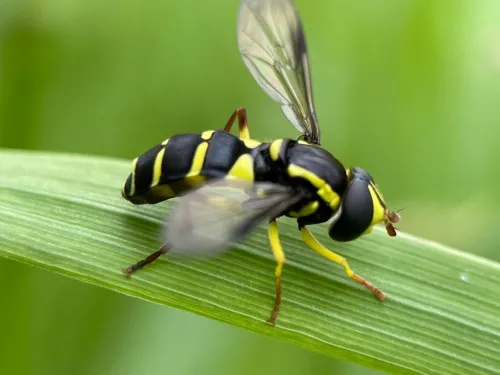
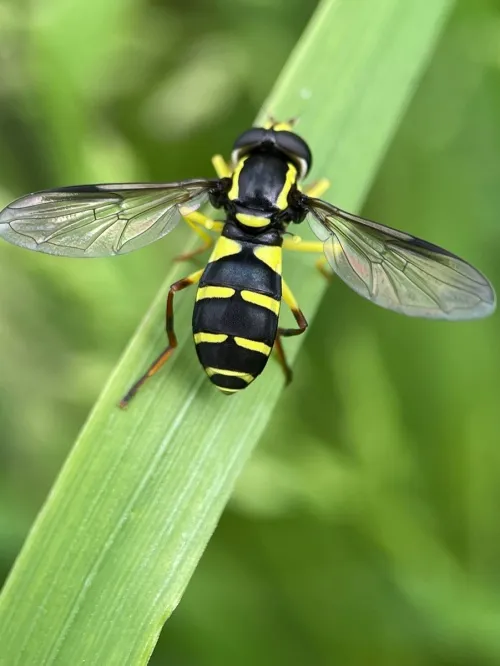
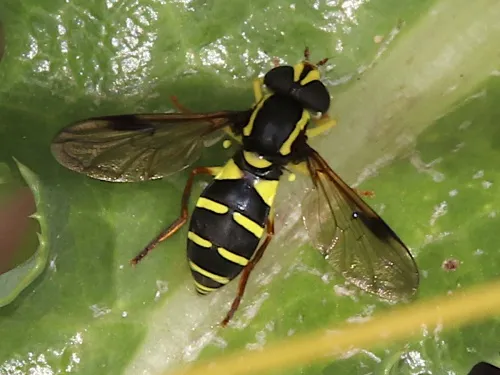
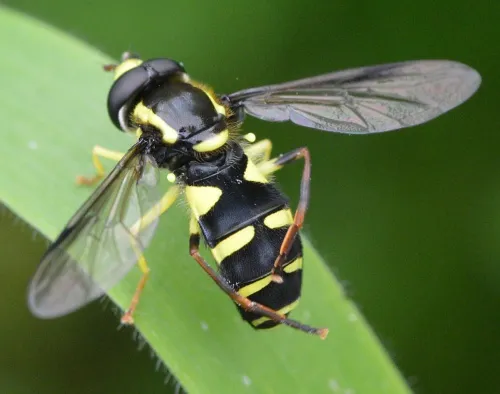
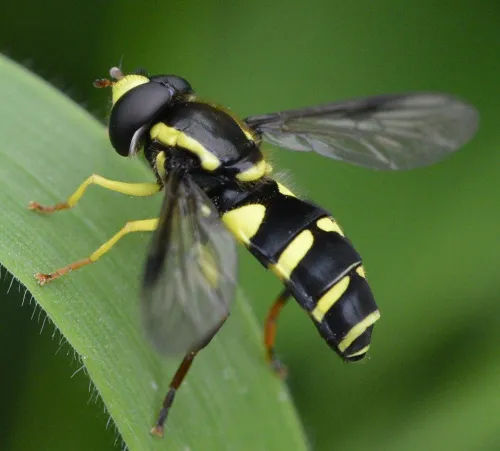
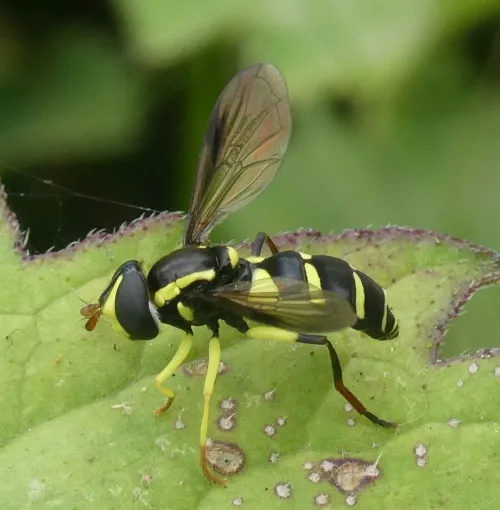
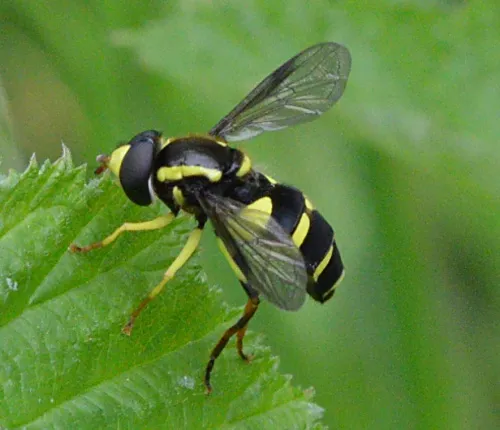
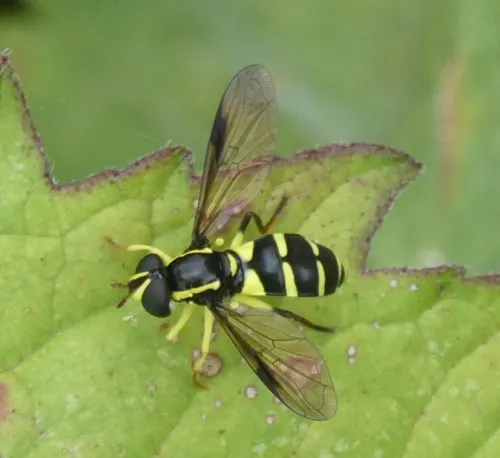
Xanthogramma pedissequum is best distinguished from the similar X. citrofasciatum by the dumpy appearance of the yellow triangles on tergite 2. However the very similar X. stackelbergi was added to the British list in 2012 (see Similar Species below). Xanthogramma stackelbergi was added to the British list in 2012, meaning that all old records of X. pedissequum without accompanying voucher material or a good supporting photo can no longer be assigned to species level. Males of X. stackelbergi have the spots on tergite 2 angled downwards on the inner edge with their lateral edges pinched posteriorly (neatly triangular in pedissequum ). The spots on tergites 3 and 4 are more oblique than in pedissequum . The sides of the thorax have several yellow spots in addition to the yellow mesopleural stripe of typical pedissequum . Females have the black stripe on the frons very narrow and often petering out where it meets the lunule. The yellow spots on tergite 2 are squarer than in pedissequum and those on tergites 3 and 4 more oblique. The sides of the thorax below the level of the wingbases seem to always have five yellow spots, with two always located near the halteres (often missing in pedissequum ). This is one of the best field characters, so always try to retain specimens with these extra yellow spots for critical checking. Further differences exist in the wings and underside of the abdomen. The dark costal patch of stackelbergi does not usually extend below vein R3+4 in contrast to typical pedissequum. Viewed from the underside, both sexes have the narrow membranous area between the sternites and tergites mainly yellow except for a dark patch coinciding with the posterior transverse stripe of sternite 2, and this creates a dark band that is less than half of the length of this sternite i.e. much less extensively darkened than pedissequum .) Unless you have provided good images and obtained expert species confirmation, records should be added as Xanthogramma pedissequum sensu lato Grassland and open woodland rides preferring short turf and some bare ground such as pathways. May to September peaking in late June and early July. Males are sometimes seen hovering just a few centimetres above the ground, particularly over bare ground like paths. The larvae feed on aphids within the nests of ants. The species seems to be quite frequent in southern England south of a line from 'The Wash' to the south Wales coast, but problems of identification make true status difficult to determine.
Classification
Habitat and Range
Habitat
Grassland and open woodland rides preferring short turf and some bare ground such as pathways.
Seasonal Activity
May to September peaking in late June and early July.
Diet and Behavior
Life History
Males are sometimes seen hovering just a few centimetres above the ground, particularly over bare ground like paths. The larvae feed on aphids within the nests of ants.
Additional species information
Recorded status
The species seems to be quite frequent in southern England south of a line from 'The Wash' to the south Wales coast, but problems of identification make true status difficult to determine.
About Flies: the wider group
Order-level background for Diptera, the group containing Xanthogramma pedissequum sensu stricto. Species-specific details appear above.
Group overview
Diptera includes over 150,000 described species of flies, mosquitoes, and midges. Mosquitoes are the deadliest animal on Earth (CDC). Malaria alone causes ~249 million cases and over 608,000 deaths annually, mostly children under 5 (WHO). Vector-borne diseases account for over 17% of all infectious diseases, causing 700,000+ deaths per year.
Ecological role of the group
Despite their disease impact, flies are critical decomposers and pollinators. Hoverflies alone pollinate hundreds of crop and wildflower species. Flies are also the primary food source for many birds, bats, and fish. Forensic entomology relies heavily on fly species for crime scene analysis.
Economic and practical significance of the group
In the U.S., vector-borne disease cases tripled between 2004-2016, with over 640,000 cases reported in that period (CDC). Tickborne diseases doubled from 22,000 to 48,000 annual reports. Globally, mosquito-borne diseases cost billions in healthcare and lost productivity.
Recorded sources for this group: WHO, CDC, PNAS. Imported estimates may describe particular regions or reporting periods.
Photos of Xanthogramma pedissequum sensu stricto (10)
Frequently Asked Questions About Xanthogramma pedissequum sensu stricto
What is Xanthogramma pedissequum sensu stricto?
Xanthogramma pedissequum sensu stricto is a species in the family Syrphidae, within the order Diptera.
How big is Xanthogramma pedissequum sensu stricto?
of this sternite i.e. much less extensively darkened than
Where is Xanthogramma pedissequum sensu stricto found?
Habitat: Grassland and open woodland rides preferring short turf and some bare ground such as pathways.
When is Xanthogramma pedissequum sensu stricto active?
Xanthogramma pedissequum sensu stricto: seasonal activity - May to September peaking in late June and early July..
What is the life cycle of a Xanthogramma pedissequum sensu stricto?
Males are sometimes seen hovering just a few centimetres above the ground, particularly over bare ground like paths. The larvae feed on aphids within the nests of ants.