
Xanthandrus comtus
This record describes Xanthandrus comtus (species). Recorded family: Syrphidae. Recorded order: Diptera.
Identification and Appearance
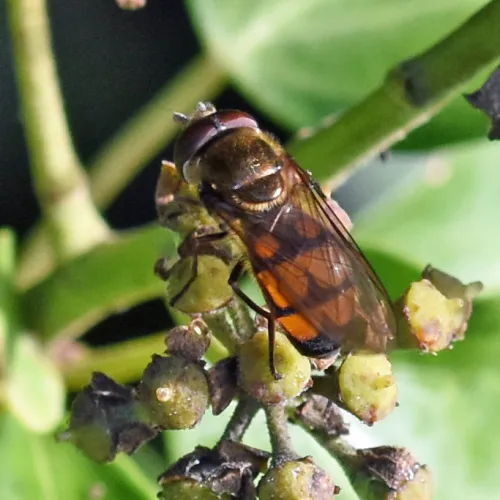
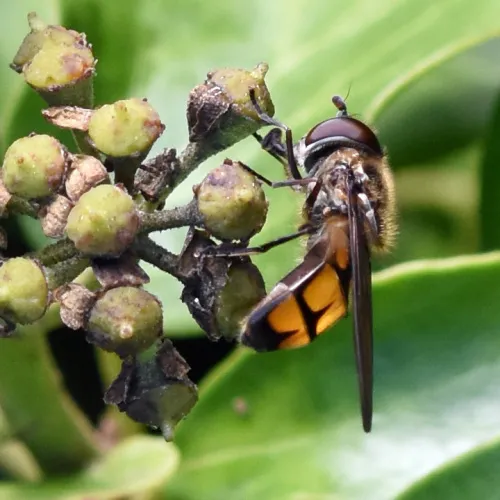
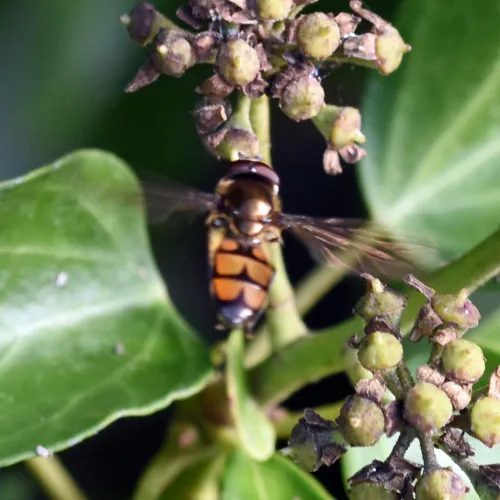
Abdomen segment T2 has round spots and segments T3 and T4 have semi-circular spots tht may join in the middle. Males are considerably more colourful than females which have darker, greyer markings on the abdomen. It usually occurs in woodland edge (deciduous and coniferous) and scrub where adults are usually found visiting flowers or resting on vegetation in clearings or along tracks. The larvae prey on the caterpillars of various micro-moths. Although relatively frequent in older collections, this species underwent a period of decline and came to be regarded as a great rarity. It has evidently recovered, as there are numerous recent records at widely scattered localities throughout the southern half of Britain, and it has recently been found in Scotland (Rotheray, 1992). Records remain very erratic, however, and there are few sites where it occurs regularly. This could possibly indicate that this species is a migrant. No additional images available for this species.
Classification
Habitat and Range
Habitat
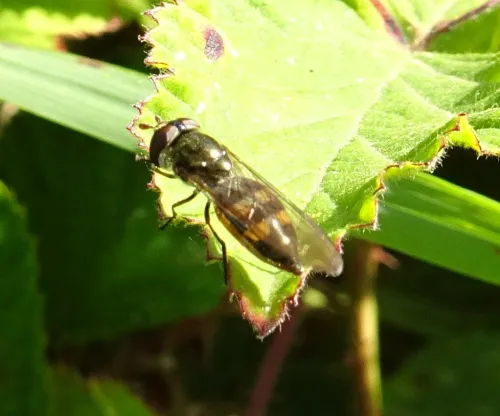
It usually occurs in woodland edge (deciduous and coniferous) and scrub where adults are usually found visiting flowers or resting on vegetation in clearings or along tracks.
Seasonal Activity
Late May to October.
Diet and Behavior
Life History
The larvae prey on the caterpillars of various micro-moths.
Additional species information
Recorded status
Although relatively frequent in older collections, this species underwent a period of decline and came to be regarded as a great rarity. It has evidently recovered, as there are numerous recent records at widely scattered localities throughout the southern half of Britain, and it has recently been found in Scotland (Rotheray, 1992). Records remain very erratic, however, and there are few sites where it occurs regularly. This could possibly indicate that this species is a migrant.
About Flies: the wider group
Order-level background for Diptera, the group containing Xanthandrus comtus. Species-specific details appear above.
Group overview
Diptera includes over 150,000 described species of flies, mosquitoes, and midges. Mosquitoes are the deadliest animal on Earth (CDC). Malaria alone causes ~249 million cases and over 608,000 deaths annually, mostly children under 5 (WHO). Vector-borne diseases account for over 17% of all infectious diseases, causing 700,000+ deaths per year.
Ecological role of the group
Despite their disease impact, flies are critical decomposers and pollinators. Hoverflies alone pollinate hundreds of crop and wildflower species. Flies are also the primary food source for many birds, bats, and fish. Forensic entomology relies heavily on fly species for crime scene analysis.
Economic and practical significance of the group
In the U.S., vector-borne disease cases tripled between 2004-2016, with over 640,000 cases reported in that period (CDC). Tickborne diseases doubled from 22,000 to 48,000 annual reports. Globally, mosquito-borne diseases cost billions in healthcare and lost productivity.
Recorded sources for this group: WHO, CDC, PNAS. Imported estimates may describe particular regions or reporting periods.
Photos of Xanthandrus comtus (4)
Frequently Asked Questions About Xanthandrus comtus
What is Xanthandrus comtus?
Xanthandrus comtus is a species in the family Syrphidae, within the order Diptera.
Where is Xanthandrus comtus found?
Habitat: It usually occurs in woodland edge (deciduous and coniferous) and scrub where adults are usually found visiting flowers or resting on vegetation in clearings or along tracks.
When is Xanthandrus comtus active?
Xanthandrus comtus: seasonal activity - Late May to October..
What is the life cycle of a Xanthandrus comtus?
The larvae prey on the caterpillars of various micro-moths.