
Usingeriessa brunnildalis - Hodges#4768
Usingeriessa brunnildalis
This record describes Usingeriessa brunnildalis (species). Recorded family: Crambidae. Recorded order: Lepidoptera.
Identification and Appearance
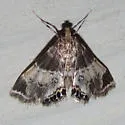
Original description online: ( Elophila brunnildalis ) This species is very similar to Usingeriessa onyxalis , differing mainly by the indistinct apical patch on the FW, not contrasting much with the dusky terminal band; the HW is generally clouded with dusky scaling, without the contrasting dark basal and pale medial areas seen in U. onyxalis . [NOTE: The barcoded specimens currently labeled as onyxalis (mostly from Costa Rica) seem to match the original description of brunnildalis . Further research is needed to clarify which is which.] Confusion with Usingeriessa onyxalis , particularly in Texas records, is common. Moreover, to date, BOLD has not barcoded any examples for brunnildalis ; the single image on MPG from Presidio Co., TX, appears to be a worn example of U. onyxalis , and even this California example of brunnildalis appears very similar to Texas onyxalis . More images, specimens, and genetic work are needed to determine how to separate these species, if they are distinct at all.
Identification notes
Original description online: ( Elophila brunnildalis ) (91) This species is very similar to Usingeriessa onyxalis , differing mainly by the indistinct apical patch on the FW, not contrasting much with the dusky terminal band; the HW is generally clouded with dusky scaling, without the contrasting dark basal and pale medial areas seen in U. onyxalis . ( 4 ) [NOTE: The barcoded specimens currently labeled as onyxalis (mostly from Costa Rica) seem to match the original description of brunnildalis . Further research is needed to clarify which is which.]
Classification
- Kingdom
- Animalia
- Phylum
- Arthropoda
- Class
- Insecta
- Order
- Lepidoptera (Butterflies and Moths)
- Superfamily
- Pyraloidea
- Family
- Crambidae (Crambid Snout Moths)
- Subfamily
- Acentropinae
- Tribe
- Argyractini
- Genus
- Usingeriessa
Imported taxonomy record. Source availability varies; see the source references and editorial policy below.
Habitat and Range
Habitat
Normally associated with permanent streams where the larvae live on alga covered rocks. ( 3 )
Geographic Range
Central and southern California, Arizona*, and western Texas**. ( 3 ) ( 5 ) ( 6 ) Moth Photographers Group - large map with some distribution data. * While both Usinger ( 6 ) and Munroe ( 3 ) include Arizona in the range description, no specimen records are recited. No online data have been found to confirm that part of the range.
Seasonal Activity
Most records for adults are from August to October.
About Butterflies and Moths: the wider group
Order-level background for Lepidoptera, the group containing Usingeriessa brunnildalis. Species-specific details appear above.
Group overview
Lepidoptera includes approximately 180,000 described species of butterflies and moths. Moths outnumber butterflies roughly 10:1. The monarch butterfly's eastern population has declined by more than 80% since the mid-1990s, and the western population by over 95% since the 1980s. The IUCN lists the migratory monarch as Vulnerable.
Ecological role of the group
Butterflies and moths are essential indicators of ecosystem health. As caterpillars, they are a primary food source for birds - a single nest of blue tit chicks requires ~10,000 caterpillars. Adult moths pollinate many night-blooming plants.
Economic and practical significance of the group
Lepidoptera are critical pollinators. In Europe, grassland butterfly species have declined by almost 50% since the early 1990s. In the UK, three-quarters of butterflies are in decline. In the U.S., five butterfly species have gone extinct since 1950, with 29 listed as endangered.
Recorded sources for this group: IUCN Red List, Xerces Society, USFWS, PNAS, WWF. Imported estimates may describe particular regions or reporting periods.
Photos of Usingeriessa brunnildalis - Hodges#4768 (5)
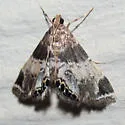
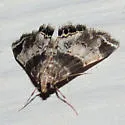
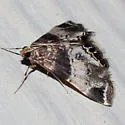
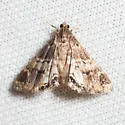
Photo credits: Contributed by Maury J. Heiman; Additional contributions by Chuck Sexton
Frequently Asked Questions About Usingeriessa brunnildalis - Hodges#4768
What is Usingeriessa brunnildalis - Hodges#4768?
Usingeriessa brunnildalis - Hodges#4768 (Usingeriessa brunnildalis) is a species in the family Crambidae, within the order Lepidoptera.
How big is Usingeriessa brunnildalis - Hodges#4768?
Forewing length 7.5-11 mm. ( 3 )
How do you identify Usingeriessa brunnildalis - Hodges#4768?
Original description online: ( Elophila brunnildalis ) (91) This species is very similar to Usingeriessa onyxalis , differing mainly by the indistinct apical patch on the FW, not contrasting much with the dusky terminal band; the HW is generally clouded with dusky scaling, without the contrasting dark basal and pale medial areas seen in U. onyxalis . ( 4 ) [NOTE: The barcoded specimens currently labeled as onyxalis (mostly from Costa Rica) seem to match the original description of brunnildalis . Further research is needed to clarify which is which.]
Where is Usingeriessa brunnildalis - Hodges#4768 found?
| Feature | Details |
|---|---|
| Habitat | Normally associated with permanent streams where the larvae live on alga covered rocks. ( 3 ) |
| Range | Central and southern California, Arizona*, and western Texas**. ( 3 ) ( 5 ) ( 6 ) Moth Photographers Group - large map with some distribution data. * While both Usinger ( 6 ) and Munroe ( 3 ) include Arizona in the range description, no specimen records are recited. No online data have been found to confirm that part of the range. |
When is Usingeriessa brunnildalis - Hodges#4768 active?
Usingeriessa brunnildalis - Hodges#4768: seasonal activity - Most records for adults are from August to October..