
Golden Silk Orbweaver
Trichonephila clavipes
This record describes Trichonephila clavipes (species). Recorded family: Araneidae. Recorded order: Araneae.
Identification and Appearance
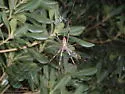
Male Female has a long cylindrical body, up to about 50mm or 2" by the end of the season, yellow to brownish-orange abdomen with silvery spots and silvery cephalothorax. Three of its four pairs of legs have hairy black patches above the joints. The male is much smaller (5-8 mm) (see below - the male is at the top of the image). The silk of the web usually has a golden color which is visible to the naked eye. Like other spiders, this one will bite in self-defense, especially if you go out of your way to provoke it (in particular, by handling or picking it up). Spiders have venom which enables them to incapacitate their prey. However, the bite of most species is described as much less severe than a bee sting. As it lives in hot places, Trichonephila has evolved some defenses against the sun. The long cylindrical abdomen of the spider may be angled towards the sun to reduce the amount of exposed body surface and thus prevent overheating. The reflective silvery surface of much of the body serves the same purpose. The gold dragline silk of this spider's web has attracted interest for its amazing tensile strength. Scientists have analyzed its content and attempted to reproduce its proteins artificially for use in high-strength fabrics. See article in Science News Magazine, March 1996 (online access requires subscription) A small silvery spider, Argyrodes nephilae , is known for its kleptoparasitism in the Golden Silk Spider's web. It will live in the frame edges or barrier webs, and occasionally move in to cut loose wrapped bundles of prey. The prey swings loose hanging from a thread which the Argyrodes has previously spun and attached to the bundle, thus ending up in the outer web where the thief can eat it at leisure.
Classification
Habitat and Range
Habitat
The female builds a large orbweb which can span several feet, most often seen (or walked into by unsuspecting hikers) 2 to 8 feet from the ground, but can be much higher (at least one has been known to spin her web at the top corner of a structure 65 feet from the ground, they are also reported to spin at the top of utility poles). Beside the main web may be one or more barrier webs which protect her from predators. One or more small males may be found sitting in the female's web. The web is a semipermanent structure which is repaired as necessary, not entirely destroyed and rebuilt daily, as is the case with some other orbweavers.
Geographic Range
Predominantly southeastern US. Florida, Gulf States, north to Virginia, south to Central and South America as far as Argentina.
Seasonal Activity
Most noticeable in late summer and into fall, when mature females can be detected from a long distance.
Diet and Behavior
Diet: Small flying insects - flies, beetles, moths etc. - are caught in the web. The spider incapacitates them by biting. Wrapped prey is brought back to the hub of the web, which is usually off-center in the structure. This central storage of food may be a strategy to reduce theft by the kleptoparasitic Argyrodes (see remarks, below).
Life History
Eggs are laid in masses in fall on the side of a structure or tree close to where the female has her web. Usually at least two large eggsacs 25 to 30mm in diameter, containing several hundred eggs. 1. egg sac, 2.newly emerged spiderlings, 3.older spiderling, 4. older spiderlings
Additional species information
Species notes from the sources
Etymology: Trichonephila clavipes Kuntner et al., 2019
About Spiders: the wider group
Order-level background for Araneae, the group containing Trichonephila clavipes. Species-specific details appear above.
Group overview
As of 2023, 51,673 spider species in 136 families have been recorded, though an estimated 150,000 species exist. Spiders rank 7th in total species diversity among all organism orders. Only 0.5% of spider species pose any risk to human health.
Ecological role of the group
Spider venom contains complex peptides with diverse pharmacological activities, making them valuable for drug development research. Spiders produce up to 7 types of silk from specialized glands. Spider silk genes have been inserted into mammals and plants for biotech applications.
Economic and practical significance of the group
The global spider community kills an estimated 400-800 million tons of prey annually (2017 study). Spiders provide billions of dollars in natural pest control for agriculture. Spider silk is 5× stronger than steel of the same diameter, driving a biomaterials research industry.
Recorded sources for this group: World Spider Catalog, PNAS, Nature, ScienceDirect. Imported estimates may describe particular regions or reporting periods.
Photos of Golden Silk Orbweaver (5)
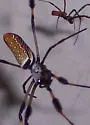
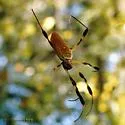
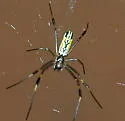
Photo credits: Contributed by Troy Bartlett; Additional contributions by Hannah Nendick-Mason , Robin McLeod , Lynette Elliott , Jeff Hollenbeck , cheins , kschnei , marcie oconnor , Laura P. , Tyler Hedlund , Nathaniel Green
Frequently Asked Questions About Golden Silk Orbweaver
What is Golden Silk Orbweaver?
Golden Silk Orbweaver (Trichonephila clavipes) is a species in the family Araneidae, within the order Araneae.
How big is Golden Silk Orbweaver?
Females to 50 mm; males to 8 mm.
How do you identify Golden Silk Orbweaver?
Male Female has a long cylindrical body, up to about 50mm or 2" by the end of the season, yellow to brownish-orange abdomen with silvery spots and silvery cephalothorax. Three of its four pairs of legs have hairy black patches above the joints. The male is much smaller (5-8 mm) (see below - the male is at the top of the image). The silk of the web usually has a golden color which is visible to the naked eye.
Where is Golden Silk Orbweaver found?
| Feature | Details |
|---|---|
| Habitat | The female builds a large orbweb which can span several feet, most often seen (or walked into by unsuspecting hikers) 2 to 8 feet from the ground, but can be much higher (at least one has been known to spin her web at the top corner of a structure 65 feet from the ground, they are also reported to spin at the top of utility poles). Beside the main web may be one or more barrier webs which protect her from predators. One or more small males may be found sitting in the female's web. The web is a semipermanent structure which is repaired as necessary, not entirely destroyed and rebuilt daily, as is the case with some other orbweavers. |
| Range | Predominantly southeastern US. Florida, Gulf States, north to Virginia, south to Central and South America as far as Argentina. |
What does Golden Silk Orbweaver eat?
The diet of the Golden Silk Orbweaver includes Small flying insects - flies, beetles, moths etc. - are caught in the web. The spider incapacitates them by biting. Wrapped prey is brought back to the hub of the web, which is usually off-center in the structure. This central storage of food may be a strategy to reduce theft by the kleptoparasitic Argyrodes (see remarks, below)..
When is Golden Silk Orbweaver active?
Golden Silk Orbweaver: seasonal activity - Most noticeable in late summer and into fall, when mature females can be detected from a long distance..
What is the life cycle of a Golden Silk Orbweaver?
Eggs are laid in masses in fall on the side of a structure or tree close to where the female has her web. Usually at least two large eggsacs 25 to 30mm in diameter, containing several hundred eggs. 1. egg sac, 2.newly emerged spiderlings, 3.older spiderling, 4. older spiderlings