
Tibicinoides boweni
This record describes Tibicinoides boweni (species). Recorded family: Cicadidae. Recorded order: Hemiptera.
Identification and Appearance
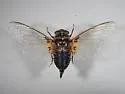
The simiple(r) differential diagnosis between this species and the allopatric O. simulata and the sympatric O. utahensis is as follows: O. boweni has lateral pronotal margins subparallel giving it a quadrate appearance and has a long yellow longitudinal sulcus on the anterior half of the pronotum. O. simulata also has a quadrate pronotum but lacks the deep yellow sulcus. O. utahensis has the sulcus but is constricted apically along the lateral margins of the pronotum. Thus a quadrate pronotum with a yellow sulcus will identify O. boweni. The songs of O. utahensis and O. boweni also differ greatly (Chatfield-Taylor and Cole 2020). While the above differential diagnosis is the fastest way to identify Okanagana boweni from similar species, the single distinguishing feature is an incurved adeagus when viewing the uncus in the lateral aspect. Female do not have an obvious secondary notch in their 7th sternite, which is also different from O. utahensis and O. simulata. This is the first species to be described in a revision of Okanagana Distant. It is worth noting that the incurved aedeagus is diagnostic from O. simulata and O. utahensis, other taxa with a hook to the uncus such O. rubrovenosa are strongly incurved. However, none of which could be confused with O. boweni. The overall impression is a large cicada that is most similar to O. simulata in aspect but to O. utahensis in pattern. This may possibly be due to primary habitat. Recently transferred from Okanagana to Tibicinoides by Cole et al. 2023.
Classification
- Kingdom
- Animalia
- Phylum
- Arthropoda
- Class
- Insecta
- Order
- Hemiptera (True Bugs, Cicadas, Hoppers, Aphids and Allies)
- Suborder
- Auchenorrhyncha
- Superfamily
- Cicadoidea
- Family
- Cicadidae (Cicadas)
- Subfamily
- Tibicininae
- Tribe
- Tibicinini
- Genus
- Tibicinoides
Imported taxonomy record. Source availability varies; see the source references and editorial policy below.
Habitat and Range
Habitat
Artemisia in the Tridentate group, usually tridentata
Geographic Range
Restricted to the alkali flats of the Walker Lane geological boundary.
Seasonal Activity
Has been recorded from May to July
Diet and Behavior
Life History
Likely a typical protoperiodical Okanagana; no fixed life-cycle and they emerge in varying abundance.
About True Bugs, Cicadas, Hoppers, Aphids and Allies: the wider group
Order-level background for Hemiptera, the group containing Tibicinoides boweni. Species-specific details appear above.
Group overview
Hemiptera (true bugs) includes over 80,000 described species across cicadas, aphids, leafhoppers, shield bugs, and bed bugs. Aphids alone cost global agriculture an estimated $2.5 billion annually in crop losses.
Ecological role of the group
Many Hemiptera are essential food sources for birds and predatory insects. Cicadas provide massive nutrient pulses during emergence events - a single Brood X emergence can involve trillions of individuals across 15 states.
Economic and practical significance of the group
The brown marmorated stink bug (Halyomorpha halys) caused $37 million in apple crop losses in a single year in the U.S. Mid-Atlantic region. Bed bug infestations in the U.S. increased by 500% between 2001-2010, costing the hotel industry hundreds of millions annually.
Recorded sources for this group: USDA, EPA, University research. Imported estimates may describe particular regions or reporting periods.
Photos of Tibicinoides boweni (5)
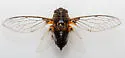
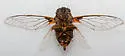
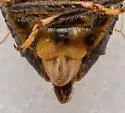
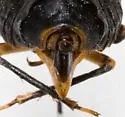
Photo credits: Contributed by Will Chatfield-Taylor; Additional contributions by antarctica
Frequently Asked Questions About Tibicinoides boweni
What is Tibicinoides boweni?
Tibicinoides boweni is a species in the family Cicadidae, within the order Hemiptera.
How big is Tibicinoides boweni?
mean body length is 26.9mm and wingspan is 69.8mm
How do you identify Tibicinoides boweni?
The simiple(r) differential diagnosis between this species and the allopatric O. simulata and the sympatric O. utahensis is as follows: O. boweni has lateral pronotal margins subparallel giving it a quadrate appearance and has a long yellow longitudinal sulcus on the anterior half of the pronotum. O. simulata also has a quadrate pronotum but lacks the deep yellow sulcus. O. utahensis has the sulcus but is constricted apically along the lateral margins of the pronotum. Thus a quadrate pronotum with a yellow sulcus will identify O. boweni. The songs of O. utahensis and O. boweni also differ greatly (Chatfield-Taylor and Cole 2020). While the above differential diagnosis is the fastest way to identify Okanagana boweni from similar species, the single distinguishing feature is an incurved adeagus when viewing the uncus in the lateral aspect. Female do not have an obvious secondary notch in their 7th sternite, which is also different from O. utahensis and O. simulata.
Where is Tibicinoides boweni found?
| Feature | Details |
|---|---|
| Habitat | Artemisia in the Tridentate group, usually tridentata |
| Range | Restricted to the alkali flats of the Walker Lane geological boundary. |
When is Tibicinoides boweni active?
Tibicinoides boweni: seasonal activity - Has been recorded from May to July.
What is the life cycle of a Tibicinoides boweni?
Likely a typical protoperiodical Okanagana; no fixed life-cycle and they emerge in varying abundance.