
Iron Cross Blister Beetle
Tegrodera latecincta
This record describes Tegrodera latecincta (species). Recorded family: Meloidae. Recorded order: Coleoptera.
Identification and Appearance
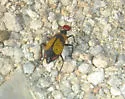
Differs from its two congeners in having a somewhat longer (from front-to-back) black transverse stripe across the elytra than the others (taking up about 1/5 the elytral length)...as well as in a few other less conspicuous characters. Closest relative of T. erosa , separated from the latter by the San Gabriel and San Bernardino Mountains, and from T. aloga by Mojave Desert .
Classification
- Kingdom
- Animalia
- Phylum
- Arthropoda
- Class
- Insecta
- Order
- Coleoptera (Beetles)
- Suborder
- Polyphaga
- Superfamily
- Tenebrionoidea
- Family
- Meloidae (Blister Beetles)
- Subfamily
- Meloinae
- Tribe
- Eupomphini
- Genus
- Tegrodera (Iron Cross Blister Beetle)
Imported taxonomy record. Source availability varies; see the source references and editorial policy below.
Habitat and Range
Geographic Range
Known from California to the east of the Sierra Nevada and the north of the Transverse Ranges (i.e. the San Gabriel and San Bernardino Mountains)...from northern Los Angeles County (i.e. Antelope valley) to Mono County. Most records are from the Owens Valley area...e.g. see this list from the California Beetle Database. The northernmost record given in Pinto was "Benton Station", but it appears the species has been found at least as far north as Mono Lake (see this iNaturalist post ).
Diet and Behavior
Diet: Adults primarily feed on plants in the genus Eriastrum . Larval hosts unknown, but presumed parasitic on bees or other hymenoptera.
Additional species information
Species notes from the sources
Etymology: Epithet from Latin: late- = wide; cincta = girdled...presumably referring to the black lateral stripe across the elytra, which is wider than in other species of the genus.
About Primitive Winged Insects: the wider group
Order-level background for Coleoptera, the group containing Tegrodera latecincta. Species-specific details appear above.
Group overview
Coleoptera is the largest order of insects with over 400,000 described species, representing ~25% of all known animal species and ~40% of all insects. In the U.S. alone, nearly 30,000 beetle species have been identified.
Ecological role of the group
Beetles are prominent decomposers, especially in forests, breaking down dead wood and recycling nutrients. As predators, they reduce populations of pest insects. Many species are also important pollinators of flowering plants.
Economic and practical significance of the group
Beetles have major economic significance: leaf beetles (Chrysomelidae) and weevils (Curculionoidea) are among the most destructive agricultural pests globally, costing billions annually, while predatory species like ladybugs provide natural pest control.
Recorded sources for this group: Britannica, Smithsonian, NCSU Entomology. Imported estimates may describe particular regions or reporting periods.
Photos of Iron Cross Blister Beetle (5)
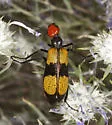
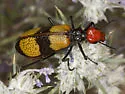
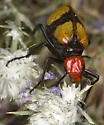
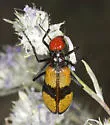
Photo credits: Contributed by Cotinis; Additional contributions by Aaron Schusteff , kschnei , v belov
Frequently Asked Questions About Iron Cross Blister Beetle
What is Iron Cross Blister Beetle?
Iron Cross Blister Beetle (Tegrodera latecincta) is a species in the family Meloidae, within the order Coleoptera.
How do you identify Iron Cross Blister Beetle?
Differs from its two congeners in having a somewhat longer (from front-to-back) black transverse stripe across the elytra than the others (taking up about 1/5 the elytral length)...as well as in a few other less conspicuous characters. Closest relative of T. erosa , separated from the latter by the San Gabriel and San Bernardino Mountains, and from T. aloga by Mojave Desert .
Where is Iron Cross Blister Beetle found?
Range: Known from California to the east of the Sierra Nevada and the north of the Transverse Ranges (i.e. the San Gabriel and San Bernardino Mountains)...from northern Los Angeles County (i.e. Antelope valley) to Mono County. Most records are from the Owens Valley area...e.g. see this list from the California Beetle Database. The northernmost record given in Pinto was Benton Station, but it appears the species has been found at least as far north as Mono Lake (see this iNaturalist post ).
What does Iron Cross Blister Beetle eat?
The diet of the Iron Cross Blister Beetle includes Adults primarily feed on plants in the genus Eriastrum . Larval hosts unknown, but presumed parasitic on bees or other hymenoptera..