
Saunders' Sympistis - Hodges#10099
Sympistis saundersiana
This record describes Sympistis saundersiana (species). Recorded family: Noctuidae. Recorded order: Lepidoptera.
Identification and Appearance
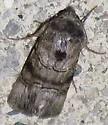
Adult: forewing median area dark brownish-gray with pale gray or silvery shading inside AM line and in subterminal area; AM and PM lines thin, black, double; diffuse black band runs across median area; reniform, orbicular, and claviform spots rimmed with black; terminal area dark gray with several black dashes; hindwing grayish-brown basally with broad dark terminal band and slightly paler fringe; top of head and thorax blackish Larva: green to pink and perhaps other colors, matching hostplant. Smooth, elongate, broadest though middle of body (A1-A6); pale middorsal and subdorsal stripes doubled with ground color darkened between. Two supraspiracular stripes, the uppermost broken, poorly developed, or absent. Prominent white spiracular stripe; upper edge ill-defined, passing through spiracles; lower edge sharply defined. Area between supraspiracular and spiracular stripe sometimes filled with white. Setae short, only 2x height of spiracle, inconspicuous. Spiracles tan with black rim. Third stemma (that closest to the antennal base) enlarged. Prepupal larvae turn pale green prior to pupation. [larva description by David Wagner et al , taken from this U. of Connecticut page ] Apparently an uncommon and/or local species. Status in Ontario is S3?. Its name appears in a PDF doc listing Species in Greatest Need of Conservation in Illinois. Saunders' Oncocnemis has not been seen in Connecticut for more than 50 years - quote from article by David Wagner et al here
Classification
- Kingdom
- Animalia
- Phylum
- Arthropoda
- Class
- Insecta
- Order
- Lepidoptera (Butterflies and Moths)
- Superfamily
- Noctuoidea
- Family
- Noctuidae (Owlet Moths)
- Subfamily
- Oncocnemidinae
- Genus
- Sympistis
Imported taxonomy record. Source availability varies; see the source references and editorial policy below.
Habitat and Range
Habitat
roadsides, rocky outcrops, sandy beaches, and other open habitats; adults are nocturnal and come to light
Geographic Range
apparently widespread but with seemingly patchy distribution: Internet records from Alberta, Florida, Illinois, Michigan, Missouri, Ohio, Ontario, Manitoba, New Jersey, New York, South Carolina, Wisconsin
Seasonal Activity
adults fly in August and September larvae in early summer
Diet and Behavior
Diet: larvae feed on Hairy Beardtongue ( Penstemon hirsutus ) and other beardtongue species
Life History
overwinters as an egg; larva feeds in early summer, then tunnels underground to pupate, and stays in its cell unitl late summer when adult emerges; one generation per year
About Butterflies and Moths: the wider group
Order-level background for Lepidoptera, the group containing Sympistis saundersiana. Species-specific details appear above.
Group overview
Lepidoptera includes approximately 180,000 described species of butterflies and moths. Moths outnumber butterflies roughly 10:1. The monarch butterfly's eastern population has declined by more than 80% since the mid-1990s, and the western population by over 95% since the 1980s. The IUCN lists the migratory monarch as Vulnerable.
Ecological role of the group
Butterflies and moths are essential indicators of ecosystem health. As caterpillars, they are a primary food source for birds - a single nest of blue tit chicks requires ~10,000 caterpillars. Adult moths pollinate many night-blooming plants.
Economic and practical significance of the group
Lepidoptera are critical pollinators. In Europe, grassland butterfly species have declined by almost 50% since the early 1990s. In the UK, three-quarters of butterflies are in decline. In the U.S., five butterfly species have gone extinct since 1950, with 29 listed as endangered.
Recorded sources for this group: IUCN Red List, Xerces Society, USFWS, PNAS, WWF. Imported estimates may describe particular regions or reporting periods.
Photos of Saunders' Sympistis - Hodges#10099 (5)
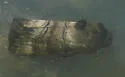
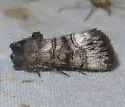
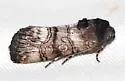
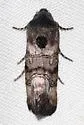
Photo credits: Contributed by Robin McLeod; Additional contributions by Chris Grinter , marcie oconnor , Kyhl Austin
Frequently Asked Questions About Saunders' Sympistis - Hodges#10099
What is Saunders' Sympistis - Hodges#10099?
Saunders' Sympistis - Hodges#10099 (Sympistis saundersiana) is a species in the family Noctuidae, within the order Lepidoptera.
How big is Saunders' Sympistis - Hodges#10099?
wingspan about 26 mm, based on photo by Jim Vargo at MPG larvae less than 35 mm
How do you identify Saunders' Sympistis - Hodges#10099?
Adult: forewing median area dark brownish-gray with pale gray or silvery shading inside AM line and in subterminal area; AM and PM lines thin, black, double; diffuse black band runs across median area; reniform, orbicular, and claviform spots rimmed with black; terminal area dark gray with several black dashes; hindwing grayish-brown basally with broad dark terminal band and slightly paler fringe; top of head and thorax blackish Larva: green to pink and perhaps other colors, matching hostplant. Smooth, elongate, broadest though middle of body (A1-A6); pale middorsal and subdorsal stripes doubled with ground color darkened between. Two supraspiracular stripes, the uppermost broken, poorly developed, or absent. Prominent white spiracular stripe; upper edge ill-defined, passing through spiracles; lower edge sharply defined. Area between supraspiracular and spiracular stripe sometimes filled with white. Setae short, only 2x height of spiracle, inconspicuous. Spiracles tan with black rim. Third stemma (that closest to the antennal base) enlarged. Prepupal larvae turn pale green prior to pupation. [larva description by David Wagner et al , taken from this U. of Connecticut page ]
Where is Saunders' Sympistis - Hodges#10099 found?
| Feature | Details |
|---|---|
| Habitat | roadsides, rocky outcrops, sandy beaches, and other open habitats; adults are nocturnal and come to light |
| Range | apparently widespread but with seemingly patchy distribution: Internet records from Alberta, Florida, Illinois, Michigan, Missouri, Ohio, Ontario, Manitoba, New Jersey, New York, South Carolina, Wisconsin |
What does Saunders' Sympistis - Hodges#10099 eat?
The diet of the Saunders' Sympistis - Hodges#10099 includes larvae feed on Hairy Beardtongue ( Penstemon hirsutus ) and other beardtongue species.
When is Saunders' Sympistis - Hodges#10099 active?
Saunders' Sympistis - Hodges#10099: seasonal activity - adults fly in August and September larvae in early summer.
What is the life cycle of a Saunders' Sympistis - Hodges#10099?
overwinters as an egg; larva feeds in early summer, then tunnels underground to pupate, and stays in its cell unitl late summer when adult emerges; one generation per year