
Private Sallow Moth - Hodges#9989
Sutyna privata
This record describes Sutyna privata (species). Recorded family: Noctuidae. Recorded order: Lepidoptera.
Identification and Appearance
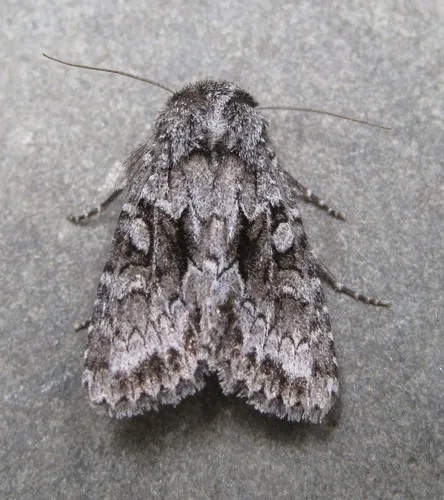
| Feature | Description |
|---|---|
| Additional details | Peppery ash gray FW has darker gray basal and median areas. All lines and spots are indistinct and edged white. Thick bar in inner median area is conspicuous. ST has black wedges at midpoint and anal angle. |
| Head | Head: Speckled gray-white and either dark brown or light brown. |
| Eyes | Eyes without hair. Palpi slightly projecting. Antenna: Female antenna simple, male’s serrated. |
| Thorax | Thorax: Speckled gray-white and either dark brown or light brown. |
| Thorax | Thorax square with large shoulders. |
| Forewings | Forewings: Speckled gray-white and either dark brown or light brown. A.m. (antemedial) line white scalloped with brown lower border does not reach side edges (costa and outer margin). Claviform spot is a long, wide, dark wedge. Orbicular spot speckled grayish-white with small dark center. Reniform spot grayish-whitish, kidney-shaped, not well defined. P. m. (postmedian) line is a series of tiny white scallops with dark upper border. Line curves to outer margin and ends with two large inverted V-shaped white marks just below black claviform spot at mid wing. Terminal line dark triangles with white top border. Fringe gray-white. |
| Hindwings | Hindwings: Female has white hindwing with median toothed dark line. Outer margin has long, dark dashes between veins. Fringe whitish, longer on inner margin. Male hindwings the same, but more sooty, except at the base. |
| Legs | Legs: Dark, middle and hind shin (tibiae) have spines. Feet have white rings. |
| Abdomen | Abdomen: Flattened with a median ridge down top side; gray mixed with brown. Male has tuft or crest at base on the top side. Types: Holotype as Polia privatus male by Walker, 1857. Locality: Colorado. In the British Museum. Holotype as Acronycta monstrata by Walker, 1857. Locality: Colorado. In the British Museum. Holotype/Allotype as Xylina sculpta by Grote, 1874. Locality: Philadelphia (Blake #42) and New York (Mead #119). Museum unknown. Holotype as Anytus sculptus var. planus by Grote, 1882. Locality: New York. In D. H. Hill Collection, North Carolina State University. |
Classification
- Kingdom
- Animalia
- Phylum
- Arthropoda
- Class
- Insecta
- Order
- Lepidoptera (Butterflies and Moths)
- Superfamily
- Noctuoidea
- Family
- Noctuidae (Owlet Moths)
- Subfamily
- Noctuinae
- Tribe
- Xylenini
- Genus
- Sutyna
Imported taxonomy record. Source availability varies; see the source references and editorial policy below.
Habitat and Range
Habitat
Forest edges, deciduous or mixed.
Geographic Range
Canada: coast to coast. U.S.A.: Eastern and Middle States
Seasonal Activity
August and September Larva June and July
Diet and Behavior
Diet: Blackberry Rubus , Blueberry Vaccinium and others.
Life History
Larva: Head green, body green with a light stripe along breathing holes (spiracles). Stripe has top border dark green. Spiracles white, trimmed in black. Segments dotted with white, two dots off-set on each side of center. A double dark green line, sometimes becoming solid green along top center. A broken darker green double line each side of center. Last instar is brown to yellowish-brown. Photos Cornell Univ. One generation per year.
About Butterflies and Moths: the wider group
Order-level background for Lepidoptera, the group containing Sutyna privata. Species-specific details appear above.
Group overview
Lepidoptera includes approximately 180,000 described species of butterflies and moths. Moths outnumber butterflies roughly 10:1. The monarch butterfly's eastern population has declined by more than 80% since the mid-1990s, and the western population by over 95% since the 1980s. The IUCN lists the migratory monarch as Vulnerable.
Ecological role of the group
Butterflies and moths are essential indicators of ecosystem health. As caterpillars, they are a primary food source for birds - a single nest of blue tit chicks requires ~10,000 caterpillars. Adult moths pollinate many night-blooming plants.
Economic and practical significance of the group
Lepidoptera are critical pollinators. In Europe, grassland butterfly species have declined by almost 50% since the early 1990s. In the UK, three-quarters of butterflies are in decline. In the U.S., five butterfly species have gone extinct since 1950, with 29 listed as endangered.
Recorded sources for this group: IUCN Red List, Xerces Society, USFWS, PNAS, WWF. Imported estimates may describe particular regions or reporting periods.
Photos of Private Sallow Moth - Hodges#9989 (2)
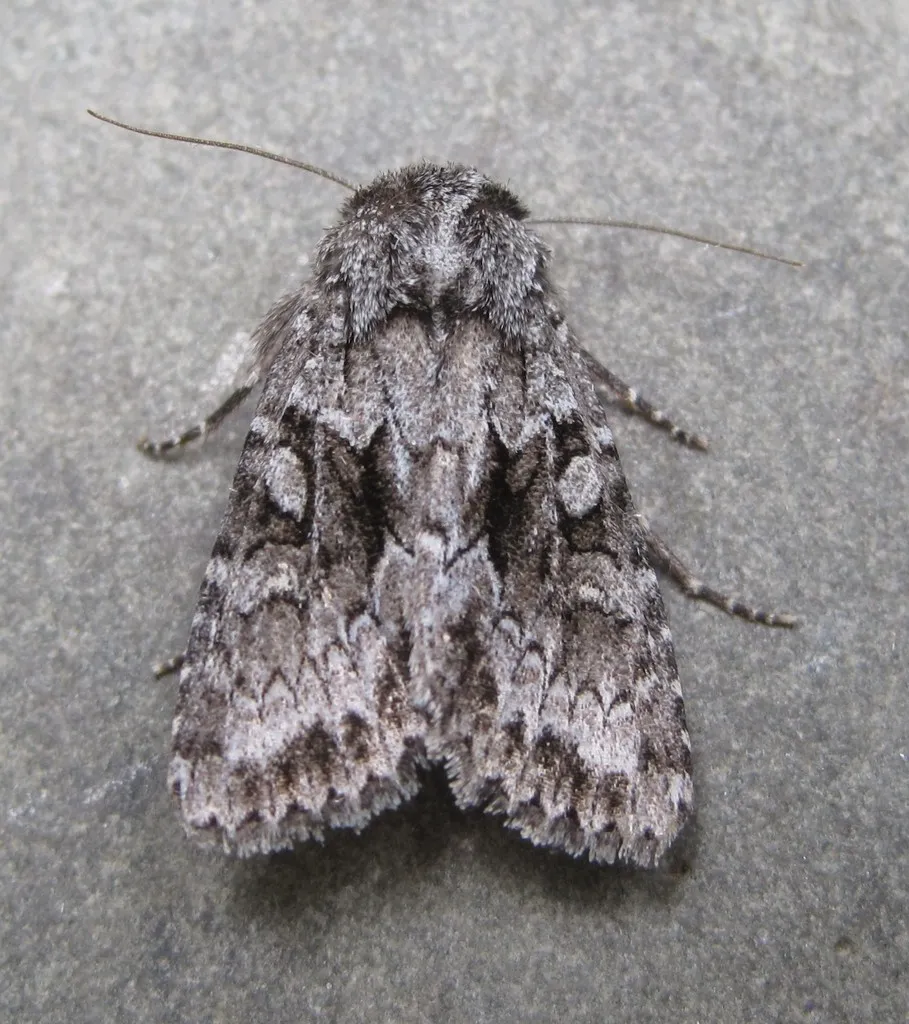
Photo credits: Contributed by john and jane balaban; Additional contributions by Robert Lord Zimlich , lee_penner
Frequently Asked Questions About Private Sallow Moth - Hodges#9989
What is Private Sallow Moth - Hodges#9989?
Private Sallow Moth - Hodges#9989 (Sutyna privata) is a species in the family Noctuidae, within the order Lepidoptera.
How big is Private Sallow Moth - Hodges#9989?
About 20 mm long. 40 to 44 mm wingspan Larva about 40 mm long
How do you identify Private Sallow Moth - Hodges#9989?
| Feature | Description |
|---|---|
| Additional details | Peppery ash gray FW has darker gray basal and median areas. All lines and spots are indistinct and edged white. Thick bar in inner median area is conspicuous. ST has black wedges at midpoint and anal angle. |
| Head | Head: Speckled gray-white and either dark brown or light brown. |
| Eyes | Eyes without hair. Palpi slightly projecting. Antenna: Female antenna simple, male’s serrated. |
| Thorax | Thorax: Speckled gray-white and either dark brown or light brown. |
| Thorax | Thorax square with large shoulders. |
| Forewings | Forewings: Speckled gray-white and either dark brown or light brown. A.m. (antemedial) line white scalloped with brown lower border does not reach side edges (costa and outer margin). Claviform spot is a long, wide, dark wedge. Orbicular spot speckled grayish-white with small dark center. Reniform spot grayish-whitish, kidney-shaped, not well defined. P. m. (postmedian) line is a series of tiny white scallops with dark upper border. Line curves to outer margin and ends with two large inverted V-shaped white marks just below black claviform spot at mid wing. Terminal line dark triangles with white top border. Fringe gray-white. |
| Hindwings | Hindwings: Female has white hindwing with median toothed dark line. Outer margin has long, dark dashes between veins. Fringe whitish, longer on inner margin. Male hindwings the same, but more sooty, except at the base. |
| Legs | Legs: Dark, middle and hind shin (tibiae) have spines. Feet have white rings. |
| Abdomen | Abdomen: Flattened with a median ridge down top side; gray mixed with brown. Male has tuft or crest at base on the top side. |
Where is Private Sallow Moth - Hodges#9989 found?
| Feature | Details |
|---|---|
| Habitat | Forest edges, deciduous or mixed. |
| Range | Canada: coast to coast. U.S.A.: Eastern and Middle States |
What does Private Sallow Moth - Hodges#9989 eat?
The diet of the Private Sallow Moth - Hodges#9989 includes Blackberry Rubus , Blueberry Vaccinium and others..
When is Private Sallow Moth - Hodges#9989 active?
Private Sallow Moth - Hodges#9989: seasonal activity - August and September Larva June and July.
What is the life cycle of a Private Sallow Moth - Hodges#9989?
Larva: Head green, body green with a light stripe along breathing holes (spiracles). Stripe has top border dark green. Spiracles white, trimmed in black. Segments dotted with white, two dots off-set on each side of center. A double dark green line, sometimes becoming solid green along top center. A broken darker green double line each side of center. Last instar is brown to yellowish-brown. Photos Cornell Univ. One generation per year.