
Big Bend Scrub-Hairstreak - Hodges#4292.2
Strymon solitario
This record describes Strymon solitario (species). Recorded family: Lycaenidae. Recorded order: Lepidoptera.
Identification and Appearance
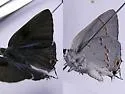
Type Locality: TEXAS: Brewster Co., Big Bend National Park, ca. 2 miles west of Boquillas Canyon. Per Grishin & Durden (2012), the holotype locality is a limestone hill immediately to the north of the paved park road leading to Boquillas Canyon, ca. 1 mile east of SH118, near Barker House, GPS around 29°11'50"N 102°57'06"W, elevation 620m. A roadside offers a small parking site here .
Classification
- Kingdom
- Animalia
- Phylum
- Arthropoda
- Class
- Insecta
- Order
- Lepidoptera (Butterflies and Moths)
- Superfamily
- Papilionoidea
- Family
- Lycaenidae (Blues, Coppers, Hairstreaks, Harvesters)
- Subfamily
- Theclinae
- Tribe
- Eumaeini
- Genus
- Strymon
Imported taxonomy record. Source availability varies; see the source references and editorial policy below.
Habitat and Range
Habitat
Arid, desert and rocky slopes (Grishin & Durden 2012)
Geographic Range
Type series (30 males and 36 females) from Presidio and Brewster counties, west Texas - Map (Grishin & Durden 2012) Also, apparently present near Ciudad Victoria, Tamaulipas, Mexico based on photos. (Grishin & Durden 2012)
Seasonal Activity
Over the years, specimens in the Big Bend area have been recorded from February to June and from September to November with majority of records being in late March–April and then September , with early and late dates being 18-Feb-2005 and 9-Oct-1944. No records are available for July, August, December and January. (Grishin & Durden 2012)
Diet and Behavior
Diet: Flowerbuds, flowers and fruits of Hechtia texensis (Bromeliaceae) serve a viable larval food source (Grishin & Durden 2012) Texas false agave - Hechtia texensis S. Watson - Photo , Range (Syn: Hechtia scariosa ) Image Gallery - Lady Bird Johnson Wildflower Center
Life History
Life cycle from oviposition to adult took about 50 days at 70F in a Dallas, TX laboratory. Larva went through 5 instars which may be attributable to laboratory rearing conditions as the overwhelming majority of Lycaenidae are known to have 4 instars with just a handful of exceptions. (Grishin & Durden 2012)
Additional species information
Species notes from the sources
Etymology: Strymon solitario Grishin & Durden 2012 Although holotype was ultimately selected from the Big Bend National Park, " solitario " rhymes with serapio , which is the species group S. solitario belongs to. (Grishin & Durden 2012) The Solitario is a large (~14 km dia.) geologic formation straddling Presidio and Brewster counties in Big Bend Ranch State Park .
About Butterflies and Moths: the wider group
Order-level background for Lepidoptera, the group containing Strymon solitario. Species-specific details appear above.
Group overview
Lepidoptera includes approximately 180,000 described species of butterflies and moths. Moths outnumber butterflies roughly 10:1. The monarch butterfly's eastern population has declined by more than 80% since the mid-1990s, and the western population by over 95% since the 1980s. The IUCN lists the migratory monarch as Vulnerable.
Ecological role of the group
Butterflies and moths are essential indicators of ecosystem health. As caterpillars, they are a primary food source for birds - a single nest of blue tit chicks requires ~10,000 caterpillars. Adult moths pollinate many night-blooming plants.
Economic and practical significance of the group
Lepidoptera are critical pollinators. In Europe, grassland butterfly species have declined by almost 50% since the early 1990s. In the UK, three-quarters of butterflies are in decline. In the U.S., five butterfly species have gone extinct since 1950, with 29 listed as endangered.
Recorded sources for this group: IUCN Red List, Xerces Society, USFWS, PNAS, WWF. Imported estimates may describe particular regions or reporting periods.
Photos of Big Bend Scrub-Hairstreak - Hodges#4292.2 (3)
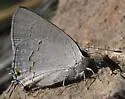
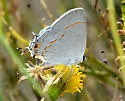
Photo credits: Contributed by Mike Quinn; Additional contributions by Steve Nanz , Nick Block
Frequently Asked Questions About Big Bend Scrub-Hairstreak - Hodges#4292.2
What is Big Bend Scrub-Hairstreak - Hodges#4292.2?
Big Bend Scrub-Hairstreak - Hodges#4292.2 (Strymon solitario) is a species in the family Lycaenidae, within the order Lepidoptera.
Where is Big Bend Scrub-Hairstreak - Hodges#4292.2 found?
| Feature | Details |
|---|---|
| Habitat | Arid, desert and rocky slopes (Grishin & Durden 2012) |
| Range | Type series (30 males and 36 females) from Presidio and Brewster counties, west Texas - Map (Grishin & Durden 2012) Also, apparently present near Ciudad Victoria, Tamaulipas, Mexico based on photos. (Grishin & Durden 2012) |
What does Big Bend Scrub-Hairstreak - Hodges#4292.2 eat?
The diet of the Big Bend Scrub-Hairstreak - Hodges#4292.2 includes Flowerbuds, flowers and fruits of Hechtia texensis (Bromeliaceae) serve a viable larval food source (Grishin & Durden 2012) Texas false agave - Hechtia texensis S. Watson - Photo , Range (Syn: Hechtia scariosa ) Image Gallery - Lady Bird Johnson Wildflower Center.
When is Big Bend Scrub-Hairstreak - Hodges#4292.2 active?
Big Bend Scrub-Hairstreak - Hodges#4292.2: seasonal activity - Over the years, specimens in the Big Bend area have been recorded from February to June and from September to November with majority of records being in late March–April and then September , with early and late dates being 18-Feb-2005 and 9-Oct-1944. No records are available for July, August, December and January. (Grishin & Durden 2012).
What is the life cycle of a Big Bend Scrub-Hairstreak - Hodges#4292.2?
Life cycle from oviposition to adult took about 50 days at 70F in a Dallas, TX laboratory. Larva went through 5 instars which may be attributable to laboratory rearing conditions as the overwhelming majority of Lycaenidae are known to have 4 instars with just a handful of exceptions. (Grishin & Durden 2012)