
Stenochironomus hilaris
This record describes Stenochironomus hilaris (species). Recorded family: Chironomidae. Recorded order: Diptera.
Identification and Appearance
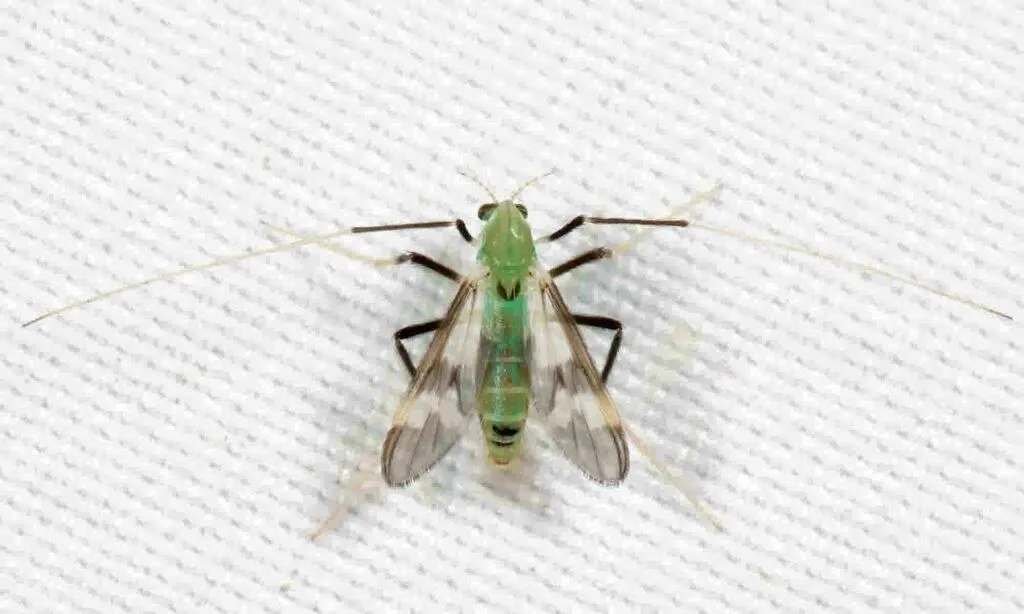
For the genus Stenochironomus page, quoting from AMN description: Pronotum very narrow medially, far surpassed by the strongly projecting anterior part of the mesoscutum. Fork of Cu slightly beyond R-M. Ends of R1 and R2+3 very near together, almost fused; ends of R4+5 and M both near the wing apex, R4+5 usually slightly nearer than M; leg ratio 1.1 to 1.5. (And other stuff that's harder to see in the usual pictures here.) Description of species, same source: Male: Pale green, usually somewhat darker green than in other Nearctic species of the genus. Flagellum beyond the first segment and mouthparts brown; lateral lobe of mesoscutum with a brown stripe in front of the wing base; postnotum marked with brown; wing marked with pale fuscous as in [figure]; apical 0.5 to 0.7 of femora brown, the hind femur being more extensively brown than the others; front and hind tibia entirely brown or the front tibia with a borad indistinct pale annulus covering just beyond its middle; middle tibia with its basal 0.3 brown; apical abdominal segments with the usual subcutaneous black blotches; genitalia brown. Female: Colored like the male except that the wing and femoral dark markings are more extensive and that the front tibia is always entirely brown. … John F. Carr, 14 December, 2008
Wikipedia reference for Stenochironomus hilaris: https://en.wikipedia.org/wiki/Stenochironomus_hilaris.
Classification
- Kingdom
- Animalia
- Phylum
- Arthropoda
- Class
- Insecta
- Order
- Diptera (Flies)
- Superfamily
- Chironomoidea
- Family
- Chironomidae (Non-biting Midges)
- Subfamily
- Chironominae
- Tribe
- Chironomini
- Genus
- Stenochironomus
Imported taxonomy record. Source availability varies; see the source references and editorial policy below.
About Flies: the wider group
Order-level background for Diptera, the group containing Stenochironomus hilaris. Species-specific details appear above.
Group overview
Diptera includes over 150,000 described species of flies, mosquitoes, and midges. Mosquitoes are the deadliest animal on Earth (CDC). Malaria alone causes ~249 million cases and over 608,000 deaths annually, mostly children under 5 (WHO). Vector-borne diseases account for over 17% of all infectious diseases, causing 700,000+ deaths per year.
Ecological role of the group
Despite their disease impact, flies are critical decomposers and pollinators. Hoverflies alone pollinate hundreds of crop and wildflower species. Flies are also the primary food source for many birds, bats, and fish. Forensic entomology relies heavily on fly species for crime scene analysis.
Economic and practical significance of the group
In the U.S., vector-borne disease cases tripled between 2004-2016, with over 640,000 cases reported in that period (CDC). Tickborne diseases doubled from 22,000 to 48,000 annual reports. Globally, mosquito-borne diseases cost billions in healthcare and lost productivity.
Recorded sources for this group: WHO, CDC, PNAS. Imported estimates may describe particular regions or reporting periods.
Photos of Stenochironomus hilaris (3)
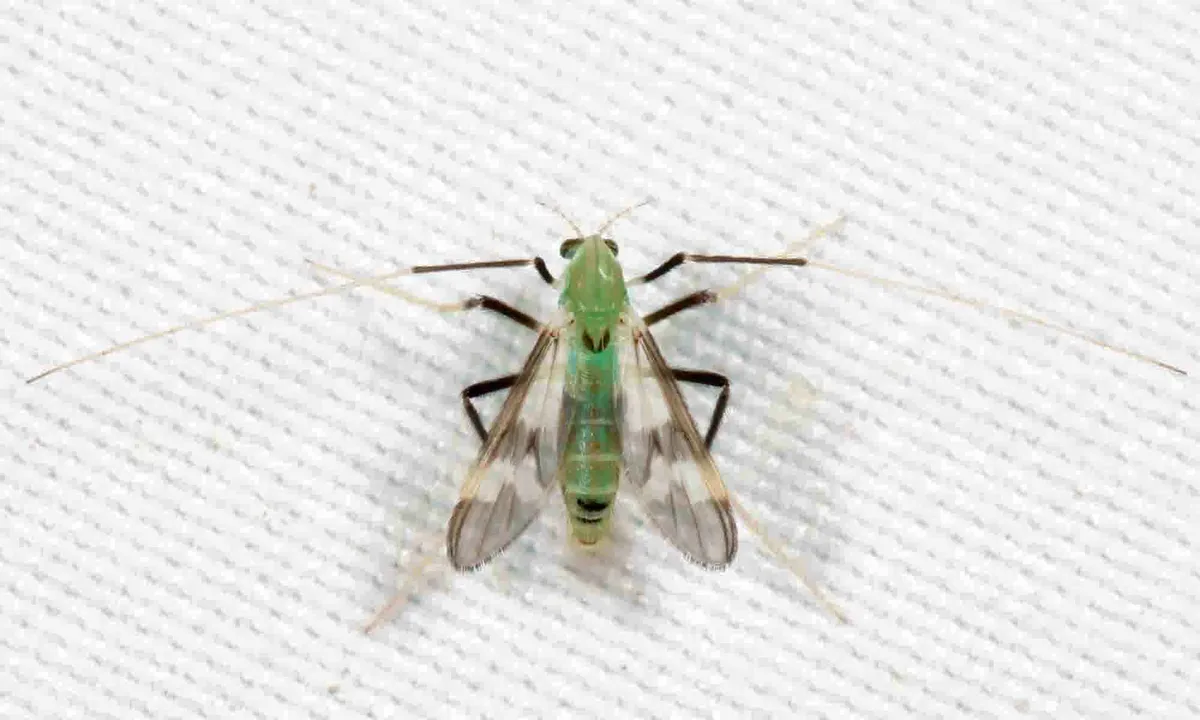
Photo credits: Contributed by john and jane balaban