
Agreeable Tiger Moth - Hodges#8134
Spilosoma congrua
This record describes Spilosoma congrua (species). Recorded family: Erebidae. Recorded order: Lepidoptera.
Identification and Appearance
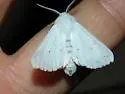
Adult: forewing pure white or marked with transverse rows of black spots; antennal shaft white; inner face of pro-femora yellow-orange; hind tibiae with both pre-apical and apical pair of spurs; abdomen white [adapted from description by Gerald Fauske] Note: This species is very often confused with Spilosoma virginica and Hyphantria cunea where ranges overlap. When a view of the abdomen is not possible, one of the key clues as to which species, lies with the appearance of the legs: in particular, the tibiae and tarsi of the forelegs. The key to using this characteristic to separate these three species is as follows: S.congrua ; tibiae and tarsi will be solid white laterally, bordered by solid black medially along the interior of the tibiae/tarsi with a clear demarcation and no banding on tarsi. S.virginica ; tibiae and tarsi will be strongly white with complete or partial black banding along the tarsi. H. cunea ; tibiae and tarsi vary – in immaculate specimens the tibiae/tarsi is often completely white/pale, while in heavily marked specimens, the tibiae/tarsi are completely black. In other lighter marked specimens, tarsi may appear banded and most similar to S.virginica , but will only appear so laterally with solid black/dark medially. When dealing with this variation, it’s typically described as H.cunea having dark tibiae/tarsi, the tarsi banded with white, verses S.virginica having mostly white tibiae/tarsi, the tarsi banded with black. Where an egg mass is present, another clue is available. The egg masses of S.virginica are typically yellow, of S.congrua typically white, and those of H.cunea , a very pale green.
Classification
- Kingdom
- Animalia
- Phylum
- Arthropoda
- Class
- Insecta
- Order
- Lepidoptera (Butterflies and Moths)
- Superfamily
- Noctuoidea
- Family
- Erebidae
- Subfamily
- Arctiinae
- Tribe
- Arctiini
- Genus
- Spilosoma
Imported taxonomy record. Source availability varies; see the source references and editorial policy below.
Habitat and Range
Geographic Range
Southwestern U.S. north to southern Canada, east to Atlantic.
Seasonal Activity
adults fly from April to August; longer flight season southward
Diet and Behavior
Diet: Larvae are general feeders on herbaceous plants, including dandelion ( Taraxacum spp.), plantain ( Plantago spp.), and pigweed ( Amaranthus spp.)
Life History
Larvae have two color forms eggs; newly emerged larvae; larvae at different stages; older larva of one color form; older larva of the other color form; cocoon; adult
About Butterflies and Moths: the wider group
Order-level background for Lepidoptera, the group containing Spilosoma congrua. Species-specific details appear above.
Group overview
Lepidoptera includes approximately 180,000 described species of butterflies and moths. Moths outnumber butterflies roughly 10:1. The monarch butterfly's eastern population has declined by more than 80% since the mid-1990s, and the western population by over 95% since the 1980s. The IUCN lists the migratory monarch as Vulnerable.
Ecological role of the group
Butterflies and moths are essential indicators of ecosystem health. As caterpillars, they are a primary food source for birds - a single nest of blue tit chicks requires ~10,000 caterpillars. Adult moths pollinate many night-blooming plants.
Economic and practical significance of the group
Lepidoptera are critical pollinators. In Europe, grassland butterfly species have declined by almost 50% since the early 1990s. In the UK, three-quarters of butterflies are in decline. In the U.S., five butterfly species have gone extinct since 1950, with 29 listed as endangered.
Recorded sources for this group: IUCN Red List, Xerces Society, USFWS, PNAS, WWF. Imported estimates may describe particular regions or reporting periods.
Photos of Agreeable Tiger Moth - Hodges#8134 (5)
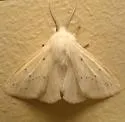
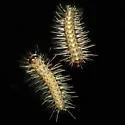
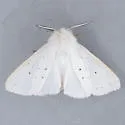
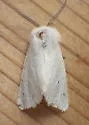
Photo credits: Contributed by Troy Bartlett; Additional contributions by Mike Boone , Beatriz Moisset , Robin McLeod , Tony-2 , Jason D. Roberts , ceiseman , Robert Lord Zimlich , marcie oconnor , Blocky
Frequently Asked Questions About Agreeable Tiger Moth - Hodges#8134
What is Agreeable Tiger Moth - Hodges#8134?
Agreeable Tiger Moth - Hodges#8134 (Spilosoma congrua) is a species in the family Erebidae, within the order Lepidoptera.
How big is Agreeable Tiger Moth - Hodges#8134?
wingspan 27-47 mm
How do you identify Agreeable Tiger Moth - Hodges#8134?
Adult: forewing pure white or marked with transverse rows of black spots; antennal shaft white; inner face of pro-femora yellow-orange; hind tibiae with both pre-apical and apical pair of spurs; abdomen white [adapted from description by Gerald Fauske]
Where is Agreeable Tiger Moth - Hodges#8134 found?
Range: Southwestern U.S. north to southern Canada, east to Atlantic.
What does Agreeable Tiger Moth - Hodges#8134 eat?
The diet of the Agreeable Tiger Moth - Hodges#8134 includes Larvae are general feeders on herbaceous plants, including dandelion ( Taraxacum spp.), plantain ( Plantago spp.), and pigweed ( Amaranthus spp.).
When is Agreeable Tiger Moth - Hodges#8134 active?
Agreeable Tiger Moth - Hodges#8134: seasonal activity - adults fly from April to August; longer flight season southward.
What is the life cycle of a Agreeable Tiger Moth - Hodges#8134?
Larvae have two color forms eggs; newly emerged larvae; larvae at different stages; older larva of one color form; older larva of the other color form; cocoon; adult