
Regal Fritillary - Hodges#4452
Speyeria idalia
This record describes Speyeria idalia (species). Recorded family: Nymphalidae. Recorded order: Lepidoptera.
Identification and Appearance
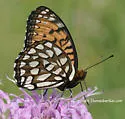
Large. Upperside of forewing bright red-orange with black markings. Upperside of hindwing black with postmedian row of white spots; submarginal row of spots is orange in male and white in female. Rapidly vanishing or declining in much of its range. A species of concern for the United States Fish and Wildlife Service. All populations should be conserved. Threatened throughout its range. Management needs: Monitor populations and manage populations on public lands and preserves. Oklahoma considers this to be a Species of Greatest Conservation Need (SGCN)
Classification
- Kingdom
- Animalia
- Phylum
- Arthropoda
- Class
- Insecta
- Order
- Lepidoptera (Butterflies and Moths)
- Superfamily
- Papilionoidea
- Family
- Nymphalidae (Brush-footed Butterflies)
- Subfamily
- Heliconiinae
- Tribe
- Argynnini
- Genus
- Speyeria (Greater Fritillaries)
Imported taxonomy record. Source availability varies; see the source references and editorial policy below.
Habitat and Range
Habitat
"Tall-grass prairie and other open sites including damp meadows, marshes, wet fields, and mountain pastures."
Geographic Range
e CO to MA to se SK - Map - MPG
Seasonal Activity
One brood, June-Sept - MPG
Diet and Behavior
Diet: "Caterpillar hosts: Violets including bird's foot violet ( Viola pedata ). Adult food: Nectar from flowers of milkweeds, thistles, red clover, and mountain mint."
Life History
"Males patrol for females with a low, steady flight. Females walk through vegetation to lay single eggs on various plants, even if the host violets are not present. Most eggs are laid in August. The caterpillars hatch and overwinter unfed; in spring they eat leaves of host plants."
Additional species information
Species notes from the sources
Etymology: Speyeria idalia (Drury, 1773)
About Butterflies and Moths: the wider group
Order-level background for Lepidoptera, the group containing Speyeria idalia. Species-specific details appear above.
Group overview
Lepidoptera includes approximately 180,000 described species of butterflies and moths. Moths outnumber butterflies roughly 10:1. The monarch butterfly's eastern population has declined by more than 80% since the mid-1990s, and the western population by over 95% since the 1980s. The IUCN lists the migratory monarch as Vulnerable.
Ecological role of the group
Butterflies and moths are essential indicators of ecosystem health. As caterpillars, they are a primary food source for birds - a single nest of blue tit chicks requires ~10,000 caterpillars. Adult moths pollinate many night-blooming plants.
Economic and practical significance of the group
Lepidoptera are critical pollinators. In Europe, grassland butterfly species have declined by almost 50% since the early 1990s. In the UK, three-quarters of butterflies are in decline. In the U.S., five butterfly species have gone extinct since 1950, with 29 listed as endangered.
Recorded sources for this group: IUCN Red List, Xerces Society, USFWS, PNAS, WWF. Imported estimates may describe particular regions or reporting periods.
Photos of Regal Fritillary - Hodges#4452 (5)
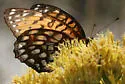
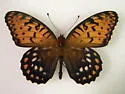
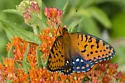
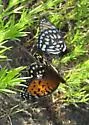
Photo credits: Contributed by Matthew Roth; Additional contributions by Beatriz Moisset , Mike Quinn , marcie oconnor
Frequently Asked Questions About Regal Fritillary - Hodges#4452
What is Regal Fritillary - Hodges#4452?
Regal Fritillary - Hodges#4452 (Speyeria idalia) is a species in the family Nymphalidae, within the order Lepidoptera.
How big is Regal Fritillary - Hodges#4452?
6.7 - 10.5 cm
How do you identify Regal Fritillary - Hodges#4452?
Large. Upperside of forewing bright red-orange with black markings. Upperside of hindwing black with postmedian row of white spots; submarginal row of spots is orange in male and white in female.
Where is Regal Fritillary - Hodges#4452 found?
| Feature | Details |
|---|---|
| Habitat | Tall-grass prairie and other open sites including damp meadows, marshes, wet fields, and mountain pastures. |
| Range | e CO to MA to se SK - Map - MPG |
What does Regal Fritillary - Hodges#4452 eat?
The diet of the Regal Fritillary - Hodges#4452 includes Caterpillar hosts: Violets including bird's foot violet ( Viola pedata ). Adult food: Nectar from flowers of milkweeds, thistles, red clover, and mountain mint..
When is Regal Fritillary - Hodges#4452 active?
Regal Fritillary - Hodges#4452: seasonal activity - One brood, June-Sept - MPG.
What is the life cycle of a Regal Fritillary - Hodges#4452?
Males patrol for females with a low, steady flight. Females walk through vegetation to lay single eggs on various plants, even if the host violets are not present. Most eggs are laid in August. The caterpillars hatch and overwinter unfed; in spring they eat leaves of host plants.