
Great Basin Fritillary - Hodges#4458
Speyeria egleis
This record describes Speyeria egleis (species). Recorded family: Nymphalidae. Recorded order: Lepidoptera.
Identification and Appearance
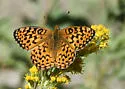
Subspecies are sometimes not separable except by knowing locality found. The value and extent of application of some names (as true in many Speyeria species) can be debated, as geographically adjacent subspecies often tend to be extremely similar, and in some cases there is no separation between them. Generally those from desert mountain ranges, particularly in the eastern Great Basin, are the palest in coloring, and sometimes (particularly northward) there is a greenish tinge below. Those from the northern coastal mountains and especially from the Southern Rocky Mountains tend to be the darkest, and especially in the Rockies may be quite reddish below. Most populations have the pale spots below silvered, but in northwest California and adjacent Oregon unsilvered individuals dominate some populations. Speyeria egleis seems to generally be more rare than other species of Speyeria , and is one of the least often encountered; however, it occurs in localized colonies where it may be quite numerous.
Classification
- Kingdom
- Animalia
- Phylum
- Arthropoda
- Class
- Insecta
- Order
- Lepidoptera (Butterflies and Moths)
- Superfamily
- Papilionoidea
- Family
- Nymphalidae (Brush-footed Butterflies)
- Subfamily
- Heliconiinae
- Tribe
- Argynnini
- Genus
- Speyeria (Greater Fritillaries)
Imported taxonomy record. Source availability varies; see the source references and editorial policy below.
Habitat and Range
Habitat
Mostly in smallish sunny openings, hollows, glades, etc. in otherwise cool forested areas; often associated with Aspen and Bracken. Usually habitats are of a fairly moist verdent nature.
Geographic Range
Western U.S. in mountain areas west of the Great Plains; north from Colorado, Utah, Nevada, and California; south of Canada. Barely entering se. British Columbia and perhaps sw. Alberta, but not officially verified from either province.
About Butterflies and Moths: the wider group
Order-level background for Lepidoptera, the group containing Speyeria egleis. Species-specific details appear above.
Group overview
Lepidoptera includes approximately 180,000 described species of butterflies and moths. Moths outnumber butterflies roughly 10:1. The monarch butterfly's eastern population has declined by more than 80% since the mid-1990s, and the western population by over 95% since the 1980s. The IUCN lists the migratory monarch as Vulnerable.
Ecological role of the group
Butterflies and moths are essential indicators of ecosystem health. As caterpillars, they are a primary food source for birds - a single nest of blue tit chicks requires ~10,000 caterpillars. Adult moths pollinate many night-blooming plants.
Economic and practical significance of the group
Lepidoptera are critical pollinators. In Europe, grassland butterfly species have declined by almost 50% since the early 1990s. In the UK, three-quarters of butterflies are in decline. In the U.S., five butterfly species have gone extinct since 1950, with 29 listed as endangered.
Recorded sources for this group: IUCN Red List, Xerces Society, USFWS, PNAS, WWF. Imported estimates may describe particular regions or reporting periods.
Photos of Great Basin Fritillary - Hodges#4458 (5)
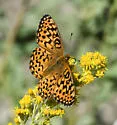
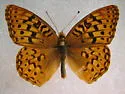
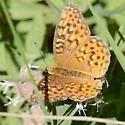
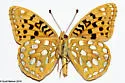
Photo credits: Contributed by tom murray; Additional contributions by Steve Nanz , David Ferguson