
Smicronyx quadrifer
This record describes Smicronyx quadrifer (species). Recorded family: Curculionidae. Recorded order: Coleoptera.
Identification and Appearance
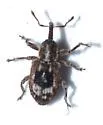
| Feature | Description |
|---|---|
| Additional details | A nearly quadrate patch of dark scales present near middle (and divided by sutural line) of elytra Description : Rostra of both sexes stout, black to piceous, rugosely punctate from base to apex; closely squamose from base to near apex in male, to just before the antennal insertions in female. |
| Head | Head black to piceous; surface dull, finely alutaceous; finely and thinly squamose in front. |
| Antennae | Antennae rufopiceous throughout. Prothorax broadly rounded at the sides, suddenly narrowed and slightly constricted near apex, scales either elongate and setalike or elliptical, yellowish brown or white, the white scales arranged in three short vittae, which extend for a little more than half the distance from base to apex. |
| Elytra | Elytra black, intervals covered, in addition to prominent setalike scales, with elliptical scales, of which some are yellowish brown; some, in a subquadrate median patch, nearly black, a few white; white scales condensed to form a white vitta at the base of the third intervals and an abbreviated band at rear edge of the dark patch. Underside of the thorax and abdomen black, covered with broadly ovate white scales. Femora moderately clavate, piceous, covered with elliptical pale yellowish brown to white scales. Tarsi piceous, covered with white scales, third segment only slightly broader than first two; fourth segment moderately exceeding third; claws nearly parallel, connate for approximately half their length. SWRS Coleoptera Course 2019 Adults come to lights |
Classification
- Kingdom
- Animalia
- Phylum
- Arthropoda
- Class
- Insecta
- Order
- Coleoptera (Beetles)
- Suborder
- Polyphaga
- Superfamily
- Curculionoidea
- Family
- Curculionidae (Snout and Bark Beetles)
- Subfamily
- Curculioninae
- Tribe
- Smicronychini
- Genus
- Smicronyx
Imported taxonomy record. Source availability varies; see the source references and editorial policy below.
Habitat and Range
Geographic Range
MD-FL-AZ - Map , most records AZ Map
Diet and Behavior
Life History
Restricted in host preference to parasitic dodders ( Cuscuta spp., Cuscutaceae) during its adult life, but its larvae consistently move from dodder stems into living stems of certain hosts of dodders, where they feed, grow to maturity, and undergo metamorphosis. Such associations, involving three interacting organisms, are very unusual among phytogragous insects. (Anderson 1970)
Additional species information
Species notes from the sources
Etymology: Smicronyx quadrifer Casey 1892
About Primitive Winged Insects: the wider group
Order-level background for Coleoptera, the group containing Smicronyx quadrifer. Species-specific details appear above.
Group overview
Coleoptera is the largest order of insects with over 400,000 described species, representing ~25% of all known animal species and ~40% of all insects. In the U.S. alone, nearly 30,000 beetle species have been identified.
Ecological role of the group
Beetles are prominent decomposers, especially in forests, breaking down dead wood and recycling nutrients. As predators, they reduce populations of pest insects. Many species are also important pollinators of flowering plants.
Economic and practical significance of the group
Beetles have major economic significance: leaf beetles (Chrysomelidae) and weevils (Curculionoidea) are among the most destructive agricultural pests globally, costing billions annually, while predatory species like ladybugs provide natural pest control.
Recorded sources for this group: Britannica, Smithsonian, NCSU Entomology. Imported estimates may describe particular regions or reporting periods.
Photos of Smicronyx quadrifer (5)
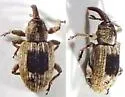
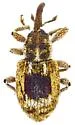
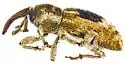
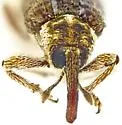
Photo credits: Contributed by v belov; Additional contributions by Mike Quinn
Frequently Asked Questions About Smicronyx quadrifer
What is Smicronyx quadrifer?
Smicronyx quadrifer is a species in the family Curculionidae, within the order Coleoptera.
How big is Smicronyx quadrifer?
2.2-2.5 mm
How do you identify Smicronyx quadrifer?
| Feature | Description |
|---|---|
| Additional details | A nearly quadrate patch of dark scales present near middle (and divided by sutural line) of elytra Description : Rostra of both sexes stout, black to piceous, rugosely punctate from base to apex; closely squamose from base to near apex in male, to just before the antennal insertions in female. |
| Head | Head black to piceous; surface dull, finely alutaceous; finely and thinly squamose in front. |
| Antennae | Antennae rufopiceous throughout. Prothorax broadly rounded at the sides, suddenly narrowed and slightly constricted near apex, scales either elongate and setalike or elliptical, yellowish brown or white, the white scales arranged in three short vittae, which extend for a little more than half the distance from base to apex. |
| Elytra | Elytra black, intervals covered, in addition to prominent setalike scales, with elliptical scales, of which some are yellowish brown; some, in a subquadrate median patch, nearly black, a few white; white scales condensed to form a white vitta at the base of the third intervals and an abbreviated band at rear edge of the dark patch. Underside of the thorax and abdomen black, covered with broadly ovate white scales. Femora moderately clavate, piceous, covered with elliptical pale yellowish brown to white scales. Tarsi piceous, covered with white scales, third segment only slightly broader than first two; fourth segment moderately exceeding third; claws nearly parallel, connate for approximately half their length. SWRS Coleoptera Course 2019 |
Where is Smicronyx quadrifer found?
Range: MD-FL-AZ - Map , most records AZ Map
What is the life cycle of a Smicronyx quadrifer?
Restricted in host preference to parasitic dodders ( Cuscuta spp., Cuscutaceae) during its adult life, but its larvae consistently move from dodder stems into living stems of certain hosts of dodders, where they feed, grow to maturity, and undergo metamorphosis. Such associations, involving three interacting organisms, are very unusual among phytogragous insects. (Anderson 1970)