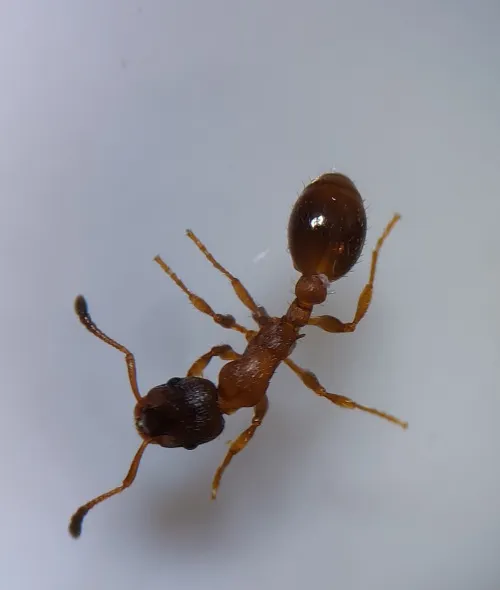
Slender Ant
Leptothorax acervorum
This record describes Leptothorax acervorum (species). Recorded family: Formicidae. Recorded order: Hymenoptera.
Identification and Appearance
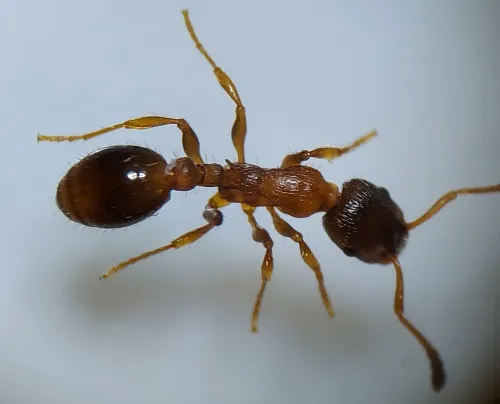
A small myrmicine ant with distinct propodeal spines and three-segmented antennal clubs. Reddish to brownish yellow with the head and gaster appearing much darker. Adult workers are typically 3 to 3.5 mm total in length. Can be confused with Temnothorax species but Leptothorax acervorum is slightly larger. It can be distinguished by an 11-segmented antenna in the females (12 in males); the Temnothorax species have one extra funicular segment. Antennae 11-segmented; scapes short, not reaching posterior margin of head in full-face view. / Pro- and mesonotal dorsa depressed in profile / Propodeal dorsum weakly convex / Propodeal spines longer than wide in side view, with acute tips Unless identified by a recognised expert, a photo is required and the specimen should be examined with a microscope. In the comments box, state the key or ID method used and describe the size and identifying characters. This ant occurs in a wide range of habitats although more frequently in undisturbed, mature areas where suitable nest sites occur. In woods and farmland the nests are commonly found in dead trees, fallen boughs or stumps, under bark and in old fence posts. In upland moor, mountain and lowland heath the nests are often in the ground around the base of heather plants, in exposed dried peat and under stones or in rock crevices. Colonies are small, containing less than a hundred individuals and usually have one to a few queens. Alates (winged reproductives) occur in mid-summer and are inconspicuous. Adult workers can be seen from early spring through to autumn. Workers of L. acervorum forage singly and unobtrusively, mainly in search of carrion, although they may tackle very small and weak invertebrates. Homoptera are not actively tended for their honeydew. They forage over the ground and rock surface or amongst fallen dead wood and leaf litter and can often be found taking scraps of food, dead corpses and nest rubbish from around the colonies of other much larger ants such as Formica species. They are rarely bothered by the larger ants due to their stealthy and appeasing nature and L. acervorum nests can also often be found in close association with those of other species. This ant is not regarded as being scarce or threatened. Widely distributed throughout England, Wales, Scotland and Ireland.
Classification
- Kingdom
- Animalia
- Phylum
- Arthropoda
- Class
- Insecta
- Order
- Hymenoptera (Ants, Bees, Wasps and Sawflies)
- Superfamily
- Formicoidea
- Family
- Formicidae (Ants)
- Subfamily
- Myrmicinae
- Tribe
- Crematogastrini
- Genus
- Leptothorax
Imported taxonomy record. Source availability varies; see the source references and editorial policy below.
Habitat and Range
Seasonal Activity
Alates (winged reproductives) occur in mid-summer and are inconspicuous. Adult workers can be seen from early spring through to autumn.
Additional species information
Recorded status
This ant is not regarded as being scarce or threatened. Widely distributed throughout England, Wales, Scotland and Ireland.
About Flies: the wider group
Order-level background for Hymenoptera, the group containing Leptothorax acervorum. Species-specific details appear above.
Group overview
Hymenoptera includes over 150,000 described species of ants, bees, wasps, and sawflies. Earth harbors approximately 20 quadrillion (20×10^15) ants, with a combined biomass of ~12 megatons of dry carbon - exceeding the combined biomass of all wild birds and mammals (PNAS, 2022).
Ecological role of the group
About 35% of the world's food crops depend on animal pollinators. The chocolate industry, valued at over $100 billion, depends on pollinating flies and midges. Ants are the dominant soil engineers in most terrestrial ecosystems, turning more soil than earthworms in many habitats.
Economic and practical significance of the group
Pollinators contribute $235-577 billion worth of annual global food production (FAO). In the U.S., bee pollination alone benefits crops valued at $18 billion annually, and honey bees are responsible for $5.4 billion in agricultural productivity. Between April 2023-2024, 55.1% of managed honey bee colonies were lost. The U.S. bee population dropped from 5 million to 2.5 million.
Recorded sources for this group: FAO, USDA, EPA, PNAS (2022), US Fish & Wildlife Service. Imported estimates may describe particular regions or reporting periods.