
Spot-winged Pond Fly
Sericomyia flagrans
This record describes Sericomyia flagrans (species). Recorded family: Syrphidae. Recorded order: Diptera.
Identification and Appearance
| Feature | Description |
|---|---|
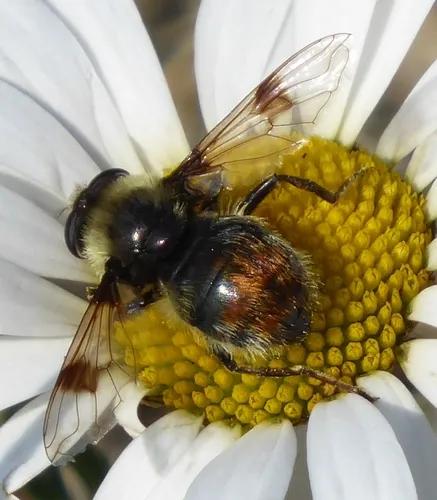
| Additional details | Bumble-bee mimic. |
| Antennae | Antennae short, with a plumose arista attached baso-dorsally on the bulbous 3rd segment (= flagellomere). |
| Thorax | Thorax with dark, metallic coppery-bronze, ground color...densely-covered with long, pale-yellow hairs. |
| Abdomen | Abdomen with shining black ground color, having long pale-yellow hairs laterally and reddish-orange hairs dorsally and near the posterior tip (sometimes reddish hairs of the central dorsal area reduced or lacking). |
| Wings | Wings with an isolated dark blotch mid-way out on their anterior half; wing-vein R4+5 with a noticeable dip beyond the dark blotch. Original description (as Anthophila flagrans ) can be read here . From the key to Sericomyia species on pg. 223 of Skevington & Thompson : Conspicuous hilltopping behavior has been noted for Sericomyia by J. H. Skevington ...and also observed in the posts below: |
Classification
Habitat and Range
Habitat
Often found in mountains at high altitude...the posts below range from 9000 to 12,000 feet in elevation: It can also occur at lower elevations, e.g. at 4700 feet in the post below: ...and closer to sea level in the far northern latitudes of its range (e.g. Alaska).
Geographic Range
w. NA (AK-CA to AB-NM)
Diet and Behavior
Diet: "Larvae are rat-tailed maggots and live in ponds rich in decomposing vegetation where they filter out microorganisms as their food."
About Flies: the wider group
Order-level background for Diptera, the group containing Sericomyia flagrans. Species-specific details appear above.
Group overview
Diptera includes over 150,000 described species of flies, mosquitoes, and midges. Mosquitoes are the deadliest animal on Earth (CDC). Malaria alone causes ~249 million cases and over 608,000 deaths annually, mostly children under 5 (WHO). Vector-borne diseases account for over 17% of all infectious diseases, causing 700,000+ deaths per year.
Ecological role of the group
Despite their disease impact, flies are critical decomposers and pollinators. Hoverflies alone pollinate hundreds of crop and wildflower species. Flies are also the primary food source for many birds, bats, and fish. Forensic entomology relies heavily on fly species for crime scene analysis.
Economic and practical significance of the group
In the U.S., vector-borne disease cases tripled between 2004-2016, with over 640,000 cases reported in that period (CDC). Tickborne diseases doubled from 22,000 to 48,000 annual reports. Globally, mosquito-borne diseases cost billions in healthcare and lost productivity.
Recorded sources for this group: WHO, CDC, PNAS. Imported estimates may describe particular regions or reporting periods.
Photos of Spot-winged Pond Fly (2)
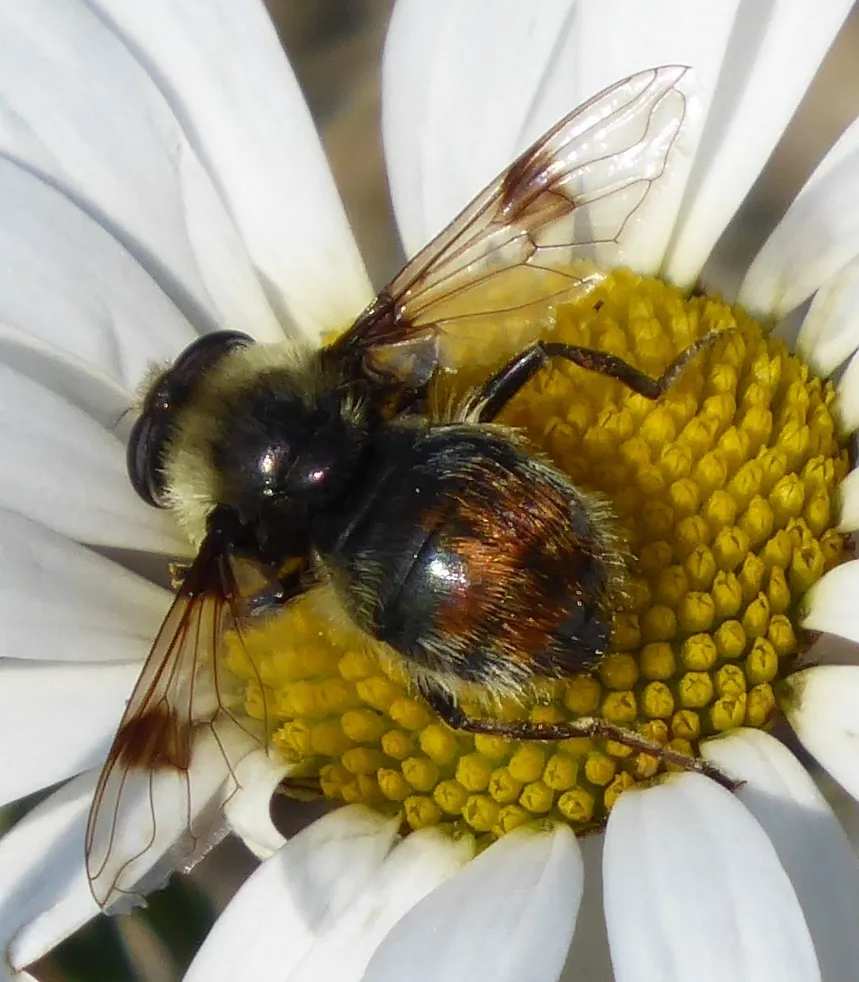
Photo credits: Contributed by Martin Hauser; Additional contributions by Aaron Schusteff , v belov , zdanko
Frequently Asked Questions About Spot-winged Pond Fly
What is Spot-winged Pond Fly?
Spot-winged Pond Fly (Sericomyia flagrans) is a species in the family Syrphidae, within the order Diptera.
How do you identify Spot-winged Pond Fly?
| Feature | Description |
|---|---|
| Additional details | Bumble-bee mimic. |
| Antennae | Antennae short, with a plumose arista attached baso-dorsally on the bulbous 3rd segment (= flagellomere). |
| Thorax | Thorax with dark, metallic coppery-bronze, ground color...densely-covered with long, pale-yellow hairs. |
| Abdomen | Abdomen with shining black ground color, having long pale-yellow hairs laterally and reddish-orange hairs dorsally and near the posterior tip (sometimes reddish hairs of the central dorsal area reduced or lacking). |
| Wings | Wings with an isolated dark blotch mid-way out on their anterior half; wing-vein R4+5 with a noticeable dip beyond the dark blotch. Original description (as Anthophila flagrans ) can be read here . From the key to Sericomyia species on pg. 223 of Skevington & Thompson : |
Where is Spot-winged Pond Fly found?
| Feature | Details |
|---|---|
| Habitat | Often found in mountains at high altitude...the posts below range from 9000 to 12,000 feet in elevation: It can also occur at lower elevations, e.g. at 4700 feet in the post below: ...and closer to sea level in the far northern latitudes of its range (e.g. Alaska). |
| Range | w. NA (AK-CA to AB-NM) |
What does Spot-winged Pond Fly eat?
The diet of the Spot-winged Pond Fly includes Larvae are rat-tailed maggots and live in ponds rich in decomposing vegetation where they filter out microorganisms as their food..