
Mesquite Looper Moth - Hodges#6415
Rindgea cyda
This record describes Rindgea cyda (species). Recorded family: Geometridae. Recorded order: Lepidoptera.
Identification and Appearance
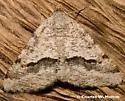
Adult: forewing ground color white but largely obscured by extensive dark transverse streaks; PM line thick, black, sinuous, interrupted by yellowish-orange blob near costa; AM and median lines blackish, diffuse, almost straight; band of dark gray shading immediately beyond PM line, followed by whitish transverse band representing a subterminal line; terminal line a series of black dashes; hindwing light yellowish-brown with conspicuous dark median line * in south Texas Rindgea cyda can only be distinguished from the nearly identical R. s-signata by genitalia. ♂ ♀ The S-signata group consists of three very similar species. Please see notes on the range which is often helpful in determining the species. Rindgea ballandrata R. cyda R. s-signata 6/5/2022 by Ann Hendrickson: I have just discovered an error in the naming of the Male genitalia in the Ferguson fascicle on Page 340. Since I have made all of my identifications from the Male genitalia, I have missed this for YEARS! I made this discovery when I recently reared Rindgea s-signata for the FIRST TIME. The mother dissects as the Ferguson R. s-signata while 5 males from the brood dissect as the Ferguson named Rindgea cyda photographs b & d! That would indicate that the female dissections are the ones that are correctly named. The caterpillar posted on BOLD as TXLEP669-19, BIN, BOLD:AAF0914 was beaten from a Mesquite tree and matches Rindgea cyda , however, it is not Barcode compliant as is the comparison specimen. All of my barcode compliant specimens match. I am hoping that when I submit three specimens that dissect as R.s-signata , they will not match the others!
Classification
- Kingdom
- Animalia
- Phylum
- Arthropoda
- Class
- Insecta
- Order
- Lepidoptera (Butterflies and Moths)
- Superfamily
- Geometroidea
- Family
- Geometridae (Geometrid Moths)
- Subfamily
- Ennominae
- Tribe
- Macariini
- Genus
- Rindgea
Imported taxonomy record. Source availability varies; see the source references and editorial policy below.
Habitat and Range
Geographic Range
Louisiana to southern California. Recorded as vagrants in Oklahoma, Arkansas, Missouri and Kansas. (its presence on a list from New York presumably represents an accidental record)
Seasonal Activity
Adults fly year round in the warmer areas. Adults fly from March to September in California.
Diet and Behavior
Diet: Larvae feed on mesquite ( Prosopis spp.) and beardtongue ( Penstemon spp.).
About Butterflies and Moths: the wider group
Order-level background for Lepidoptera, the group containing Rindgea cyda. Species-specific details appear above.
Group overview
Lepidoptera includes approximately 180,000 described species of butterflies and moths. Moths outnumber butterflies roughly 10:1. The monarch butterfly's eastern population has declined by more than 80% since the mid-1990s, and the western population by over 95% since the 1980s. The IUCN lists the migratory monarch as Vulnerable.
Ecological role of the group
Butterflies and moths are essential indicators of ecosystem health. As caterpillars, they are a primary food source for birds - a single nest of blue tit chicks requires ~10,000 caterpillars. Adult moths pollinate many night-blooming plants.
Economic and practical significance of the group
Lepidoptera are critical pollinators. In Europe, grassland butterfly species have declined by almost 50% since the early 1990s. In the UK, three-quarters of butterflies are in decline. In the U.S., five butterfly species have gone extinct since 1950, with 29 listed as endangered.
Recorded sources for this group: IUCN Red List, Xerces Society, USFWS, PNAS, WWF. Imported estimates may describe particular regions or reporting periods.
Photos of Mesquite Looper Moth - Hodges#6415 (5)
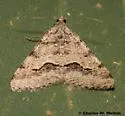
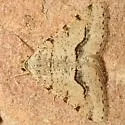
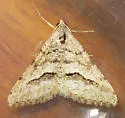
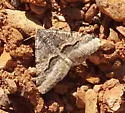
Photo credits: Contributed by Robin McLeod; Additional contributions by Steve Nanz , Mike Quinn , Maury Heiman , Robert Lord Zimlich , Randy Hardy , A. Hendrickson , Robert H. Biagi
Frequently Asked Questions About Mesquite Looper Moth - Hodges#6415
What is Mesquite Looper Moth - Hodges#6415?
Mesquite Looper Moth - Hodges#6415 (Rindgea cyda) is a species in the family Geometridae, within the order Lepidoptera.
How big is Mesquite Looper Moth - Hodges#6415?
Forewing length: ♂ 10-13 mm, ♀ 10-15 mm.
How do you identify Mesquite Looper Moth - Hodges#6415?
Adult: forewing ground color white but largely obscured by extensive dark transverse streaks; PM line thick, black, sinuous, interrupted by yellowish-orange blob near costa; AM and median lines blackish, diffuse, almost straight; band of dark gray shading immediately beyond PM line, followed by whitish transverse band representing a subterminal line; terminal line a series of black dashes; hindwing light yellowish-brown with conspicuous dark median line * in south Texas Rindgea cyda can only be distinguished from the nearly identical R. s-signata by genitalia. ♂ ♀
Where is Mesquite Looper Moth - Hodges#6415 found?
Range: Louisiana to southern California. Recorded as vagrants in Oklahoma, Arkansas, Missouri and Kansas. (its presence on a list from New York presumably represents an accidental record)
What does Mesquite Looper Moth - Hodges#6415 eat?
The diet of the Mesquite Looper Moth - Hodges#6415 includes Larvae feed on mesquite ( Prosopis spp.) and beardtongue ( Penstemon spp.)..
When is Mesquite Looper Moth - Hodges#6415 active?
Mesquite Looper Moth - Hodges#6415: seasonal activity - Adults fly year round in the warmer areas. Adults fly from March to September in California..