
Red-veined Darter
Sympetrum fonscolombii
This record describes Sympetrum fonscolombii (species). Recorded family: Libellulidae. Recorded order: Odonata.
Identification and Appearance
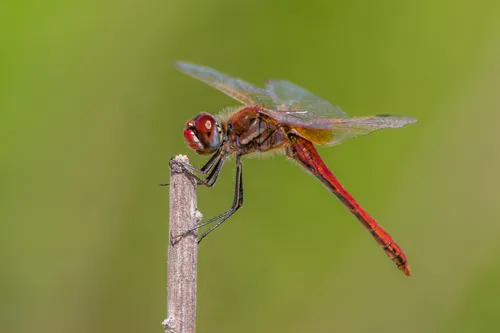
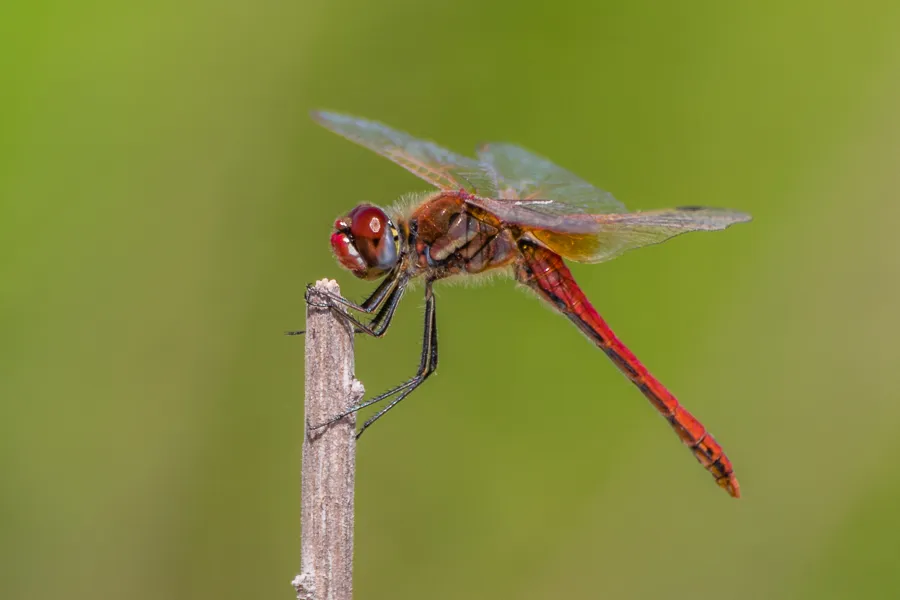
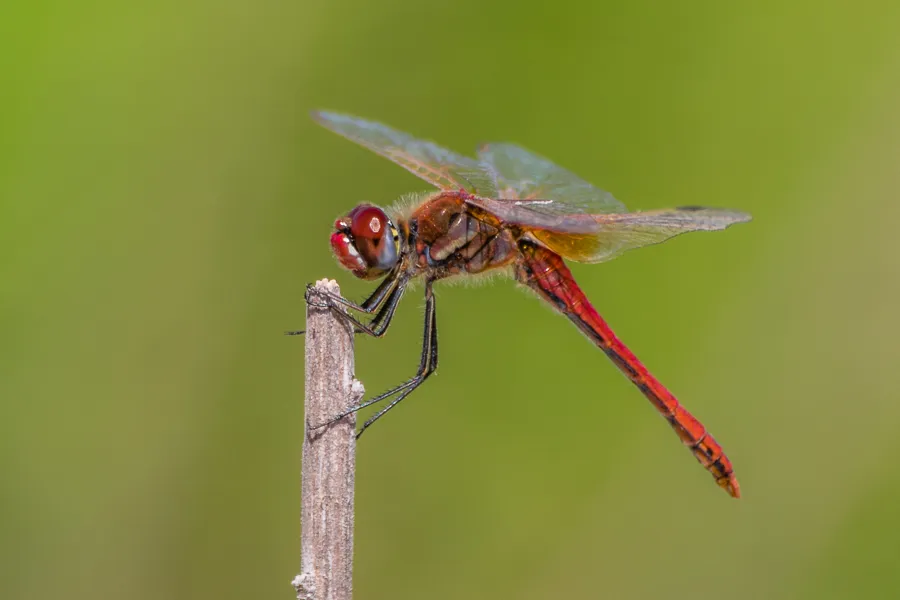
Length: 38 to 40 mm.The bright red males and clear yellow-brown females are attractive. The eyes are brown above and blue below and the wing bases are yellow. The pterostigma is yellow to orange strongly outlined in black. The males become a deep red with maturity with red veins on the wings, particularly on the leading edges. The frons and the thorax are red-brown. Females have a ochre yellow abdomen with two black lines along each side. The wing veins are yellow at the costa, leading edge and base. Immature males are coloured as the females but have only a single line along each side of the abdomen. As a long-distance migrant this species can occur practically anywhere. Locally bred specimens will likely favour a variety of shallow water ponds, lakes, rivers and ditches. Breeds nearly annually in Britain, but colonies seemingly not stable. Recent colonist (first records 1999). Local but spreading spectacularly through southeast England and the Isle of Wight. Historically the Red-veined Darter has been regarded as a migrant to the British Isles, with scattered records being documented in most years. Prior to 2006 this species maintained a similar status in VC 55, with just two records of what were assumed to be migrants appearing on the LRDG database. These were of a female at Huncote in June 1992 and a male at Kelham Bridge NR in July 1992. Coinciding with a number of widespread proven breeding occurrences in Britain, up to 12 fresh teneral Red-veined Darters were recorded at Huncote in 2006. The initial observation was made on 3rd September and the last on 7th October, with local emergence being strongly suspected. Additionally a further four male Red-veined Darters were observed at Priory Water in 2006, between mid June and early August, though there was no reason to suspect breeding at this site.
Wikipedia reference for Sympetrum fonscolombii: http://en.wikipedia.org/wiki/Red-veined_darter.
Classification
- Kingdom
- Animalia
- Phylum
- Arthropoda
- Class
- Insecta
- Order
- Odonata
- Family
- Libellulidae
- Genus
- Sympetrum
Imported taxonomy record. Source availability varies; see the source references and editorial policy below.
Habitat and Range
Habitat
As a long-distance migrant this species can occur practically anywhere. Locally bred specimens will likely favour a variety of shallow water ponds, lakes, rivers and ditches.
Seasonal Activity
June to early October.
Diet and Behavior
Life History
Breeds nearly annually in Britain, but colonies seemingly not stable.
Additional species information
Recorded status
Recent colonist (first records 1999). Local but spreading spectacularly through southeast England and the Isle of Wight.
About Dragonflies and Damselflies: the wider group
Order-level background for Odonata, the group containing Sympetrum fonscolombii. Species-specific details appear above.
Group overview
Odonata includes ~6,000 described species of dragonflies and damselflies. Dragonflies are among the fastest flying insects, reaching 36 mph (58 km/h). They can fly in any direction including backward, and hover in place - each wing operates independently.
Ecological role of the group
Dragonflies predate dinosaurs by nearly 100 million years - fossils date to 325 million years ago. The largest dragonfly ancestor, Meganeuropsis permiana (285 mya), had a 75cm wingspan, enabled by atmospheric oxygen levels of 31-35% compared to today's 21%. Dragonflies have a 95% hunting success rate - the highest of any predator.
Economic and practical significance of the group
Dragonflies are voracious predators that consume hundreds of mosquitoes daily, providing natural pest control worth millions in reduced mosquito-borne disease risk. A single dragonfly can eat 30 to hundreds of mosquitoes per day.
Recorded sources for this group: Natural History Museum London, Britannica, fossil record research. Imported estimates may describe particular regions or reporting periods.
Photos of Red-veined Darter (3)
Frequently Asked Questions About Red-veined Darter
What is Red-veined Darter?
Red-veined Darter (Sympetrum fonscolombii) is a species in the family Libellulidae, within the order Odonata.
Where is Red-veined Darter found?
Habitat: As a long-distance migrant this species can occur practically anywhere. Locally bred specimens will likely favour a variety of shallow water ponds, lakes, rivers and ditches.
When is Red-veined Darter active?
Red-veined Darter: seasonal activity - June to early October..
What is the life cycle of a Red-veined Darter?
Breeds nearly annually in Britain, but colonies seemingly not stable.