
Pyrausta linealis - Hodges#5024
Pyrausta linealis
This record describes Pyrausta linealis (species). Recorded family: Crambidae. Recorded order: Lepidoptera.
Identification and Appearance
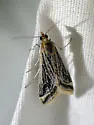
| Feature | Description |
|---|---|
| Head | Head, thorax, and palpi on the outside, light chestnut brown. Palpi, white beneath, and a white line over each eye, which extends forward and around the frontal projection. |
| Forewings | Forewings, dark brown, chestnut brown on the basal part of the costs, and overlaid to a great extent with white scales, especially along the veins which are indicated by white lines. The inner cross-line is not indicated. The outer cross-line is white, nearly parallel with the outer border, and nearer to it than to the end of the cell, wider on the costa than elsewhere, and not quite reaching the hind margin. Terminal line, dark brown, bordered on the inside by a wider white line. Fringes, pale yellowish, with a darker line through the basal part. |
| Hindwings | Hindwings light ash gray, with a darker terminal line preceded by a light line, neither of which reaches the anal angle. The outer cross-line, which is scarcely visible, extends from the outer fourth of the costa nearly straight to a spot near the end of vein 2. Fringes white, with an ash gray line near the base. Under side of the forewings ash gray, lighter on the costa and beyond the crossline, which shows faintly. Under side of hind wings silvery white, grayish along the costal portion; the beginning of a cross-line on the outer fourth of the costa. All the Wings have a terminal row of dark points beneath; those of the hind wings do not reach the anal angle. Under side of the body and of the legs silvery white. Type locality: USA, California, Argus Mts. |
Classification
- Kingdom
- Animalia
- Phylum
- Arthropoda
- Class
- Insecta
- Order
- Lepidoptera (Butterflies and Moths)
- Superfamily
- Pyraloidea
- Family
- Crambidae (Crambid Snout Moths)
- Subfamily
- Pyraustinae
- Tribe
- Pyraustini
- Genus
- Pyrausta
Imported taxonomy record. Source availability varies; see the source references and editorial policy below.
About Butterflies and Moths: the wider group
Order-level background for Lepidoptera, the group containing Pyrausta linealis. Species-specific details appear above.
Group overview
Lepidoptera includes approximately 180,000 described species of butterflies and moths. Moths outnumber butterflies roughly 10:1. The monarch butterfly's eastern population has declined by more than 80% since the mid-1990s, and the western population by over 95% since the 1980s. The IUCN lists the migratory monarch as Vulnerable.
Ecological role of the group
Butterflies and moths are essential indicators of ecosystem health. As caterpillars, they are a primary food source for birds - a single nest of blue tit chicks requires ~10,000 caterpillars. Adult moths pollinate many night-blooming plants.
Economic and practical significance of the group
Lepidoptera are critical pollinators. In Europe, grassland butterfly species have declined by almost 50% since the early 1990s. In the UK, three-quarters of butterflies are in decline. In the U.S., five butterfly species have gone extinct since 1950, with 29 listed as endangered.
Recorded sources for this group: IUCN Red List, Xerces Society, USFWS, PNAS, WWF. Imported estimates may describe particular regions or reporting periods.
Photos of Pyrausta linealis - Hodges#5024 (5)
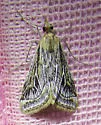
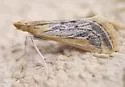
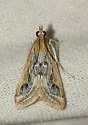
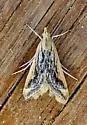
Photo credits: Contributed by Kyhl Austin
Frequently Asked Questions About Pyrausta linealis - Hodges#5024
What is Pyrausta linealis - Hodges#5024?
Pyrausta linealis - Hodges#5024 (Pyrausta linealis) is a species in the family Crambidae, within the order Lepidoptera.
How big is Pyrausta linealis - Hodges#5024?
Expense: 20 mm.
How do you identify Pyrausta linealis - Hodges#5024?
| Feature | Description |
|---|---|
| Head | Head, thorax, and palpi on the outside, light chestnut brown. Palpi, white beneath, and a white line over each eye, which extends forward and around the frontal projection. |
| Forewings | Forewings, dark brown, chestnut brown on the basal part of the costs, and overlaid to a great extent with white scales, especially along the veins which are indicated by white lines. The inner cross-line is not indicated. The outer cross-line is white, nearly parallel with the outer border, and nearer to it than to the end of the cell, wider on the costa than elsewhere, and not quite reaching the hind margin. Terminal line, dark brown, bordered on the inside by a wider white line. Fringes, pale yellowish, with a darker line through the basal part. |
| Hindwings | Hindwings light ash gray, with a darker terminal line preceded by a light line, neither of which reaches the anal angle. The outer cross-line, which is scarcely visible, extends from the outer fourth of the costa nearly straight to a spot near the end of vein 2. Fringes white, with an ash gray line near the base. Under side of the forewings ash gray, lighter on the costa and beyond the crossline, which shows faintly. Under side of hind wings silvery white, grayish along the costal portion; the beginning of a cross-line on the outer fourth of the costa. All the Wings have a terminal row of dark points beneath; those of the hind wings do not reach the anal angle. Under side of the body and of the legs silvery white. |