
Psorthaspis brimleyi
This record describes Psorthaspis brimleyi (species). Recorded family: Pompilidae. Recorded order: Hymenoptera.
Identification and Appearance
| Feature | Description |
|---|---|
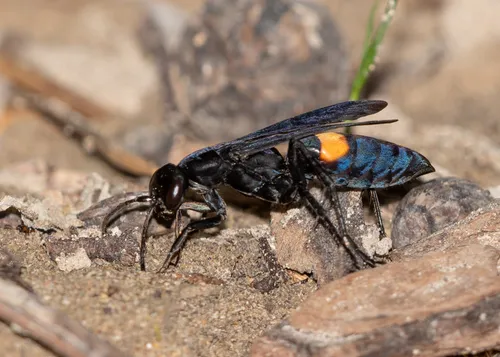
| Additional details | Apparently the only eastern member of the genus where female is mostly dark. Like most other members of this genus, known only from the female. Original description below (Malloch, 1928): Pedinaspis brimleyi , new species. Female. - Black, shining where abraded, otherwise dull because of the dense tomentum; abdomen with a large orange-yellow mark on dorsum of second tergite which extends from anterior margin about three-fourths of its length, and is slightly notched in middle of its posterior outline. |
| Head | Head a little wider than thorax, vertex slightly raised above eyes; posterior ocelli distinctly proximal of upper margin of eyes, separated from each other by about three-fourths as great a distance as either is from eye; central depressed line faint; clypeus broadly rounded, flat on disc, a quite large conspicuous depression around bases of antennae which is rather abrupt on its lower margin, extending over upper margin of clypeus; second, third, and fourth, flagellar segments subequal. Propodeum but shghtly concave posteriorly, no obvious angle on sides of hind margin; no submedian angles on hind margin of mesosternum. |
| Abdomen | Abdomen as in mariae . Third submarginal cell subquadrate. Length, 20 mm. Type locality.- Raleigh, N. C., July 2, 1921 (C. S. Brimley). Type.-Cat. No. 27433, U. S. N. M. Named in honor of the collector. This species superficially resembles Psammocharis (Lophopompilus) atrox (Dahlb.). It runs to texanus in Banks' key to the species of this genus but differs in having only the second abdominal tergite largely reddish, the depressions at bases of antennae much larger, and the hind margin of mesosternum more rounded. Editorial note. Psammocharis (Lophopompilus) atrox = Anoplius atrox . |
Classification
- Kingdom
- Animalia
- Phylum
- Arthropoda
- Class
- Insecta
- Order
- Hymenoptera (Ants, Bees, Wasps and Sawflies)
- Superfamily
- Pompiloidea
- Family
- Pompilidae (Spider Wasps)
- Subfamily
- Pompilinae
- Tribe
- Aporini
- Genus
- Psorthaspis
Imported taxonomy record. Source availability varies; see the source references and editorial policy below.
Habitat and Range
Geographic Range
Southeastern United States (BugGuide records)
Seasonal Activity
Reported June-September from North Carolina--guide photos and Brimley .
Additional species information
Species notes from the sources
Etymology: Named for North Carolina entomologist Clement Samuel Brimley (1863-1946). Brimley collected the type specimen (Malloch, 1928).
About Flies: the wider group
Order-level background for Hymenoptera, the group containing Psorthaspis brimleyi. Species-specific details appear above.
Group overview
Hymenoptera includes over 150,000 described species of ants, bees, wasps, and sawflies. Earth harbors approximately 20 quadrillion (20×10^15) ants, with a combined biomass of ~12 megatons of dry carbon - exceeding the combined biomass of all wild birds and mammals (PNAS, 2022).
Ecological role of the group
About 35% of the world's food crops depend on animal pollinators. The chocolate industry, valued at over $100 billion, depends on pollinating flies and midges. Ants are the dominant soil engineers in most terrestrial ecosystems, turning more soil than earthworms in many habitats.
Economic and practical significance of the group
Pollinators contribute $235-577 billion worth of annual global food production (FAO). In the U.S., bee pollination alone benefits crops valued at $18 billion annually, and honey bees are responsible for $5.4 billion in agricultural productivity. Between April 2023-2024, 55.1% of managed honey bee colonies were lost. The U.S. bee population dropped from 5 million to 2.5 million.
Recorded sources for this group: FAO, USDA, EPA, PNAS (2022), US Fish & Wildlife Service. Imported estimates may describe particular regions or reporting periods.
Photos of Psorthaspis brimleyi (2)
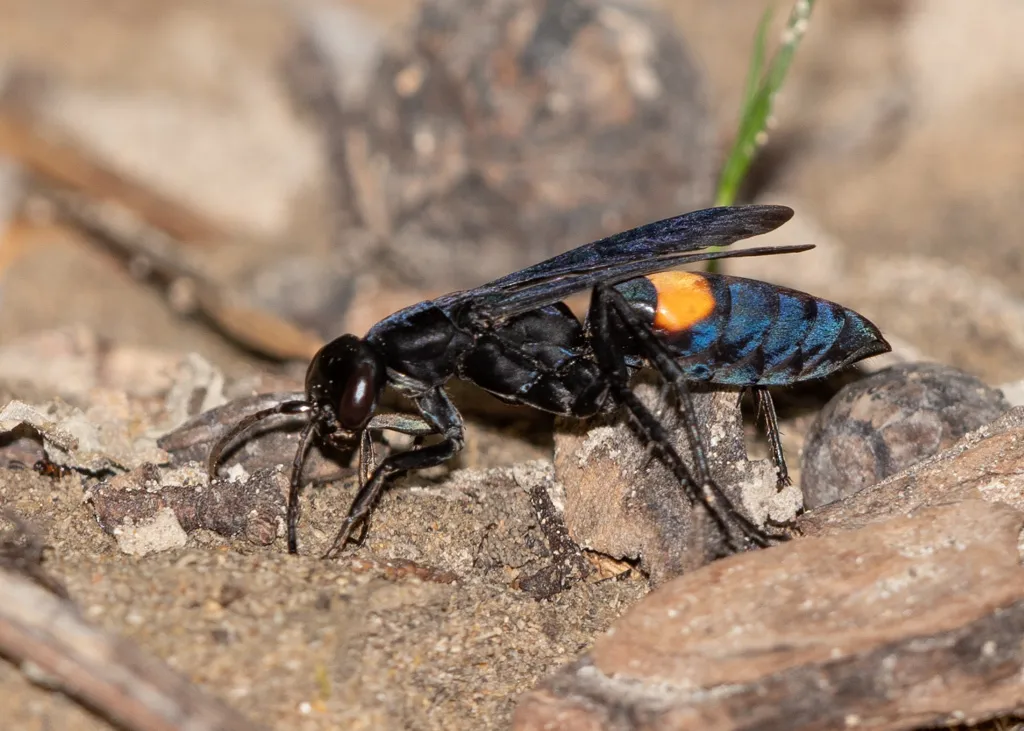
Photo credits: Contributed by john and jane balaban; Additional contributions by cotinis , Robert H. Biagi
Frequently Asked Questions About Psorthaspis brimleyi
What is Psorthaspis brimleyi?
Psorthaspis brimleyi is a species in the family Pompilidae, within the order Hymenoptera.
How big is Psorthaspis brimleyi?
female body length 20 mm (Malloch, 1928); 23 mm (guide photo)
How do you identify Psorthaspis brimleyi?
| Feature | Description |
|---|---|
| Additional details | Apparently the only eastern member of the genus where female is mostly dark. Like most other members of this genus, known only from the female. Original description below (Malloch, 1928): Pedinaspis brimleyi , new species. Female. - Black, shining where abraded, otherwise dull because of the dense tomentum; abdomen with a large orange-yellow mark on dorsum of second tergite which extends from anterior margin about three-fourths of its length, and is slightly notched in middle of its posterior outline. |
| Head | Head a little wider than thorax, vertex slightly raised above eyes; posterior ocelli distinctly proximal of upper margin of eyes, separated from each other by about three-fourths as great a distance as either is from eye; central depressed line faint; clypeus broadly rounded, flat on disc, a quite large conspicuous depression around bases of antennae which is rather abrupt on its lower margin, extending over upper margin of clypeus; second, third, and fourth, flagellar segments subequal. Propodeum but shghtly concave posteriorly, no obvious angle on sides of hind margin; no submedian angles on hind margin of mesosternum. |
| Abdomen | Abdomen as in mariae . Third submarginal cell subquadrate. Length, 20 mm. Type locality.- Raleigh, N. C., July 2, 1921 (C. S. Brimley). Type.-Cat. No. 27433, U. S. N. M. Named in honor of the collector. This species superficially resembles Psammocharis (Lophopompilus) atrox (Dahlb.). It runs to texanus in Banks' key to the species of this genus but differs in having only the second abdominal tergite largely reddish, the depressions at bases of antennae much larger, and the hind margin of mesosternum more rounded. Editorial note. Psammocharis (Lophopompilus) atrox = Anoplius atrox . |
Where is Psorthaspis brimleyi found?
Range: Southeastern United States (BugGuide records)
When is Psorthaspis brimleyi active?
Psorthaspis brimleyi: seasonal activity - Reported June-September from North Carolina--guide photos and Brimley ..