
Pseudorthocladius macrostomus
This record describes Pseudorthocladius macrostomus (species). Recorded family: Chironomidae. Recorded order: Diptera.
Identification and Appearance
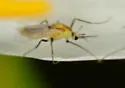
Note long proboscis. Male / Female I cannot find any biographical information on the author of this species, Annelle R. Soponis. She has a publication record mostly in the late 1970's through the 80's, with one as late as 1992: Soponis, A.R., Simpson, K.W. Polypedilum digitifer Townes and Polypedilum griseopunctatum (Malloch) (Diptera, Chironomidae): Redescription of adult males with a description and separation of the immature stages. Netherlands Journal of Aquatic Ecology 26, 203–213 (1992). https://doi.org/10.1007/BF02255243 At that time her affiliations were listed as Present address: Reading Area Community College, Reading, Pennsylvania, U.S.A. (and) Wadsworth Center for Laboratories and Research, New York State Health Department, Albany, New York, U.S.A. A 1986 publication lists here affiliation as: Annelle R. Soponis; A.R. Soponis, Entomology, Florida A&M University, Tallahassee, Florida 32307 U.S.A. Note also this ResearchGate profile . Dissertation-- Carlton University An obituary for her (apparent) sister, Leocadia Codispoti, deceased 30 September 2025, is at Skook News . An Annelle Soponis is listed as a survivor. (This is perhaps a different Annelle Soponis.)
Identification notes
Note long proboscis. Male / Female
Classification
- Kingdom
- Animalia
- Phylum
- Arthropoda
- Class
- Insecta
- Order
- Diptera (Flies)
- Superfamily
- Chironomoidea
- Family
- Chironomidae (Non-biting Midges)
- Subfamily
- Orthocladiinae
- Genus
- Pseudorthocladius
Imported taxonomy record. Source availability varies; see the source references and editorial policy below.
Habitat and Range
Habitat
Apparently moist coastal plain pine savannas.
Geographic Range
Southeastern United States: described from the Florida panhandle with some iNaturalist records there; noted also from Southeastern North Carolina.
Seasonal Activity
Late summer-early fall (September-October)
Diet and Behavior
Diet: Current records show them found on flowers of Rush Featherling ( Pleea tenuifolia , below) and Carolina Grass of Parnassus ( Parnassia caroliniana )--see iNaturalist observation .
About Flies: the wider group
Order-level background for Diptera, the group containing Pseudorthocladius macrostomus. Species-specific details appear above.
Group overview
Diptera includes over 150,000 described species of flies, mosquitoes, and midges. Mosquitoes are the deadliest animal on Earth (CDC). Malaria alone causes ~249 million cases and over 608,000 deaths annually, mostly children under 5 (WHO). Vector-borne diseases account for over 17% of all infectious diseases, causing 700,000+ deaths per year.
Ecological role of the group
Despite their disease impact, flies are critical decomposers and pollinators. Hoverflies alone pollinate hundreds of crop and wildflower species. Flies are also the primary food source for many birds, bats, and fish. Forensic entomology relies heavily on fly species for crime scene analysis.
Economic and practical significance of the group
In the U.S., vector-borne disease cases tripled between 2004-2016, with over 640,000 cases reported in that period (CDC). Tickborne diseases doubled from 22,000 to 48,000 annual reports. Globally, mosquito-borne diseases cost billions in healthcare and lost productivity.
Recorded sources for this group: WHO, CDC, PNAS. Imported estimates may describe particular regions or reporting periods.
Photos of Pseudorthocladius macrostomus (5)
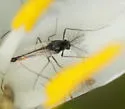
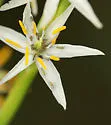
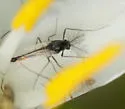
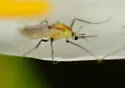
Photo credits: Contributed by Cotinis
Frequently Asked Questions About Pseudorthocladius macrostomus
What is Pseudorthocladius macrostomus?
Pseudorthocladius macrostomus is a species in the family Chironomidae, within the order Diptera.
How do you identify Pseudorthocladius macrostomus?
Note long proboscis. Male / Female
Where is Pseudorthocladius macrostomus found?
| Feature | Details |
|---|---|
| Habitat | Apparently moist coastal plain pine savannas. |
| Range | Southeastern United States: described from the Florida panhandle with some iNaturalist records there; noted also from Southeastern North Carolina. |
What does Pseudorthocladius macrostomus eat?
The diet of the Pseudorthocladius macrostomus includes Current records show them found on flowers of Rush Featherling ( Pleea tenuifolia , below) and Carolina Grass of Parnassus ( Parnassia caroliniana )--see iNaturalist observation ..
When is Pseudorthocladius macrostomus active?
Pseudorthocladius macrostomus: seasonal activity - Late summer-early fall (September-October).