
Fourteen-spotted Lady Beetle
Propylea quatuordecimpunctata
This record describes Propylea quatuordecimpunctata (species). Recorded family: Coccinellidae. Recorded order: Coleoptera.
Identification and Appearance
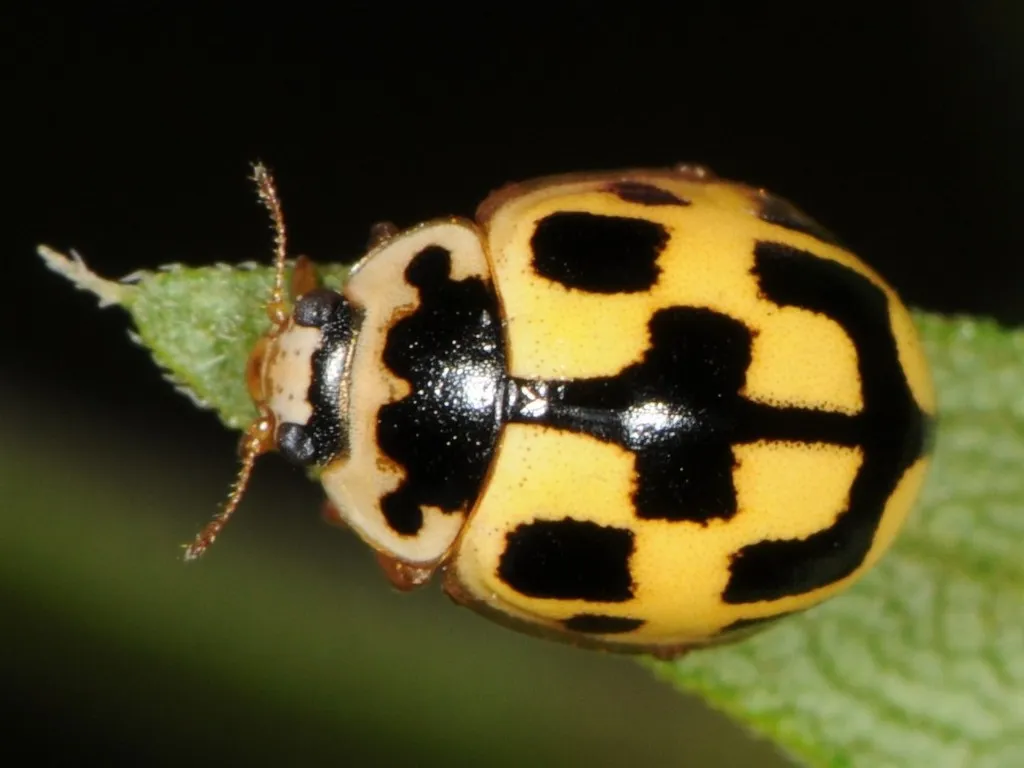
Gordon's Figures Larva: Black with white markings. White face and leg joints. Most important ID feature is small pointed projection from last abdominal segment: Repeated introduction attempts prior to the 1960s were unsuccessful. The first established population was accidentally introduced in the 1960s via European ships stopping at ports along the St. Lawrence River (first reported near Quebec City in 1968). During 1987-1993, more than half a million lab-reared individuals were released in 16 western US states to control the Russian Wheat Aphid ( Diuraphis noxia ) but follow-up surveys have not detected any established populations. Males and females can be told apart by the white markings on the head: males have solid white face, females have a dark spot in the middle.
Wikipedia reference for Propylea quatuordecimpunctata: http://en.wikipedia.org/wiki/Propylea_quatuordecimpunctata.
Classification
- Kingdom
- Animalia
- Phylum
- Arthropoda
- Class
- Insecta
- Order
- Coleoptera (Beetles)
- Suborder
- Polyphaga
- Superfamily
- Coccinelloidea
- Family
- Coccinellidae (Lady Beetles)
- Subfamily
- Coccinellinae
- Genus
- Propylea
Imported taxonomy record. Source availability varies; see the source references and editorial policy below.
Habitat and Range
Habitat
gardens, lawns, fields, vacant lots
Geographic Range
adventive to ne.NA: IA-VA-NS-ON - Map native to the Palaearctic, adventive and widespread in e. NA (southeastern Canada to Great Lakes and Florida), and still spreading; however, repeated intentional releases have not resulted in established populations
Seasonal Activity
mostly: May-Aug (BG data)
Diet and Behavior
Diet: Aphids
Life History
This sp. has, among Coccinellidae, the minimum recorded time from deposition of egg the to emergence of the adult beetle of 12 days. ( 4 ) Pale green eggs hatch into alligator-like black larvae with white markings. Larvae feed on aphids for 8-10 days and pupate. The adult beetle emerges 4-5 days later. 1. Egg. 2. First instar larva. 3. Later instar larva. 4. Pupa. 5. Adult
Additional species information
Species notes from the sources
Etymology: quatourdecim , "fourteen" + punctata , "spotted" (refers to the 14 black spots on elytra)
About Primitive Winged Insects: the wider group
Order-level background for Coleoptera, the group containing Propylea quatuordecimpunctata. Species-specific details appear above.
Group overview
Coleoptera is the largest order of insects with over 400,000 described species, representing ~25% of all known animal species and ~40% of all insects. In the U.S. alone, nearly 30,000 beetle species have been identified.
Ecological role of the group
Beetles are prominent decomposers, especially in forests, breaking down dead wood and recycling nutrients. As predators, they reduce populations of pest insects. Many species are also important pollinators of flowering plants.
Economic and practical significance of the group
Beetles have major economic significance: leaf beetles (Chrysomelidae) and weevils (Curculionoidea) are among the most destructive agricultural pests globally, costing billions annually, while predatory species like ladybugs provide natural pest control.
Recorded sources for this group: Britannica, Smithsonian, NCSU Entomology. Imported estimates may describe particular regions or reporting periods.
Photos of Fourteen-spotted Lady Beetle (3)
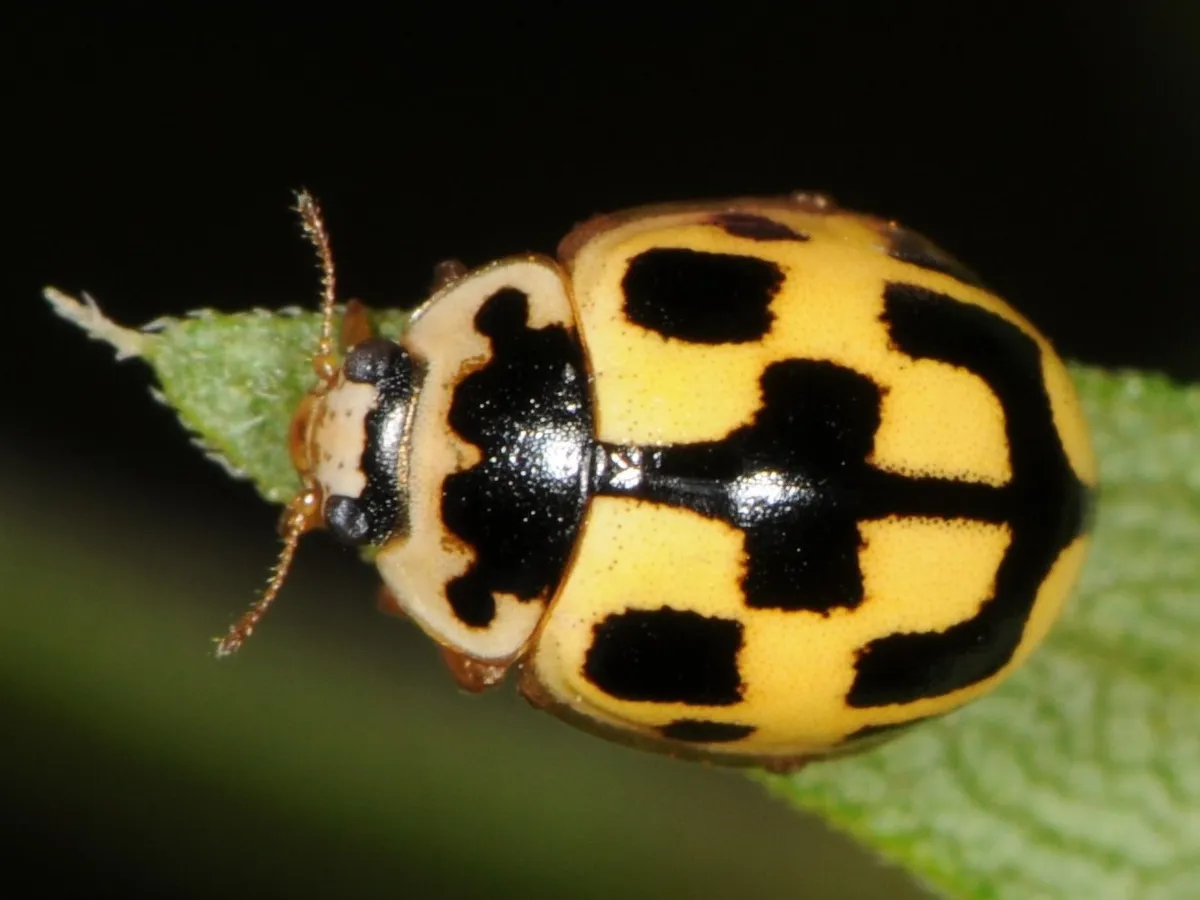
Photo credits: Contributed by Troy Bartlett; Additional contributions by Beatriz Moisset , Robin McLeod , Mike Quinn , Wisconsin Oecanthinancy , v belov , Abigail Parker
Frequently Asked Questions About Fourteen-spotted Lady Beetle
What is Fourteen-spotted Lady Beetle?
Fourteen-spotted Lady Beetle (Propylea quatuordecimpunctata) is a species in the family Coccinellidae, within the order Coleoptera.
How big is Fourteen-spotted Lady Beetle?
3.5-5.2 mm
How do you identify Fourteen-spotted Lady Beetle?
Gordon's Figures Larva: Black with white markings. White face and leg joints. Most important ID feature is small pointed projection from last abdominal segment:
Where is Fourteen-spotted Lady Beetle found?
| Feature | Details |
|---|---|
| Habitat | gardens, lawns, fields, vacant lots |
| Range | adventive to ne.NA: IA-VA-NS-ON - Map native to the Palaearctic, adventive and widespread in e. NA (southeastern Canada to Great Lakes and Florida), and still spreading; however, repeated intentional releases have not resulted in established populations |
What does Fourteen-spotted Lady Beetle eat?
The diet of the Fourteen-spotted Lady Beetle includes Aphids.
When is Fourteen-spotted Lady Beetle active?
Fourteen-spotted Lady Beetle: seasonal activity - mostly: May-Aug (BG data).
What is the life cycle of a Fourteen-spotted Lady Beetle?
This sp. has, among Coccinellidae, the minimum recorded time from deposition of egg the to emergence of the adult beetle of 12 days. ( 4 ) Pale green eggs hatch into alligator-like black larvae with white markings. Larvae feed on aphids for 8-10 days and pupate. The adult beetle emerges 4-5 days later. 1. Egg. 2. First instar larva. 3. Later instar larva. 4. Pupa. 5. Adult