
Promachus giganteus
This record describes Promachus giganteus (species). Recorded family: Asilidae. Recorded order: Diptera.
Identification and Appearance
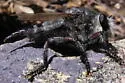
One of the largest North American robber flies; quite common in NM and w. TX throughout June and sometimes as late as August. Sufficient rainfall is required to support a large population. Their prey includes large grasshoppers, cicadas, the largest Xylocopa, male Pepsis wasps and other large robber flies. Female body frequently exceeds 40 mm (occasional giants >46 mm). The wings are proportionately longer than those of other Promachus . Though frequently mistaken, even by entomologists, for the large form of P. nigrialbus from central Arizona, giganteus can be separated by the mixture of gray pollen into the black abdominal bands, ovipositor beginning with segment six, sparse black spination dorsally on femora (appearing gray from a distance - those of nigrialbus appear nearly black) and larger size (though some nigrialbus individuals overlap small giganteus in length). --David Williams
Classification
Habitat and Range
Geographic Range
TX-AZ; Mexico
Additional species information
Species notes from the sources
Etymology: Promachus giganteus Hine 1911
About Flies: the wider group
Order-level background for Diptera, the group containing Promachus giganteus. Species-specific details appear above.
Group overview
Diptera includes over 150,000 described species of flies, mosquitoes, and midges. Mosquitoes are the deadliest animal on Earth (CDC). Malaria alone causes ~249 million cases and over 608,000 deaths annually, mostly children under 5 (WHO). Vector-borne diseases account for over 17% of all infectious diseases, causing 700,000+ deaths per year.
Ecological role of the group
Despite their disease impact, flies are critical decomposers and pollinators. Hoverflies alone pollinate hundreds of crop and wildflower species. Flies are also the primary food source for many birds, bats, and fish. Forensic entomology relies heavily on fly species for crime scene analysis.
Economic and practical significance of the group
In the U.S., vector-borne disease cases tripled between 2004-2016, with over 640,000 cases reported in that period (CDC). Tickborne diseases doubled from 22,000 to 48,000 annual reports. Globally, mosquito-borne diseases cost billions in healthcare and lost productivity.
Recorded sources for this group: WHO, CDC, PNAS. Imported estimates may describe particular regions or reporting periods.
Photos of Promachus giganteus (4)
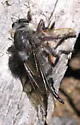
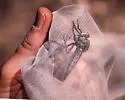
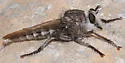
Photo credits: Contributed by norman and cheryl lavers; Additional contributions by kschnei , v belov
Frequently Asked Questions About Promachus giganteus
What is Promachus giganteus?
Promachus giganteus is a species in the family Asilidae, within the order Diptera.
How do you identify Promachus giganteus?
One of the largest North American robber flies; quite common in NM and w. TX throughout June and sometimes as late as August. Sufficient rainfall is required to support a large population. Their prey includes large grasshoppers, cicadas, the largest Xylocopa, male Pepsis wasps and other large robber flies. Female body frequently exceeds 40 mm (occasional giants >46 mm). The wings are proportionately longer than those of other Promachus . Though frequently mistaken, even by entomologists, for the large form of P. nigrialbus from central Arizona, giganteus can be separated by the mixture of gray pollen into the black abdominal bands, ovipositor beginning with segment six, sparse black spination dorsally on femora (appearing gray from a distance - those of nigrialbus appear nearly black) and larger size (though some nigrialbus individuals overlap small giganteus in length). --David Williams
Where is Promachus giganteus found?
Range: TX-AZ; Mexico