
Proctacanthus nigriventris
This record describes Proctacanthus nigriventris (species). Recorded family: Asilidae. Recorded order: Diptera.
Identification and Appearance
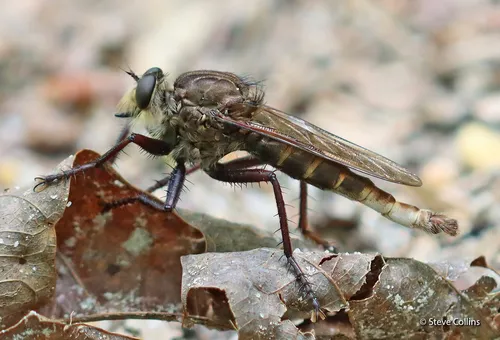
| Feature | Description |
|---|---|
| Additional details | Description from Hine : Body very dark, nearly black; wings uniformly rather pale brown. Mystax very pale yellowish, often with black bristles intermixed, beard gray, occipito-orbital bristles black. |
| Thorax | Thorax dark, brown pollinose, mesothoracic dorsum with black hair and bristles, usual markings not plainly differentiated; scutellum with black hairs and bristles. |
| Wings | Wings uniformly rather pale brown, legs dark nearly black; femora, except the apices, black, apexes of femora, tibiae and tarsi dark brown. |
| Abdomen | Abdomen dark, nearly black, dark pollinose with a narrow band before each incisure light pollinose, venter and sides of the last two or three segments in the male gray pollinose; male genitalia dark red, rather short, appendages widest at the base, gradually narrowed toward apex where they are evenly rounded; ovipositor shining black with strong black spines at the tip. The very dark color of the whole body is distinctive. |
Classification
Habitat and Range
Geographic Range
MA-GA-AL-MS
Additional species information
Species notes from the sources
Etymology: Proctacanthus nigriventris Macquart 1838
About Flies: the wider group
Order-level background for Diptera, the group containing Proctacanthus nigriventris. Species-specific details appear above.
Group overview
Diptera includes over 150,000 described species of flies, mosquitoes, and midges. Mosquitoes are the deadliest animal on Earth (CDC). Malaria alone causes ~249 million cases and over 608,000 deaths annually, mostly children under 5 (WHO). Vector-borne diseases account for over 17% of all infectious diseases, causing 700,000+ deaths per year.
Ecological role of the group
Despite their disease impact, flies are critical decomposers and pollinators. Hoverflies alone pollinate hundreds of crop and wildflower species. Flies are also the primary food source for many birds, bats, and fish. Forensic entomology relies heavily on fly species for crime scene analysis.
Economic and practical significance of the group
In the U.S., vector-borne disease cases tripled between 2004-2016, with over 640,000 cases reported in that period (CDC). Tickborne diseases doubled from 22,000 to 48,000 annual reports. Globally, mosquito-borne diseases cost billions in healthcare and lost productivity.
Recorded sources for this group: WHO, CDC, PNAS. Imported estimates may describe particular regions or reporting periods.
Photos of Proctacanthus nigriventris (2)
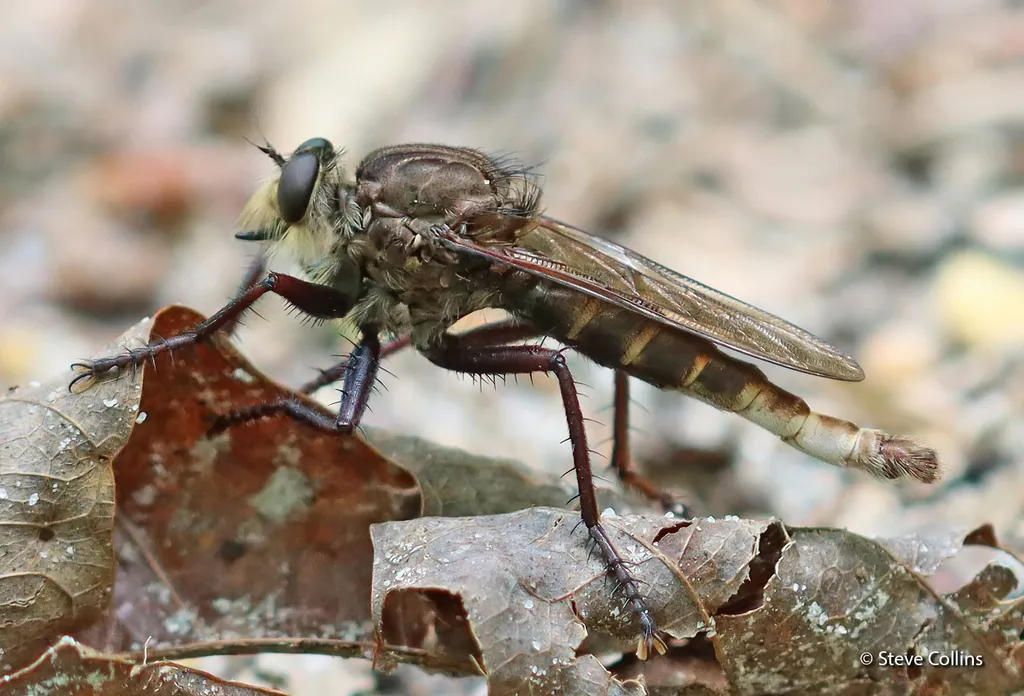
Photo credits: Contributed by norman and cheryl lavers; Additional contributions by cotinis , v belov
Frequently Asked Questions About Proctacanthus nigriventris
What is Proctacanthus nigriventris?
Proctacanthus nigriventris is a species in the family Asilidae, within the order Diptera.
How big is Proctacanthus nigriventris?
30-35 mm length Hine
How do you identify Proctacanthus nigriventris?
| Feature | Description |
|---|---|
| Additional details | Description from Hine : Body very dark, nearly black; wings uniformly rather pale brown. Mystax very pale yellowish, often with black bristles intermixed, beard gray, occipito-orbital bristles black. |
| Thorax | Thorax dark, brown pollinose, mesothoracic dorsum with black hair and bristles, usual markings not plainly differentiated; scutellum with black hairs and bristles. |
| Wings | Wings uniformly rather pale brown, legs dark nearly black; femora, except the apices, black, apexes of femora, tibiae and tarsi dark brown. |
| Abdomen | Abdomen dark, nearly black, dark pollinose with a narrow band before each incisure light pollinose, venter and sides of the last two or three segments in the male gray pollinose; male genitalia dark red, rather short, appendages widest at the base, gradually narrowed toward apex where they are evenly rounded; ovipositor shining black with strong black spines at the tip. The very dark color of the whole body is distinctive. |
Where is Proctacanthus nigriventris found?
Range: MA-GA-AL-MS