
Populicerus telus
This record describes Populicerus telus (species). Recorded family: Cicadellidae. Recorded order: Hemiptera.
Identification and Appearance
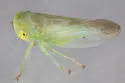
Resembling pallidus in form and appearance but with different male genitalia. White tinged with green without dark markings, basal angles of scutellum yellowish. Elytra subhyaline, veins tinted with green. Face pale. Antennal discs large, black, ovate. Genitalia: Male plates elongate, rather narrow. Styles slightly broadened near apex then rapidly narrowed to a pointed apex. Each style bears a prominent spine just before apex. Ventral portion of aedeagus tapered from base to apical fifth which is broadened by a pair of prominent spines which are webbed to the main aedeagus shaft. These spines slope almost to apex giving the head portion a triangular appearance, with a blunt apex. The dorsal portion is shorter and constricted at middle between a rather broad base and a broader, diamond shaped apex. The latter has a pointed apical margin, and a broadened pointed lateral margin on each side. (DeLong & Hershberger, 1947) The only note from Freytag (1965) on the synonymy with Idiocerus pallidus does not mention the distinctive genitalia, which are noted in the original description and Hamilton (1980): The specimens which lack the antennal disc in males, previously identified as telus , are now considered to be but a variant of pallidus .
Classification
- Kingdom
- Animalia
- Phylum
- Arthropoda
- Class
- Insecta
- Order
- Hemiptera (True Bugs, Cicadas, Hoppers, Aphids and Allies)
- Suborder
- Auchenorrhyncha
- Superfamily
- Membracoidea
- Family
- Cicadellidae (Typical Leafhoppers)
- Subfamily
- Eurymelinae
- Tribe
- Idiocerini
- Genus
- Populicerus
Imported taxonomy record. Source availability varies; see the source references and editorial policy below.
Habitat and Range
Geographic Range
IL, OH
Additional species information
Species notes from the sources
Etymology: Populicerus telus (DeLong & Hershberger, 1947)
About True Bugs, Cicadas, Hoppers, Aphids and Allies: the wider group
Order-level background for Hemiptera, the group containing Populicerus telus. Species-specific details appear above.
Group overview
Hemiptera (true bugs) includes over 80,000 described species across cicadas, aphids, leafhoppers, shield bugs, and bed bugs. Aphids alone cost global agriculture an estimated $2.5 billion annually in crop losses.
Ecological role of the group
Many Hemiptera are essential food sources for birds and predatory insects. Cicadas provide massive nutrient pulses during emergence events - a single Brood X emergence can involve trillions of individuals across 15 states.
Economic and practical significance of the group
The brown marmorated stink bug (Halyomorpha halys) caused $37 million in apple crop losses in a single year in the U.S. Mid-Atlantic region. Bed bug infestations in the U.S. increased by 500% between 2001-2010, costing the hotel industry hundreds of millions annually.
Recorded sources for this group: USDA, EPA, University research. Imported estimates may describe particular regions or reporting periods.
Frequently Asked Questions About Populicerus telus
What is Populicerus telus?
Populicerus telus is a species in the family Cicadellidae, within the order Hemiptera.
How big is Populicerus telus?
5mm
How do you identify Populicerus telus?
Resembling pallidus in form and appearance but with different male genitalia. White tinged with green without dark markings, basal angles of scutellum yellowish. Elytra subhyaline, veins tinted with green. Face pale. Antennal discs large, black, ovate. Genitalia: Male plates elongate, rather narrow. Styles slightly broadened near apex then rapidly narrowed to a pointed apex. Each style bears a prominent spine just before apex. Ventral portion of aedeagus tapered from base to apical fifth which is broadened by a pair of prominent spines which are webbed to the main aedeagus shaft. These spines slope almost to apex giving the head portion a triangular appearance, with a blunt apex. The dorsal portion is shorter and constricted at middle between a rather broad base and a broader, diamond shaped apex. The latter has a pointed apical margin, and a broadened pointed lateral margin on each side. (DeLong & Hershberger, 1947)
Where is Populicerus telus found?
Range: IL, OH