
Populicerus perplexus
This record describes Populicerus perplexus (species). Recorded family: Cicadellidae. Recorded order: Hemiptera.
Identification and Appearance
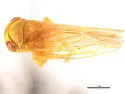
| Feature | Description |
|---|---|
| Additional details | Near pallidus , differing from that species as follows: Genae sharply incurved beneath the eyes, then rounded to clypeus, and the clypeus more broadened out towards the tip. Last ventral segment produced on posterior margin very much as in pallidus , but rounded at extreme tip, not truncate. Color pale yellow, unicolorous throughout. This may prove to be only a variety of pallidus but the specimens we have examined seem quite distinct. - Gillette & Baker 1895 Resembling pallidus in general appearance, but with distinctly different male genitalia. Vertex evenly rounded, nearly same length in middle as near eyes. Postclypeus much longer than wide; anteclypeus longer than wide, with an expanded apex. Male antennae with a thin oval disc at apex. |
| Forewing | Forewing flaring, venation neady obscure, with a large appendix. Color . - Vertex and face yellow, male antennal disc black. |
| Pronotum | Pronotum and scutellum yellow. |
| Forewing | Forewing yellow, with veins deep yellow. Male genitalia . - Plate long, thin. wider near apex. Pygofer wide, rounded, with a nearly pointed apex. Style nearly same width to a sharply pointed apex, with several large spines near apex. Connective shaped like an inverted T, with a pointed ventra! projection. Aedeagus with shaft tubular to apex, gonopore at apex, a long process on each side of shaft about their own length from apex; apodeme greatly enlarged at apex. with a large dorsal expansion. Female genitalia . - The female genitalia of this species is seemingly the same as pallidus . (Freytag, 1965) Very few specimens have been seen of this species but the longer processes on the aedeagus will identify it. (Freytag, 1965) |
Classification
- Kingdom
- Animalia
- Phylum
- Arthropoda
- Class
- Insecta
- Order
- Hemiptera (True Bugs, Cicadas, Hoppers, Aphids and Allies)
- Suborder
- Auchenorrhyncha
- Superfamily
- Membracoidea
- Family
- Cicadellidae (Typical Leafhoppers)
- Subfamily
- Eurymelinae
- Tribe
- Idiocerini
- Genus
- Populicerus
Imported taxonomy record. Source availability varies; see the source references and editorial policy below.
Habitat and Range
Geographic Range
Colorado
Additional species information
Species notes from the sources
Etymology: Populicerus perplexus (Gillette & Baker 1895)
About True Bugs, Cicadas, Hoppers, Aphids and Allies: the wider group
Order-level background for Hemiptera, the group containing Populicerus perplexus. Species-specific details appear above.
Group overview
Hemiptera (true bugs) includes over 80,000 described species across cicadas, aphids, leafhoppers, shield bugs, and bed bugs. Aphids alone cost global agriculture an estimated $2.5 billion annually in crop losses.
Ecological role of the group
Many Hemiptera are essential food sources for birds and predatory insects. Cicadas provide massive nutrient pulses during emergence events - a single Brood X emergence can involve trillions of individuals across 15 states.
Economic and practical significance of the group
The brown marmorated stink bug (Halyomorpha halys) caused $37 million in apple crop losses in a single year in the U.S. Mid-Atlantic region. Bed bug infestations in the U.S. increased by 500% between 2001-2010, costing the hotel industry hundreds of millions annually.
Recorded sources for this group: USDA, EPA, University research. Imported estimates may describe particular regions or reporting periods.
Frequently Asked Questions About Populicerus perplexus
What is Populicerus perplexus?
Populicerus perplexus is a species in the family Cicadellidae, within the order Hemiptera.
How big is Populicerus perplexus?
Male 5.3 to 5.9 mm, female 5.5 to 6.4 mm (Freytag, 1965)
How do you identify Populicerus perplexus?
| Feature | Description |
|---|---|
| Additional details | Near pallidus , differing from that species as follows: Genae sharply incurved beneath the eyes, then rounded to clypeus, and the clypeus more broadened out towards the tip. Last ventral segment produced on posterior margin very much as in pallidus , but rounded at extreme tip, not truncate. Color pale yellow, unicolorous throughout. This may prove to be only a variety of pallidus but the specimens we have examined seem quite distinct. - Gillette & Baker 1895 Resembling pallidus in general appearance, but with distinctly different male genitalia. Vertex evenly rounded, nearly same length in middle as near eyes. Postclypeus much longer than wide; anteclypeus longer than wide, with an expanded apex. Male antennae with a thin oval disc at apex. |
| Forewing | Forewing flaring, venation neady obscure, with a large appendix. Color . - Vertex and face yellow, male antennal disc black. |
| Pronotum | Pronotum and scutellum yellow. |
| Forewing | Forewing yellow, with veins deep yellow. Male genitalia . - Plate long, thin. wider near apex. Pygofer wide, rounded, with a nearly pointed apex. Style nearly same width to a sharply pointed apex, with several large spines near apex. Connective shaped like an inverted T, with a pointed ventra! projection. Aedeagus with shaft tubular to apex, gonopore at apex, a long process on each side of shaft about their own length from apex; apodeme greatly enlarged at apex. with a large dorsal expansion. Female genitalia . - The female genitalia of this species is seemingly the same as pallidus . (Freytag, 1965) |
Where is Populicerus perplexus found?
Range: Colorado