
Populicerus formosus
This record describes Populicerus formosus (species). Recorded family: Cicadellidae. Recorded order: Hemiptera.
Identification and Appearance
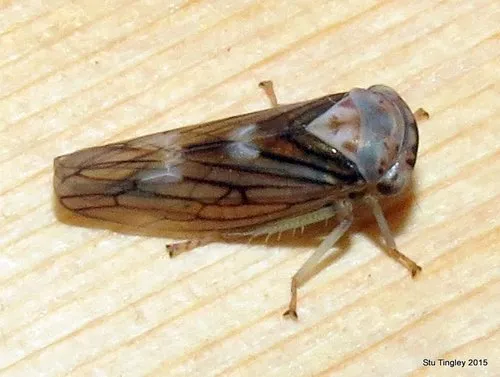
Smaller and narrower than lachrymalis , resembling the European populi in size and form, but more heavily marked. Vertex long, but little curved; face almost flat, front broad below, but not expanded as much as usual at the antennas; elytral nervures nontuberculate, outer apical nervure curving away to costa without forming an anteapical cell, or, at most, a short triangular one. Female segment short, transverse, the middle third produced into a rounded lobe nearly twice as long as the rest of the segment; pygofers moderately long, much inflated, exceeded by the ovipositor by about twice its width. Male valve trisinuate; antennal discs large, about twice longer than wide. Colour: vertex and face pale greenish yellow, a pair of round black spots on the vertex and a pair of elongate spots against the eye, both pairs of spots connected on their lower margins by a transverse black band; another pair of black spots within and beneath the ocelli, on the front. The black band and spots on the front are sometimes absent in the male. Pronotum grayish or greenish, with irregular fuscous markings on the anterior third; scutellum pale yellow or greenish, usually with the basal angles and a pair of round spots on disc fuscous; elytra varying from tawny to dark brown, usually iridescent, the apices of the claval nervures and an irregular oblique band back of the clavus milky white. Sometimes there is more or less of milky white between the dark nervures on the base of the corium. The face and pronotal markings are similar to lachrymalis , while the elytra, especially in the male, are quite different. It should follow that species in the key, from which the small size and long antennal discs will readily separate it. (Ball, 1902)
Classification
- Kingdom
- Animalia
- Phylum
- Arthropoda
- Class
- Insecta
- Order
- Hemiptera (True Bugs, Cicadas, Hoppers, Aphids and Allies)
- Suborder
- Auchenorrhyncha
- Superfamily
- Membracoidea
- Family
- Cicadellidae (Typical Leafhoppers)
- Subfamily
- Eurymelinae
- Tribe
- Idiocerini
- Genus
- Populicerus
Imported taxonomy record. Source availability varies; see the source references and editorial policy below.
Habitat and Range
Geographic Range
Transcontinental USA (type locality: several localities in Colorado)
Additional species information
Species notes from the sources
Etymology: Populicerus formosus (Ball, 1902) formosus (L). 'graceful, beautiful'
About True Bugs, Cicadas, Hoppers, Aphids and Allies: the wider group
Order-level background for Hemiptera, the group containing Populicerus formosus. Species-specific details appear above.
Group overview
Hemiptera (true bugs) includes over 80,000 described species across cicadas, aphids, leafhoppers, shield bugs, and bed bugs. Aphids alone cost global agriculture an estimated $2.5 billion annually in crop losses.
Ecological role of the group
Many Hemiptera are essential food sources for birds and predatory insects. Cicadas provide massive nutrient pulses during emergence events - a single Brood X emergence can involve trillions of individuals across 15 states.
Economic and practical significance of the group
The brown marmorated stink bug (Halyomorpha halys) caused $37 million in apple crop losses in a single year in the U.S. Mid-Atlantic region. Bed bug infestations in the U.S. increased by 500% between 2001-2010, costing the hotel industry hundreds of millions annually.
Recorded sources for this group: USDA, EPA, University research. Imported estimates may describe particular regions or reporting periods.
Photos of Populicerus formosus (2)
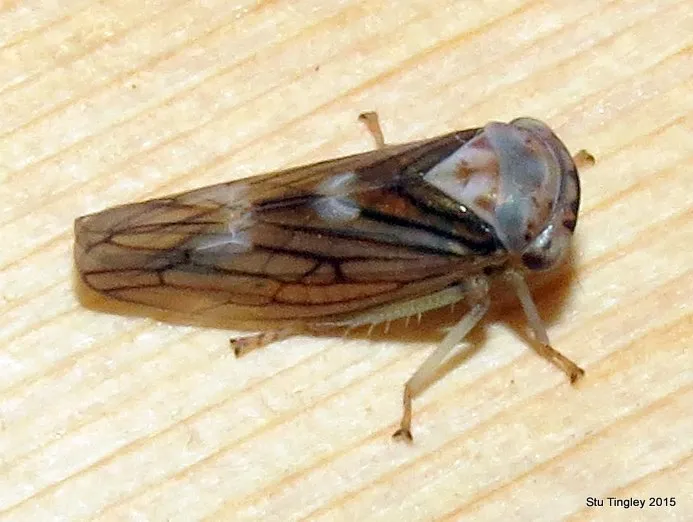
Photo credits: Contributed by john and jane balaban; Additional contributions by Beatriz Moisset , Robin McLeod , Mike Quinn , antarctica
Frequently Asked Questions About Populicerus formosus
What is Populicerus formosus?
Populicerus formosus is a species in the family Cicadellidae, within the order Hemiptera.
How big is Populicerus formosus?
5.25-6mm
How do you identify Populicerus formosus?
Smaller and narrower than lachrymalis , resembling the European populi in size and form, but more heavily marked. Vertex long, but little curved; face almost flat, front broad below, but not expanded as much as usual at the antennas; elytral nervures nontuberculate, outer apical nervure curving away to costa without forming an anteapical cell, or, at most, a short triangular one. Female segment short, transverse, the middle third produced into a rounded lobe nearly twice as long as the rest of the segment; pygofers moderately long, much inflated, exceeded by the ovipositor by about twice its width. Male valve trisinuate; antennal discs large, about twice longer than wide. Colour: vertex and face pale greenish yellow, a pair of round black spots on the vertex and a pair of elongate spots against the eye, both pairs of spots connected on their lower margins by a transverse black band; another pair of black spots within and beneath the ocelli, on the front. The black band and spots on the front are sometimes absent in the male. Pronotum grayish or greenish, with irregular fuscous markings on the anterior third; scutellum pale yellow or greenish, usually with the basal angles and a pair of round spots on disc fuscous; elytra varying from tawny to dark brown, usually iridescent, the apices of the claval nervures and an irregular oblique band back of the clavus milky white. Sometimes there is more or less of milky white between the dark nervures on the base of the corium. The face and pronotal markings are similar to lachrymalis , while the elytra, especially in the male, are quite different. It should follow that species in the key, from which the small size and long antennal discs will readily separate it. (Ball, 1902)
Where is Populicerus formosus found?
Range: Transcontinental USA (type locality: several localities in Colorado)