
Northern Blue - Hodges#4374
Plebejus idas
This record describes Plebejus idas (species). Recorded family: Lycaenidae. Recorded order: Lepidoptera.
Identification and Appearance
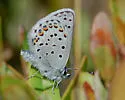
Distinguishable from Anna Blue - Plebejus anna only by more easterly distribution. From other blues by (usually) some marginal orange on ventral hind and front wings. No obvious dark spot on middle of upper front wings of males. In most regions where found, underside tending to bluish gray. Can be very similar to mostly more southern and lowland Melissa Blue - Plebejus melissa (and its segregates), which tends to be slightly grayish or brownish below with markings all more bold and contrasting, and female usually with prominent marginal orange band on all four wings (commonly narrower if present on P. ida ). In the afterword to Lolita , Vladimir Nabokov mentions that he caught the first known female of Lycaeides sublivens Nabokov on the mountain trail he used as the setting for the book's final scene. This butterfly is now considered a subspecies of Plebejus idas according to this page .
Classification
- Kingdom
- Animalia
- Phylum
- Arthropoda
- Class
- Insecta
- Order
- Lepidoptera (Butterflies and Moths)
- Superfamily
- Papilionoidea
- Family
- Lycaenidae (Blues, Coppers, Hairstreaks, Harvesters)
- Subfamily
- Polyommatinae
- Genus
- Plebejus
Imported taxonomy record. Source availability varies; see the source references and editorial policy below.
Habitat and Range
Habitat
Bay of Fundy coastal bogs in NB; Upland bogs in CBI.
Geographic Range
Northern North America east of Cascades, mostly north of southern Canadian border, lapping into U.S. mostly near Great Lakes, and south to Colorado along high elevation Rocky Mountains. Replaced by P. anna in Cascades and California Sierras west to coast. New Brunswick; Cape Breton Island, Nova Scotia (AWT) North America as well as Europe and Asia.
Diet and Behavior
Diet: Ericaceae in the east; legumes of the pea family (Fabaceae) in the west.
Additional species information
Species notes from the sources
Etymology: Author: Linnaeus, 1761
About Butterflies and Moths: the wider group
Order-level background for Lepidoptera, the group containing Plebejus idas. Species-specific details appear above.
Group overview
Lepidoptera includes approximately 180,000 described species of butterflies and moths. Moths outnumber butterflies roughly 10:1. The monarch butterfly's eastern population has declined by more than 80% since the mid-1990s, and the western population by over 95% since the 1980s. The IUCN lists the migratory monarch as Vulnerable.
Ecological role of the group
Butterflies and moths are essential indicators of ecosystem health. As caterpillars, they are a primary food source for birds - a single nest of blue tit chicks requires ~10,000 caterpillars. Adult moths pollinate many night-blooming plants.
Economic and practical significance of the group
Lepidoptera are critical pollinators. In Europe, grassland butterfly species have declined by almost 50% since the early 1990s. In the UK, three-quarters of butterflies are in decline. In the U.S., five butterfly species have gone extinct since 1950, with 29 listed as endangered.
Recorded sources for this group: IUCN Red List, Xerces Society, USFWS, PNAS, WWF. Imported estimates may describe particular regions or reporting periods.
Photos of Northern Blue - Hodges#4374 (5)
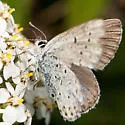
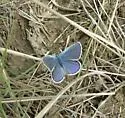
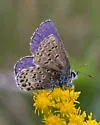
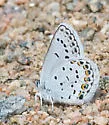
Photo credits: Contributed by Tom Bentley; Additional contributions by Steve Nanz , Beatriz Moisset , Tony-2 , David Ferguson , ceiseman
Frequently Asked Questions About Northern Blue - Hodges#4374
What is Northern Blue - Hodges#4374?
Northern Blue - Hodges#4374 (Plebejus idas) is a species in the family Lycaenidae, within the order Lepidoptera.
How do you identify Northern Blue - Hodges#4374?
Distinguishable from Anna Blue - Plebejus anna only by more easterly distribution. From other blues by (usually) some marginal orange on ventral hind and front wings. No obvious dark spot on middle of upper front wings of males. In most regions where found, underside tending to bluish gray. Can be very similar to mostly more southern and lowland Melissa Blue - Plebejus melissa (and its segregates), which tends to be slightly grayish or brownish below with markings all more bold and contrasting, and female usually with prominent marginal orange band on all four wings (commonly narrower if present on P. ida ).
Where is Northern Blue - Hodges#4374 found?
| Feature | Details |
|---|---|
| Habitat | Bay of Fundy coastal bogs in NB; Upland bogs in CBI. |
| Range | Northern North America east of Cascades, mostly north of southern Canadian border, lapping into U.S. mostly near Great Lakes, and south to Colorado along high elevation Rocky Mountains. Replaced by P. anna in Cascades and California Sierras west to coast. New Brunswick; Cape Breton Island, Nova Scotia (AWT) North America as well as Europe and Asia. |
What does Northern Blue - Hodges#4374 eat?
The diet of the Northern Blue - Hodges#4374 includes Ericaceae in the east; legumes of the pea family (Fabaceae) in the west..