
Platycentrus taurinus
This record describes Platycentrus taurinus (species). Recorded family: Membracidae. Recorded order: Hemiptera.
Identification and Appearance
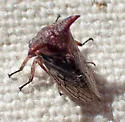
Shorter and stouter than acuticornis with much shorter horns. Resembling obtusicornis , but with horns more slender and tapering. Head broader and less arcuated at base than in obtusicornis , metapodium convex, coarsely punctured, rugulose. A pair of large depressed, finely shagreened callosities situated on a line with the horns and the ocelli and two pairs of smaller irregular ones outside these. A pair of horns arising directly above the humeri and extending obliquely forward and upward forming a right angle with the margin of the pronotum and curving outward and slightly backward until their acute apices extend horizontally. Viewed from above the extreme curve of the horns exceeds the metapodium. Viewed from in front they rise but little above the level of the dorsum. The horns are thick at the base, triquetrous or almost quadrangular, regularly narrowing to the acuminate apices. Anterior and posterior carinae sharp and definite, usually a carina arising from above the humeri and extending to the apex and an irregular dorsal one much broken at the base. Posterior process of pronotum broad at base then slightly inflated and rapidly roundingly narrowing to an acute apex. Color: dark brown punctured with fuscous, which is emphasized on the face, base of horns and posterior process. Carinae and coarse rugae lighter especially behind the horns and before the process. Callosities black. Tegmina hyaline, nervures distinct, brown, growing paler toward the margins; basal area fuscous adjoined by a light band which interrupts the brown on the nervures. (Ball, 1918) This is probably the species listed by VanDuzee as acuticornis Stål but is quite distinct from examples of that species in the writer's collection from Mexico. It is much nearer obtusicornis but differs from that species in the shape and position of the horns. (Ball, 1918)
Classification
- Kingdom
- Animalia
- Phylum
- Arthropoda
- Class
- Insecta
- Order
- Hemiptera (True Bugs, Cicadas, Hoppers, Aphids and Allies)
- Suborder
- Auchenorrhyncha
- Superfamily
- Membracoidea
- Family
- Membracidae (Typical Treehoppers)
- Subfamily
- Centrotinae
- Tribe
- Platycentrini
- Genus
- Platycentrus
Imported taxonomy record. Source availability varies; see the source references and editorial policy below.
Habitat and Range
Geographic Range
s. California (type locality: Cabazon, Riverside Co.), also AZ (BG data)
Diet and Behavior
Diet: Unknown
Additional species information
Species notes from the sources
Etymology: Platycentrus taurinus Ball, 1918
About True Bugs, Cicadas, Hoppers, Aphids and Allies: the wider group
Order-level background for Hemiptera, the group containing Platycentrus taurinus. Species-specific details appear above.
Group overview
Hemiptera (true bugs) includes over 80,000 described species across cicadas, aphids, leafhoppers, shield bugs, and bed bugs. Aphids alone cost global agriculture an estimated $2.5 billion annually in crop losses.
Ecological role of the group
Many Hemiptera are essential food sources for birds and predatory insects. Cicadas provide massive nutrient pulses during emergence events - a single Brood X emergence can involve trillions of individuals across 15 states.
Economic and practical significance of the group
The brown marmorated stink bug (Halyomorpha halys) caused $37 million in apple crop losses in a single year in the U.S. Mid-Atlantic region. Bed bug infestations in the U.S. increased by 500% between 2001-2010, costing the hotel industry hundreds of millions annually.
Recorded sources for this group: USDA, EPA, University research. Imported estimates may describe particular regions or reporting periods.
Photos of Platycentrus taurinus (5)
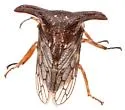
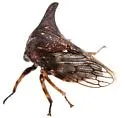
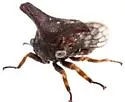
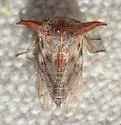
Photo credits: Contributed by Solomon V. Hendrix; Additional contributions by Mike Quinn
Frequently Asked Questions About Platycentrus taurinus
What is Platycentrus taurinus?
Platycentrus taurinus is a species in the family Membracidae, within the order Hemiptera.
How big is Platycentrus taurinus?
6.5mm
How do you identify Platycentrus taurinus?
Shorter and stouter than acuticornis with much shorter horns. Resembling obtusicornis , but with horns more slender and tapering. Head broader and less arcuated at base than in obtusicornis , metapodium convex, coarsely punctured, rugulose. A pair of large depressed, finely shagreened callosities situated on a line with the horns and the ocelli and two pairs of smaller irregular ones outside these. A pair of horns arising directly above the humeri and extending obliquely forward and upward forming a right angle with the margin of the pronotum and curving outward and slightly backward until their acute apices extend horizontally. Viewed from above the extreme curve of the horns exceeds the metapodium. Viewed from in front they rise but little above the level of the dorsum. The horns are thick at the base, triquetrous or almost quadrangular, regularly narrowing to the acuminate apices. Anterior and posterior carinae sharp and definite, usually a carina arising from above the humeri and extending to the apex and an irregular dorsal one much broken at the base. Posterior process of pronotum broad at base then slightly inflated and rapidly roundingly narrowing to an acute apex. Color: dark brown punctured with fuscous, which is emphasized on the face, base of horns and posterior process. Carinae and coarse rugae lighter especially behind the horns and before the process. Callosities black. Tegmina hyaline, nervures distinct, brown, growing paler toward the margins; basal area fuscous adjoined by a light band which interrupts the brown on the nervures. (Ball, 1918)
Where is Platycentrus taurinus found?
Range: s. California (type locality: Cabazon, Riverside Co.), also AZ (BG data)
What does Platycentrus taurinus eat?
The diet of the Platycentrus taurinus includes Unknown.