
Plagiognathus verticalis
This record describes Plagiognathus verticalis (species). Recorded family: Miridae. Recorded order: Hemiptera.
Identification and Appearance
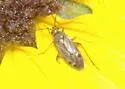
Recognized by medium to moderately large body size, the uneven brownish coloration of the dorsum with some lighter, diffuse, mostly longitudinal markings, the tumid frons with dark transverse striae, the brown calli, and the black, suberect, bristlelike setae on the pronotum and costal margin of the hemelytra. Also body appearing slender and transversely convexly rounded as viewed from above. Possibly confused with lineatus because of the longitudinal markings, and also with moerens on the basis of bristlelike setae, distribution, and occurrence on ruderal vegetation, but distinguished because both of those species with frons entirely dark and lacking obvious striate markings, lineatus lacking black bristlelike setae on dorsum, and moerens with black setae over entire dorsum and with distinctive genitalia. One of the most commonly collected Plagiognathus in California
Classification
- Kingdom
- Animalia
- Phylum
- Arthropoda
- Class
- Insecta
- Order
- Hemiptera (True Bugs, Cicadas, Hoppers, Aphids and Allies)
- Suborder
- Heteroptera
- Superfamily
- Miroidea
- Family
- Miridae (Plant Bugs)
- Subfamily
- Phylinae
- Tribe
- Phylini
- Genus
- Plagiognathus
Imported taxonomy record. Source availability varies; see the source references and editorial policy below.
Habitat and Range
Geographic Range
w. NA (BC‒ID to Baja)
Diet and Behavior
Diet: Host: various herbaceous plants, mostly annuals
Additional species information
Species notes from the sources
Etymology: Plagiognathus verticalis (Uhler 1894)
About True Bugs, Cicadas, Hoppers, Aphids and Allies: the wider group
Order-level background for Hemiptera, the group containing Plagiognathus verticalis. Species-specific details appear above.
Group overview
Hemiptera (true bugs) includes over 80,000 described species across cicadas, aphids, leafhoppers, shield bugs, and bed bugs. Aphids alone cost global agriculture an estimated $2.5 billion annually in crop losses.
Ecological role of the group
Many Hemiptera are essential food sources for birds and predatory insects. Cicadas provide massive nutrient pulses during emergence events - a single Brood X emergence can involve trillions of individuals across 15 states.
Economic and practical significance of the group
The brown marmorated stink bug (Halyomorpha halys) caused $37 million in apple crop losses in a single year in the U.S. Mid-Atlantic region. Bed bug infestations in the U.S. increased by 500% between 2001-2010, costing the hotel industry hundreds of millions annually.
Recorded sources for this group: USDA, EPA, University research. Imported estimates may describe particular regions or reporting periods.
Photos of Plagiognathus verticalis (5)
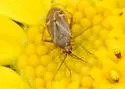
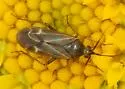
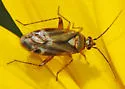
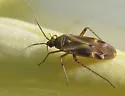
Photo credits: Contributed by Ron M.; Additional contributions by v belov , onegunah
Frequently Asked Questions About Plagiognathus verticalis
What is Plagiognathus verticalis?
Plagiognathus verticalis is a species in the family Miridae, within the order Hemiptera.
How big is Plagiognathus verticalis?
♂ 3.9‒5 mm, ♀ 3.6‒4.2 mm
How do you identify Plagiognathus verticalis?
Recognized by medium to moderately large body size, the uneven brownish coloration of the dorsum with some lighter, diffuse, mostly longitudinal markings, the tumid frons with dark transverse striae, the brown calli, and the black, suberect, bristlelike setae on the pronotum and costal margin of the hemelytra. Also body appearing slender and transversely convexly rounded as viewed from above. Possibly confused with lineatus because of the longitudinal markings, and also with moerens on the basis of bristlelike setae, distribution, and occurrence on ruderal vegetation, but distinguished because both of those species with frons entirely dark and lacking obvious striate markings, lineatus lacking black bristlelike setae on dorsum, and moerens with black setae over entire dorsum and with distinctive genitalia.
Where is Plagiognathus verticalis found?
Range: w. NA (BC‒ID to Baja)
What does Plagiognathus verticalis eat?
The diet of the Plagiognathus verticalis includes Host: various herbaceous plants, mostly annuals.